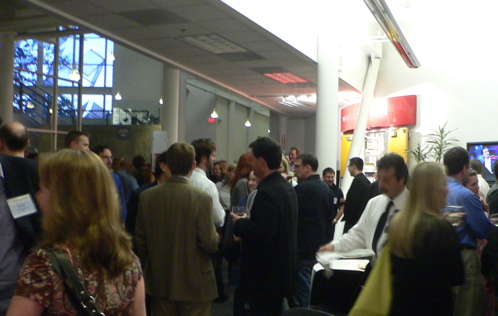
Well, it wasn’t a part of Web 2.0 Expo, but while I was here, I wanted to catch a big wing-ding last night at the Computer History Museum in Mountain View: Walt Mossberg and Kara Swisher’s launch party for their new Wall Street Journal AllThingsD.com web site. So, we bolted from Moscone West about 7:00 pm, with Aaron Fulkerson of MindTouch at the wheel. It looked like a Volvo, this car he rented, but I think it was actually a rocket ship. Either that or Aaron has received some serious tutoring in Formula One racing in his day. Tha man pushed it. But then we were running quite late for this gig. It was wild ride down the 101, white knuckles all the way (mine). Somehow we got there safe and sound, after almost losing it on a really sharp turn on the freeway exit, while he was telling me he once saw Steve Miller perform at the ampitheater close by. Anyway, it was great event, and we were glad we made the trip. Quite crowded — I’d say a few hundred people, luminaries everywhere. Couldn’t figure out why I was invited… 🙂 Here are some pix, first a few shot in the computer display area, including some with Aaron.
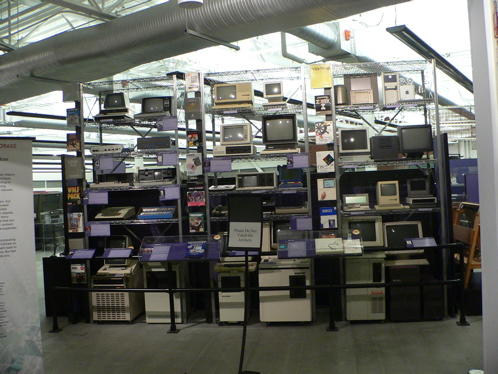
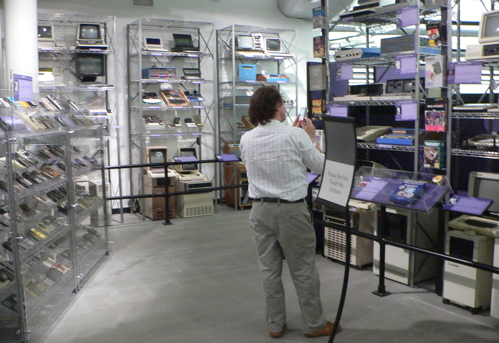

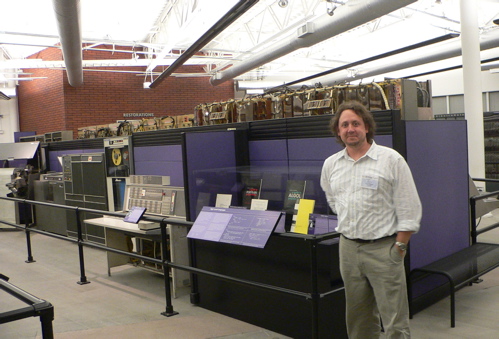
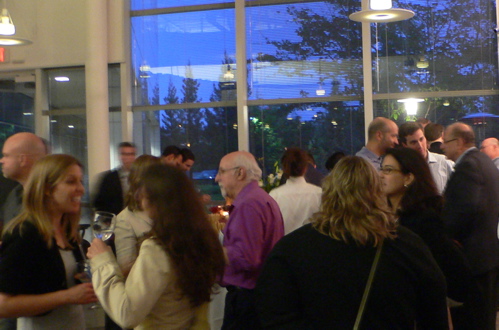
And here’s a shot of Walt (center) and his assistant Katie Boehret (far left), along with a couple other scenes in the lobby area of the venue, which is really quite nice (my first time there). But they don’t do justice to how crowded this party was…

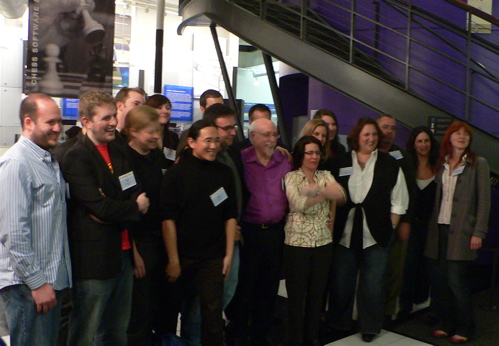
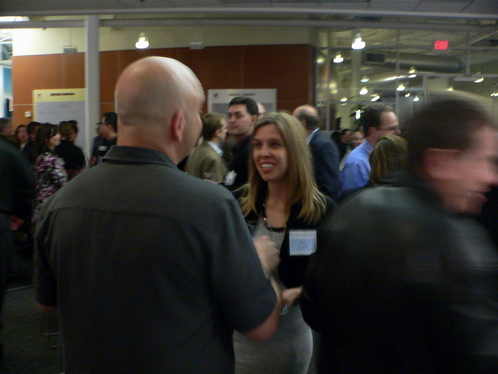
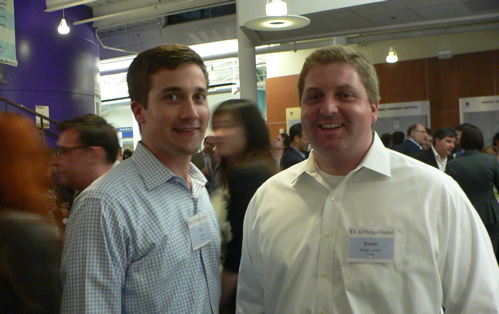
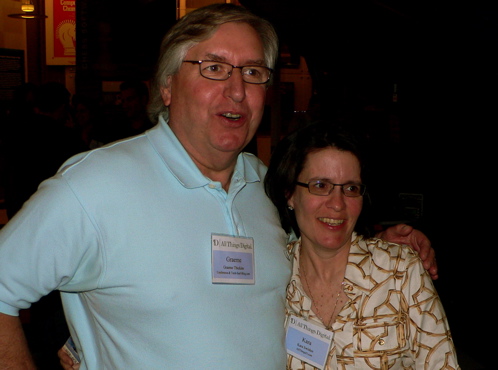
Finally, after a couple glasses of some really great Pinot, I grabbed this shot of the whole AllThingD team. Everyone was there to celebrate all their hard work getting the site ready for its imminent launch. The second shot below is of Katie Boehret chatting with a guy from the Participatory Culture Foundation (sorry, forgot his name), whose mission is to build an open and democratic television platform. The third shot is of two guys from Google who work in new biz dev — Tom Sly, whom I met at Demo ’07, and Ronny Conway, son of legendary Silicon Valley angel, Ron Conway. Told him I’d met his dad, way back when. (Way to make a guy feel old, Ronny!) Fun guys! And the best shot I saved for last, of me doing my pose.pngth-famous-person shot with Kara Swisher. It was a fun time! Just wish I’d have thought to hit up Kara for a press pass to their next D Conference, coming up in May…. 🙂 Man, would I love to blog that baby.
 But I was able to bop right into one session before lunch: “Open Source Business Models for Web2.0.” John Roberts, CEO and cofounder of SugarCRM, told us about the non-traditional way his company started: really as a project, then it wasn’t incorporated for almost two years. Funding came even later. “Companies are starting differently these days,” he said. Now, SugarCRM has 100+ employees, 1200 customers in 30 countries, 100,000 users, and 7000 registered developers. How are they 2.0? “We sell subscriptions, not licenses,” he said. “And, as Tim O’Reilly would define it, we trust our users as co-developers.”
  Webb asked the question, “How do we design for this generation?” Though he’s a product designer himself, he went on to say later that Generation C is capable of building products of their own, being so into social networks and mashups and things — so one wonders then why we need product designers? But that’s just the pixel side of the equation. We still need people with design sense to help us sculpt things made out atoms — plastic or whatever. Products are getting smarter and more social, with all kinds of networking capabilities, of course. And we have “new paradigms for interaction,” said Webb. He cited widgets, for example, which he said is such a great paradigm, “it shouldn’t be limited to just the desktop and web.” A key point Webb made is that experience is what counts to this generation, and “how do we design for experience?” He said in his wrapup that experience should be “treated as a design surface,” and that all of us in the room are the right people to address these new design challenges. One nice thing the O’Reilly people pointed out to us in the description of this session was that “people have been paying for plastic longer than pixels.” So, the business model is there! 🙂 It should be an exciting future for product designers, whoever they may be.
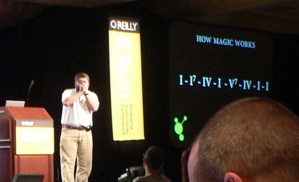 Similarly, games are made up of games — lots of little ones are in any good game, he said. Building games is about good “interaction design.” Then he ran us through a quick lesson in designing for fun, or applying game design to, for example, social media applications. He said you should have statistical features and opportunities for competition. “Never start an interaction with no context,” he said. And the participant must be able to prepare for the next encounter. Users should be able to solve challenges with a choice of tools, he said. “Reward them with different feedback. Variable feedback keeps things lively. And it should be visible to everyone.” Raph closed by telling us to check out his book site for more:
Recent Comments