Reflections & analysis about innovation, technology, startups, investing, healthcare, and more .... with a focus on Minnesota, Land of 10,000 Lakes. Blogging continuously since 2005.

Category: Innovation (Page 46 of 78)

Defrag 1: The Rise of the Implicit

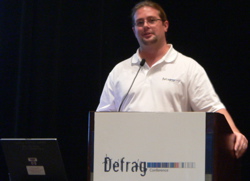
The whole idea of doing this event, said Eric Norlin in his opening remarks, began with an email from Brad Feld. He said he admitted he really didn’t understand it, but decided "maybe there’s a conference there." Big laughs. He later said that part of the thinking was also to "get the band back together" after Esther Dyson’s longstanding PC Forum conference was retired. He’s done a nice job — there’s an awesome collection of big thinkers here.  Ericn

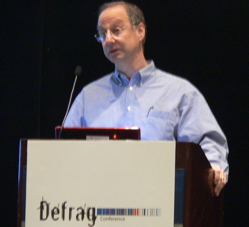
David Weinberger, author and Fellow, Harvard’s Berkman Center, took the stage to deliver a new talk he called "The Rise of the Implicit."  Basically, we tend to focus too much on the eplicit. Computers do explicit stuff, whereas humans by nature are creatures of the implicit, which is the social stuff. Whereas computers have forced us to "infomationalize" everything, it’s links that are fully social. "Links are a type of writing," said Weinberger, "which is a lot different from the fundamental vioew of information."  Davidw
In fact, he said, "the Web itself is the counter to the traditional view of information." Links connect us, they’re "the joins in a world that’s overloaded with information … we’re together writing the world … they’re the gestures of what matters to us." In a lively question and answer  session following, Jerry Michalski spoke of how we’re headed from a world of nouns to one of verbs, and asked Weinberger if his views aren’t overly optimistic. "The Web is working very well. It’s about connectedness, it transcends language," he said. "It works because we’re fundamentally not information machines."  He’s very optimistic about this, though pessimistic about other aspects of the Internet. "We’re insanely social and insist on connecting," Weinberger said in closing. "Take Twitter, for example. It looked like a parody of the Web — 140 characters, are you kidding me? But now I love it — it’s fantastic!"

Overlapping Starfishes, Everything Is Miscellaneous, and Collaboration 2.0

Greetings from the Mile High City. I love the way my morning reading starts out before I head down the elevator for the kickoff of Defrag…talk about timing:  My colleague Ed Kohler’s post on Overlapping Starfishes … a reminder that Feedblitz’ book-of-the month is David Weinberger’s Everything is Miscellaneous (David’s our opening speaker at Defrag) … and a blog post from Defrag producer Eric Norlin that gets at why this conference is timed perfectly.  I love it.  Bring on Defrag! Defregconf

SmartLinks: Give Readers More Without Taking Them from Your Site

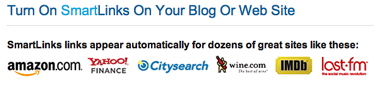
AdaptiveBlue is a company founded by my friend Alex Iskold, who also does some great analysis type posts on Read/Write Web regularly. (I’m looking forward to seeing Alex at the Defrag conference, which starts tomorrow in Denver.) AdaptiveBlue, based in NJ, was launched at DEMOfall ’06 (my coverage). It has since received funding from Union Square Ventures in NYC.   I like the company’s mission: they want everyone to "browse smarter."  Who can’t support that?  Alex and his firm are very much out in front of the whole Semantic Web movement.  But they aren’t just talking about it; they coming up with practical tools now to help us see the power and the potential of the Semantic Web. The latest of these?  SmartLinks, which bring what Alex decribes as "fun, utility, and a social dimension to your pages…whether you’re a blogger or a big media company."  Here’s a screenshot showing some of the sites whose links are displayed when you click on a SmartLink.

Smartlinkstypes

It’s all based on a little blue icon that appears next to certain links on your site. I’ve intalled SmartLinks on this blog, and here’s what one of those little blue icons looks like, at the end of a book link on my blog: Smartlinkiconrebook

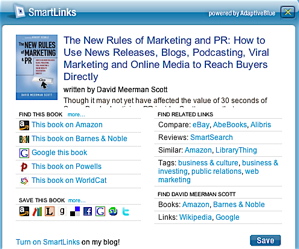
And here’s what you see when you click on this icon in this case — choices on where you can go to get the book, information on the author, reviews, and other links. (Installing was a breeze, by the way — it’s one click for Blogger or Typepad, my platform; a plug-in for WordPress; and just a single line of code for other types of sites. Note: to see where SmartLinks appear on my site, scroll down to the books section in my sidebar.) Smartlinkresultsrebook

Key point about these SmartLinks: they let your readers explore related information, such as book reviews,
similar movies, stock research, music videos, etc, without navigating away from your content. That is huge.               

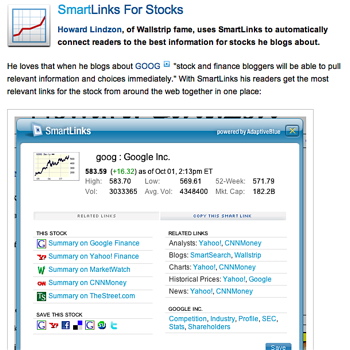
One use of SmartLinks that’s really getting a lot of attention since the company introduced the tool a week or so ago is SmartLinks for stocks.  Here’s an example of what you’d see when you click on that little blue icon next to a Google link (stock symbol: GOOG): Smartlinksforstocks

For more discussion of what this is all about, see the company’s blog, including a post on how to use Smart Links for stocks. Also, on the same blog, here’s a Q&A on Smart Links.

Andreessen: Any Site Can Now Be a ‘Social App’

You say you’re feeling down, bunky, because everyone seems to have a Facebook app but you?  Well, got a web site?  Then, perk up, son!  Because you are well on your way to having a social app — one that’ll actually run on a whole bunch of social networking sites that have at least as much traffic as Facebook — and maybe even on Facebook itself soon. At least that’s what Marc Andreessen, founder of social-networking platform Ning, has to say on his blog post today.

It’s all thanks to the "Open Social" spec set to be announced tomorrow by Google, which says it already has about a dozen partners, including Hi5, LinkedIn, Ning,
Friendster, Salesforce.com, and Oracle. See this Wall Street Journal story (actually dated tomorrow!) and this one in the New York Times, which was published today.

So, how can you transform your web site into an "Open Social" app?  Andreessen says it’s even easier than developing a Facebook app. He says you "just take your current HTML and Javascript front-end pages and create a version of those pages that use the Open Social API."

Andreessen believes web site owners will soon begin maintaining multiple sets of front-end pages for their web sites, in order to get "maximum distribution across the largest number of users." And he says it’s easy. They’ll have a single back-end, but multiple sets of front-end pages.  Here’s how he defines what those multiple sets will be:

• One set of standard HTML and Javascript pages for consumption by normal web browser.
• Another set of HTML and Javascript pages that use the Open Social API’s Javascript calls for consumption with Open Social containers/social networks.
• A third set of pages in FBML (Facebook Markup Language) that use Facebook’s proprietary APIs for consumption within Facebook as a Facebook app.
• Perhaps a fourth set of pages adapted for the Apple iPhone and/or other mobile devices.

"The overwhelming good news here," said Andreessen in his blog post, "is that these pages can all be served and serviced by the same back end code."

I think this "Open Social" spec is big news.  It’s something I know a lot of insiders have been been thinking about, at least in the back of their minds, since the Facebook juggernaut took off some five months ago.  Walled gardens — proprietary platforms — just don’t last on the Internet. Like my buddy PXLated said in a previous comment, "The Internet just routes around ’em."  Indeed.  Let the party begin….

UPDATE (11/1):  Marc Andreessen did another very informative blog post with a screen cast and screenshots showing how the Open Social spec can be implemented, using three actual Ning social networks as examples.


‘Defrag’ Conference: Brainstorming the Next Big Thing

Next Sunday, I’m off to Denver for a really cool conference called Defrag. (Here’s the blog, which will tell you what’s really goin’ on.) I’m looking forward to it, because it’s different — a smaller, more intimate kind of event. The kind of event "where you send your brains for a workout," say the producers. Defregconf
There’ll be a couple hundred really smart people participating, many whose names you would know. Folks like Esther Dyson, Jerry Michalski, Clay Shirky, David Weinberger, Doc Searls, Paul Kedrosky, Brad Feld, Jeff Clavier, Chris Shipley, Steve Larsen, and a couple of new players I’ve met in the semantic web movement, Nova Spivack and Alex Iskold. Denverhyatt
And that’s just a few I can remember — there are many more smart Internet minds who’ll be there.  We need this kind of event after Esther Dyson retired her great "PC Forum" conference after the 2006 edition. (I’m so glad I got to cover that one. It was soo timely, and everybody-who-was-anybody was there.)

Defrag is being held at the very cool, new Denver Hyatt. Here’s an invitation to all my friends here in the Minnesota technology community:  please join me at Defrag!  (At least two already are, and we’re flying out together.)  Denver’s not that far — and, hey, you guys need to get out of town once in a while! 🙂  I even have a special discount code that will get you $500 off.  But you have to act fast, since that expires soon: the code is "DefragMN"…and you can use it when you register right here.  I guarantee you, you won’t be sorry you attended this conference!  Check the agenda.

One of the three producers of Defrag is a guy I know named Eric Norlin, and I’m looking forward to meeting the other two. I met Eric back in ’99 through my work with Net Perceptions, and he’s become an even more plugged-in guy since then. He’s been in the digital identity business and has run other conferences, such as Digital ID World.  He lives in Florida now, but was in Colorado for many years, so has lots of contacts there. (He also was based in the Twin Cities for a couple of years, quite some time ago.)  Early on, Eric even worked with the NSA, so he’s just an interesting cat to say the least. It’ll be fun to see him again. Here’s how Eric and friends describe their newest creation:

Defrag is the first conference focused solely on the internet-based tools that transform loads of information into layers of knowledge, and accelerate the “aha” moment. Defrag is about the space that lives in between knowledge management, social networking, collaboration and business intelligence …. it’s a gathering place for the growing community of implementers, users, builders and thinkers that are working on the next wave of software innovation.

The sponsors of Defrag are BEA, Yahoo, Me.dium, Newsgator, ThinkFree, Adaptive Blue, AOL, Dapper, HiveLive, Lijit, Near-Time, Siderean, Microsoft, ZDnet, ProQuo, and Collective Intellect.  For more on the sponsors, see this post on the Defrag blog: All the Cool Kids Are Doing It.

And here’s more insight into what this inaugural Defrag is all about, from another of Eric’s blog posts,  Inter-Twining at Defrag:

One of the earliest phrases that I hit upon to help describe Defrag was ‘networked knowledge’ … That idea — that knowledge is not simply a passive, managed asset, but an active agent in a system that is working for me — is the core of what we’re exploring.

I’m pumped!  Watch for my live blogging next week — Monday and Tuesday, November 5 and 6. Take a look at the agenda and tell me what you like. I especially like "Social Networking in the Enterprise." Cheers.

« Older posts Newer posts »