“Fun is a chemical response. It comes from the same place as chocolate and orgasm,” said Raph Koster, game developer. According to one researcher he cited, there are four types of fun: hard, easy, visceral, and social. Games, he said, are mostly hard fun. Raph then moved into telling us how magic works. “It’s about structure,” he said. “It’s the same in nature, physics, and social media.” Another word for structure is grammar, he said. “All it means is how things fit together. It’s not a bad word.” He showed slides of the structure of blues music — and even sang us some blues — telling us songs are really made up of other songs, overlapping. And visual compositions are made up of spaces. 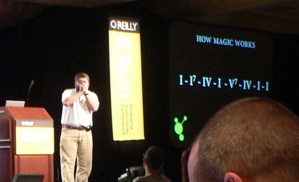 Similarly, games are made up of games — lots of little ones are in any good game, he said. Building games is about good “interaction design.” Then he ran us through a quick lesson in designing for fun, or applying game design to, for example, social media applications. He said you should have statistical features and opportunities for competition. “Never start an interaction with no context,” he said. And the participant must be able to prepare for the next encounter. Users should be able to solve challenges with a choice of tools, he said. “Reward them with different feedback. Variable feedback keeps things lively. And it should be visible to everyone.” Raph closed by telling us to check out his book site for more: www.TheoryofFun.com.
 The CEOs of two widget syndication networks,
 Watch for another link to Read/Write Web soon, a recap of the whole Web 2.0 Expo experience. And I hope to be writing for this great blog again in the future. It was also fun hanging out again with Alex Iskold, a regular writer at Read/Write Web, who’s also founder of
  Webb asked the question, “How do we design for this generation?” Though he’s a product designer himself, he went on to say later that Generation C is capable of building products of their own, being so into social networks and mashups and things — so one wonders then why we need product designers? But that’s just the pixel side of the equation. We still need people with design sense to help us sculpt things made out atoms — plastic or whatever. Products are getting smarter and more social, with all kinds of networking capabilities, of course. And we have “new paradigms for interaction,” said Webb. He cited widgets, for example, which he said is such a great paradigm, “it shouldn’t be limited to just the desktop and web.” A key point Webb made is that experience is what counts to this generation, and “how do we design for experience?” He said in his wrapup that experience should be “treated as a design surface,” and that all of us in the room are the right people to address these new design challenges. One nice thing the O’Reilly people pointed out to us in the description of this session was that “people have been paying for plastic longer than pixels.” So, the business model is there! 🙂 It should be an exciting future for product designers, whoever they may be.
Recent Comments