In the technology startup world, angels and VCs have at best been seen as different camps, with separate perspectives, and even being at odds with each other many times. One is from Venus, the other’s from Mars. One tends to be a cocky MBA, the other’s an entrepreneur with real operational experience. 
One pounds spreadsheets all day, the other’s a cowboy. As a minimum, they certainly don’t have a record of working closely together. They can compete for deal flow, they often distrust each another, and it’s frequently heard that angel investments can foul up the chance for later VC rounds because of unrealistic valuations or poor cap structure, or whatever.
There was a time when "venture capital" was synonymous with seed-stage investing. But, with the trend in recent years toward larger and larger funds, some approaching $1 billion, "You don’t have to do much math to realize that such firms are forced to make bigger and bigger investments to generate adequate returns for their limited partners," says Sramana Mitra in her recent column in Forbes: The Real VCs of Silicon Valley. (Mitra is an experienced technology entrepreneur and strategy consultant in Silicon Valley.) An excerpt from the column:
"…if you are an entrepreneur, especially a first-time entrepreneur,
you need to look for the ‘real’ VCs who are willing to take risks and
invest their time in mentoring you, not those big names that the term
venture capital normally conjures."
And who does Mitra say those real VCs are?
"So-called ‘angels.’ While VCs primarily invest other people’s money,
angels invest their own. An entrepreneur working on a fledgling idea
needs investors who not only provide valuable business advice but also
connect the dots to make business development partnerships happen, help
recruit key team members and help move the venture from concept to a
fundable company. Angels tend to have the operational background
necessary to play such a role."
Angels investing is no small phenomenon. One study found that that angels invested $25.6 billion in
2006 in the U.S. in 251,000 mostly early-stage deals (for an average investment of
about $100,000).
In her piece, Mitra seriously questions whether and how the gap created by VCs moving to larger and larger investments is being filled. Her closing line: "In capitalism, gaps generally get spotted and filled. This one–and the entrepreneurs in it–is still waiting."
Clarion Call
Mitra’s point comes early in her column: "we need to create a sort of microequity program for start-ups." It’s getting to be a common refrain; angels are clearly being expected to pick up more of the slack, as VCs leave early-stage investing behind and entrepreneurs get increasingly frustrated. Yet positive things are starting to happen, with more and more sophisticated, managed angel groups forming (or becoming more formalized), all across the country.
Note: this is not just a Silicon Valley phenomenon. That may be the epicenter of the VC industry, and where most of their money is invested, but not so for angel investors. Their is no epicenter. Sure, there are some notable angel groups in the Valley. But the distribution of these groups is much more even across the country. If anything, the Midwest rules. The Angel Capital Association is located in, are you ready? …Kansas. Of the organization’s approximately 150 member groups (see their directory), it’s the Midwest region that has the largest number of such groups (40), by a wide margin. So, yes, it’s fair to say that angel investing is more a heartland thing.
Reactions from Both Sides
Seeing the column in Forbes inspired me to do another blog post on angel investing. (See this category of my blog for lots more I’ve written on the topic; I also did a recent post on the new blog Minnov8.) After reading the Forbes piece, I reached out to three of my contacts whom I thought would have something to say in reaction. First, from the angel side:
"I really think that linking the angel and VC markets really hurts both models," said Pete Birkeland, CFO of angel network management firm RAIN Source Capital, St. Paul. "The VCs get hammered for not investing early enough, and the angels get hammered for scattershot investing. These are two complementary but distinct activities. They’re both needed to continue to grow companies and innovate. As we run our angel groups, we want to be able to look at opportunities that are early and risky, and invest in those that have a potential for a return. That return may be 3-5x, and we may be able to live on a seven-year horizon — that (scenario) wouldn’t even get past a first screen by a VC. We need an ‘angel manifesto’ that breaks us away from VCs, and the mindset that we have to all become VCs. However, with the view of limited partners and the dollars involved, it’s tough to escape the gravitational pull of the VC model."
And from an individual angel: "Founders, especially those without prior startup experience, need strong advisors, even operational advisors," said Doug Henrich, a former Microsoft executive and angel investor now living in the Twin Cities. "For an angel to be successful, I feel he or she needs to be active in the startup. The money of course is needed, but the experience and counsel are more valuable in successful startups. The experience has to come from somewhere…I wonder how large VCs can make money in the software space these days." I read that last comment of Henrich’s to mean that, for software startups, angel investors are naturally a better fit — that such firms need the type of mentoring that comes from angels in their early stages. In other words, VCs’ big money isn’t the answer; it doesn’t tend to produce the desired result.
One Big Sign of Hope
From the VC side, I very much wanted to get a comment from a firm I know well — one that started in Minneapolis, still has close ties here, but has been headquartered in Palo Alto for several years: Crescendo Ventures. 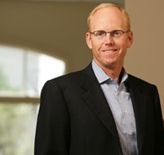
David Spreng is the Managing General Partner of the firm, and has been on the board of the NVCA (National Venture Capital Association) since 2005. He recently launched a great blog called "Lightbulb," and here’s his About page there. But the most interesting thing is that David was recently tapped by the NVCA board to be the organization’s liaison to the angel community. That, to me, is very cool — a sure sign the two sides will be coming closer together in the future.
David was jumping on a plane when he I caught him, but pointed me to a recent blog post of his titled Angels and VCs Find Common Ground. In it, he reprints an article he co-wrote a couple of months ago with a board member of the Angel Capital Association. I had heard wind of this article before, and told him I bet I could get some good insights of his from it. I was right. I encourage you to read the full article, but here’s an excerpt:
While both angel groups and VCs have issues to improve in our relationships and processes, establishing strong relationships with quality angel groups can be extremely valuable to a venture firm’s deal flow and ultimate returns.
At $250,000 to $1 million, the average size round for an angel group is often below what most venture capitalists would consider investing in a Series A round. However, respected angel groups may well have the next generation of promising early stage companies that a venture capitalist is not ready to invest in but also doesn’t want to lose track of.
The ACA and the NVCA are both committed to working together to improve the relationships between angel groups and venture capitalists by sharing best practices and enhancing communications between the two associations.
Transitions from angel groups to venture capitalists should be seamless and considered a valued relationship for all the stakeholders, including entrepreneurs, co-investors and limited partners.
As I said, signs of hope. And it can all only be good for you entrepreneurs out there.
UPDATE (4/11/08): Well, maybe not as much hope as I thought. Just saw Sramana Mitra’s new column this morning in Forbes: Fund Envy: Venture funds are getting bigger all the time. This is bad news for aspiring entrepreneurs. Yes, she says, taking a poke at the name of a well-known VC’s blog, "Greed, indeed, is infectious."

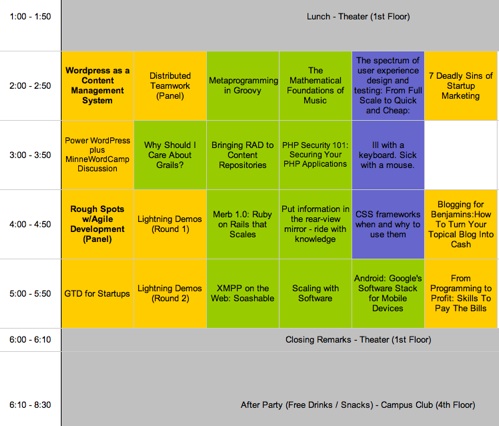

 (Minnebar is held once a year, while evening "Minnedemo" sessions are held in each of the other three quarters.)

Recent Comments