Reflections & analysis about innovation, technology, startups, investing, healthcare, and more .... with a focus on Minnesota, Land of 10,000 Lakes. Blogging continuously since 2005.

Category: IT/Software (Page 38 of 58)

Andreessen: Any Site Can Now Be a ‘Social App’

You say you’re feeling down, bunky, because everyone seems to have a Facebook app but you?  Well, got a web site?  Then, perk up, son!  Because you are well on your way to having a social app — one that’ll actually run on a whole bunch of social networking sites that have at least as much traffic as Facebook — and maybe even on Facebook itself soon. At least that’s what Marc Andreessen, founder of social-networking platform Ning, has to say on his blog post today.

It’s all thanks to the "Open Social" spec set to be announced tomorrow by Google, which says it already has about a dozen partners, including Hi5, LinkedIn, Ning,
Friendster, Salesforce.com, and Oracle. See this Wall Street Journal story (actually dated tomorrow!) and this one in the New York Times, which was published today.

So, how can you transform your web site into an "Open Social" app?  Andreessen says it’s even easier than developing a Facebook app. He says you "just take your current HTML and Javascript front-end pages and create a version of those pages that use the Open Social API."

Andreessen believes web site owners will soon begin maintaining multiple sets of front-end pages for their web sites, in order to get "maximum distribution across the largest number of users." And he says it’s easy. They’ll have a single back-end, but multiple sets of front-end pages.  Here’s how he defines what those multiple sets will be:

• One set of standard HTML and Javascript pages for consumption by normal web browser.
• Another set of HTML and Javascript pages that use the Open Social API’s Javascript calls for consumption with Open Social containers/social networks.
• A third set of pages in FBML (Facebook Markup Language) that use Facebook’s proprietary APIs for consumption within Facebook as a Facebook app.
• Perhaps a fourth set of pages adapted for the Apple iPhone and/or other mobile devices.

"The overwhelming good news here," said Andreessen in his blog post, "is that these pages can all be served and serviced by the same back end code."

I think this "Open Social" spec is big news.  It’s something I know a lot of insiders have been been thinking about, at least in the back of their minds, since the Facebook juggernaut took off some five months ago.  Walled gardens — proprietary platforms — just don’t last on the Internet. Like my buddy PXLated said in a previous comment, "The Internet just routes around ’em."  Indeed.  Let the party begin….

UPDATE (11/1):  Marc Andreessen did another very informative blog post with a screen cast and screenshots showing how the Open Social spec can be implemented, using three actual Ning social networks as examples.


‘Defrag’ Conference: Brainstorming the Next Big Thing

Next Sunday, I’m off to Denver for a really cool conference called Defrag. (Here’s the blog, which will tell you what’s really goin’ on.) I’m looking forward to it, because it’s different — a smaller, more intimate kind of event. The kind of event "where you send your brains for a workout," say the producers. Defregconf
There’ll be a couple hundred really smart people participating, many whose names you would know. Folks like Esther Dyson, Jerry Michalski, Clay Shirky, David Weinberger, Doc Searls, Paul Kedrosky, Brad Feld, Jeff Clavier, Chris Shipley, Steve Larsen, and a couple of new players I’ve met in the semantic web movement, Nova Spivack and Alex Iskold. Denverhyatt
And that’s just a few I can remember — there are many more smart Internet minds who’ll be there.  We need this kind of event after Esther Dyson retired her great "PC Forum" conference after the 2006 edition. (I’m so glad I got to cover that one. It was soo timely, and everybody-who-was-anybody was there.)

Defrag is being held at the very cool, new Denver Hyatt. Here’s an invitation to all my friends here in the Minnesota technology community:  please join me at Defrag!  (At least two already are, and we’re flying out together.)  Denver’s not that far — and, hey, you guys need to get out of town once in a while! 🙂  I even have a special discount code that will get you $500 off.  But you have to act fast, since that expires soon: the code is "DefragMN"…and you can use it when you register right here.  I guarantee you, you won’t be sorry you attended this conference!  Check the agenda.

One of the three producers of Defrag is a guy I know named Eric Norlin, and I’m looking forward to meeting the other two. I met Eric back in ’99 through my work with Net Perceptions, and he’s become an even more plugged-in guy since then. He’s been in the digital identity business and has run other conferences, such as Digital ID World.  He lives in Florida now, but was in Colorado for many years, so has lots of contacts there. (He also was based in the Twin Cities for a couple of years, quite some time ago.)  Early on, Eric even worked with the NSA, so he’s just an interesting cat to say the least. It’ll be fun to see him again. Here’s how Eric and friends describe their newest creation:

Defrag is the first conference focused solely on the internet-based tools that transform loads of information into layers of knowledge, and accelerate the “aha” moment. Defrag is about the space that lives in between knowledge management, social networking, collaboration and business intelligence …. it’s a gathering place for the growing community of implementers, users, builders and thinkers that are working on the next wave of software innovation.

The sponsors of Defrag are BEA, Yahoo, Me.dium, Newsgator, ThinkFree, Adaptive Blue, AOL, Dapper, HiveLive, Lijit, Near-Time, Siderean, Microsoft, ZDnet, ProQuo, and Collective Intellect.  For more on the sponsors, see this post on the Defrag blog: All the Cool Kids Are Doing It.

And here’s more insight into what this inaugural Defrag is all about, from another of Eric’s blog posts,  Inter-Twining at Defrag:

One of the earliest phrases that I hit upon to help describe Defrag was ‘networked knowledge’ … That idea — that knowledge is not simply a passive, managed asset, but an active agent in a system that is working for me — is the core of what we’re exploring.

I’m pumped!  Watch for my live blogging next week — Monday and Tuesday, November 5 and 6. Take a look at the agenda and tell me what you like. I especially like "Social Networking in the Enterprise." Cheers.

Widget Summit, Day 2: Platform Mania

So, how many platforms do we need for widget development, anyway?  And how many will survive, or thrive?  That’s surely an open question — one that will likely get answered in the next year or two. And then there’s the question of what is a widget, really?  Or "mini web app" … "social media app" … "gadget" … or whatever we call them. Or does the name really matter?

This post is my final coverage of the Widget Summit conference — specifically, the last five breakout sessions, which extended through end of day Tuesday. (All the rest of my Widget Summit coverage is here.) I thought the best sessions to catch on the second day would be those devoted to widget/web-app platforms from the majors. So, two sessions I attended were about development on (guess what?) Facebook, while the other three were on Apple’s iPhone, Microsoft’s new Popfly platform, and Google Gadgets. Here’s the way the rest of Day 2 played out, in the order of appearance:

Redmond Wants a Piece
Popfly is a new plug-in for Silverlight, Microsoft’s new Flash competitor. It’s now available on the web in private beta — and, according to Dan Fernandez, Popfly product manager and evangelist, the goal is to "democratize development." He said there’s a huge world of non-professionals using MySpace and other sites and doing some amount of HTML and Javascript to build web apps or widgets. "There are 7 million ‘pros’, but 107 million ‘non-pros’," he said.  MIcrosoft wants a piece of that. [Like they want a piece of everything else in the Web 2.0 world if they can get it, no?]  Popflyslide
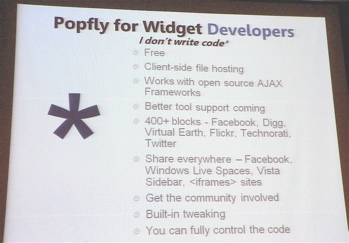
"Users are the stars," said Fernandez, noting that it’s all about "embracing expression."  He mentioned a recent study that found people spend more than an hour a week changing their online profile. He showed how, with Popfly, non-pro developers can snap together different "blocks" to build an app. They’ll be able to make what he called "Popfly gadgets" for Windows Live Spaces. In the audience questions following, someone asked when the product will actually be released, but Fernandez indicated he had no idea. Another obvious question came next: "What about Adobe AIR?" To which Fernandez said, "That’s a different audience."  As in real developers. He did say that Microsoft is looking at the possibility of going open with Popfly. He also said that cross-platform support is being addressed. "Support for Mac is in the Silverlight runtime," and Linux support is (or is coming), too. [By the way, here’s some coverage of the Popfly demo at Web 2.0 Summit, which Steve Ballmer did a day or two afterwards — with Fernandez at the keyboard; he told me that morning at The Palace Hotel he was hoping his demo would work so he didn’t get shot…  🙂 ]

The Facebook Gurus Speak
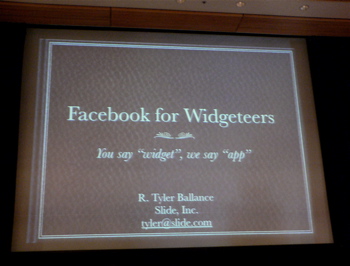
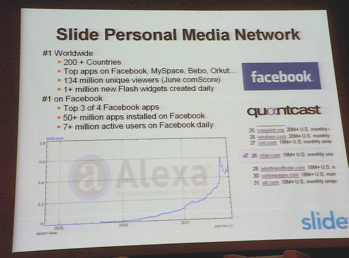
Tyler Ballance of Slide is the developer of some of the most popular apps on Facebook — including Top Friends, Fun Wall, Fortune Cookie, and Famous Quotes.  He of course talked about FB’s favorite term of late — the "Social Graph" — and about the concept of "Social Utility."  Slidestats
Tylertitleslide
To develop a successful Facebook app, you need "real social interactions," Tyler said. "Helping users interact is what makes a good app."  But how about what we commonly know as widgets, other than Facebook apps?  "Little biddy things you drop on a page," as Tyler called them. Socialgraph
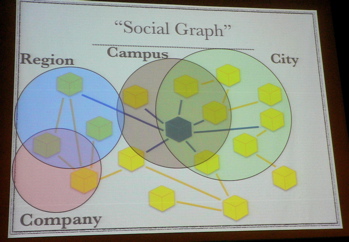
He said using those on Facebook "isn’t too brilliant…they might work on Facebook — some do — but it’s probably not the way you want to go." On the other hand, he was happy to tell us that his Fun Wall app is "the best implementation of the widget idea on Facebook." [How humble of him.] He also said that "just porting apps to Facebook doesn’t work" and "just putting an RSS feed on your profile, for example, isn’t that interesting."  The point is that FB users use this platform differently — "it’s unique." He talked about a new app he’s working on (or has just completed?) called "Why Are You Awesome?"  He said it let’s you tell your friends why you are and — a key point he stressed — "it gives them a reason to check back."  A couple of other key points Tyler made were these: "Notifications" are important, because people "crave these updates"….and the "Feed" is the "highway on Facebook — put things there that are interesting and relevant."  He talked about the pros and cons of FBML (Facebook’s own markup language). It gives you the native look and feel, making the app "indistinguishable from the platform," he said. On the negative side, FB’s bugs become your bugs, "and you’ll always be the one to get blamed." The other option for developers is the "embedded iFrame" approach. On the plus side, it gives you "near complete control — you’re only constrained by space and the terms of service."  However, you must call the Facebook API "lots"….and if an iFrame app is done wrong, "user experience suffers." So, what do you do? "Pick the one that you’re most comfortable with, and what you can ship the fastest. If it’s more than three days, forget it." Perhaps the most interesting insight was this: "Figure out how users interact with your app. And don’t take things so seriously. Facebook users don’t sign on to do work."  [I’m not so sure FB’s leaders would agree with him there, as they try to make the platform attractive to more adults — meaning those active in the workaday world, concerned about things like, oh, productivity, business networking, and the like?  Employers are already cutting off Facebook from their corporate networks because it’s perceived to be all about screwing off. So, the notion that FB users don’t care about work can’t be something FB’s investors like to hear.]  The audience questions began with "What about useful and fun apps — are there any"?"  I didn’t hear a good answer. "Is there any way to link to several pages within an iFrame app?" Tyler said it would be better and easier to use FBML in this instance. [He did note, in passing, that Top Friends is an iFrame app. And, later, he noted he works on this app "all day long."] Another general tip Tyler gave was to make an effort to stay on top of Facebook changes. "They’re definitely building out the platform." He also said metrics of what what people do inside the app are very important — "not so much their whole social map."  But be careful you don’t violate FB’s terms of service: "You can only hash someone’s data for 24 hours."

Dave Fetterman is the creator, lead engineer, and a founding member of the Facebook Platform project.  He was formerly with Microsoft and has a master’s in computer science from Harvard. He opened his talk by telling us how many Facebook developers there are now. Davefetterman
Are you ready?
It’s more than 50,000! He also said the site gets 54 billion page views a month. Yes, that’s a "b." 

Fetterman launched into his advice for aspiring Facebook developers — the first and most obvious being "Make your app social." To be quite blunt about it, he said this: "Your content’s not interesting unless it’s interesting to your friends — or my friends." He also stressed the benefits of privacy. "It’s not a burden — it’s an asset."  So, how does one get viral distribution?
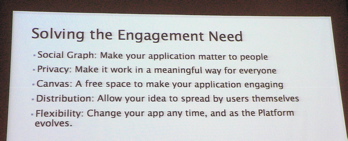
Fettermanslide_5
Fetterman talked about the Facebook News Feed, and also about adding an app from the Profile (he said to develop with FBML for this), and he stressed the importance of Notifications "from granular updates." He said that mass distribution in "now easy."  But he noted that "spreading an app is entirely different from spreading
a widget."  The latter, he said, is like "mailing HTML."  He gave his take on how an app is different from a widget [see his slide here: "Widgets, eh?" you have to forgive Dave — he’s a Canadian  🙂 …] Fettermanslide2_3
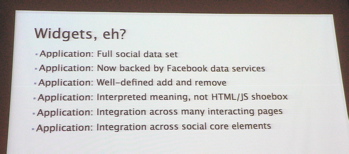
Facebook’s goal is to make developers as comfortable building on its platform as on your own site, Fetterman said. He added that FB has its own flavor of Javascript now, called FBJS — "to help you play in our environment." The goal is to give you JS while ensuring that you "remain safe" on Facebook.  He also said they have "MockAJAX."  New solutions he named as being in the works now are: message attachments, fb:mobile, and fb:ref. For more, Dave said to go to developers.facebook.com and wiki.developers.facebook.com.

iPhone Calling
Matt Drance was next up, the "Sharing Technologies Evangelist" at Apple.  How’s that for a title?  He does a bunch of stuff, and one of those is helping third parties develop for the iPhone platform, which was his topic this day. Matt said the iPhone was only 109 days old, and that it’s already had three updates in three months. He reminded us that the iPhone’s Safari browser is the same one for the new iPod Touch. Last week, Matt said a new iPhone web apps directory went live. "Apple is very serious about the web development platform for the the iPhone." [What Matt didn’t let us in on was the news that Uncle Steve was about to drop, the very next morning, that Apple was planning to open up the iPhone to third-party apps. Can’t blame him, I guess — he’d like to keep his job. But, c’mon, Matt — we wouldn’t have told anyone! 🙂 ] Mattdrance
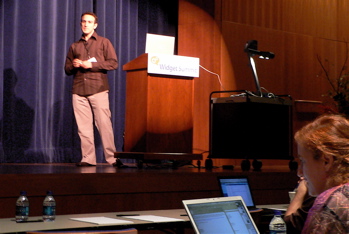
Matt talked about the Safari "WebKit," which is a web development engine. And he gave a bunch of pointers for those who plan to develop for the iPhone: understand the browser prefs (JS can be turned off, popups disabled, etc) … you need to separate your page content (JS, CSS,and HTML), and "be well formed and standard" (he specifically recommended the CSS Zen Garden site for inspiration) … know your resource limits … know your scripting limits … understand windows and dialogs (window.open and target="_new") … use supported content types, including Word, Excel, PDF, Quicktime (no Java, Flash, or SVG for iPhone, at least not yet) … use native fonts … test and bug with Safari 3 … and remember that the iPhone’s input device is a finger — which is a lot different from a mouse! Matt reminded us that the iPhone does not have cut & paste, drag & drop, or selection — at least not yet.  Finally, he advised, even if you don’t yet have an iPhone or iPod Touch, you should get Safari 3 and see how your site or app looks in it.

GOOG Got It Goin’ On (Oh, Really?)
We were lucky to have presenting, in the very final session, Adam Sah, the architect for Google Gadgets. The most common place to find them, said Adam, is on iGoogle start pages. Google Gadgets is a platform for multiple sites, not a plug-in. Adamsah
"The end-user owns the page," said Adam. "Why do they like gadgets? Because they’re just remote HTML, cached by Google."  And why do providers like them? "Because it’s an easy, cheap way to create interactive content," he continued. "You can write one in 30 seconds. And it’s high leverage — write once, run all over. Whataregadgets_2
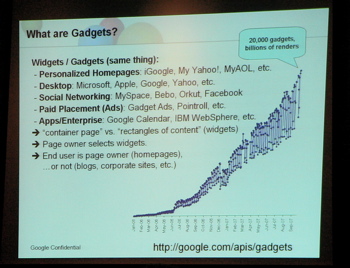
You get free, effective distribution to tens of millions of users." He showed a slide identifying all the distributors of Google Gadgets. He said Gadgets are "frictionless and scaled…you don’t have to cut a deal with Google." 

Adam also spoke about the newest type of Google Gadget — "Gadget Ads."  He said they’re paid-placement gadgets that reach hundreds of thousands of sites. "A Google Gadget ad is nothing more than buying traffic for your gadget," said Adam. "They’re great for time-sensitive content, like movie openings," he said, " and great for ‘seeding’ viral distribution." What percentage of Gadget Ads get syndicated by others?" someone in the audience asked. Adam said it’s still too early in the game to talk about that. But, speaking of virality, he recommended that "putting an ‘Add to Google’ or ‘Email This’ button inside your gadget will get you free traffic." He said "It’s been hard to get initial virality started, but not so now with Google Gadgets." 

In closing, he said what makes a good Gadget in general (not necessarily the ad type) is a very small or no logo, usefulness or utility, and no registration required. He also put up a slide (shown here) with a whole bunch of resource links. Googgadglinks_3
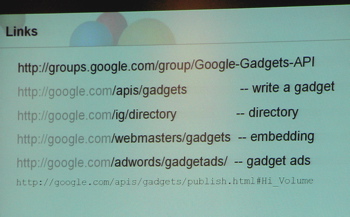
One link he didn’t mention, which I found on my own, was this one: Google Gadget Ventures, a page that tells you how you can develop new gadgets with the financial support of Google. 

That’s right — yet another company is stepping up with a financing program for widget (gadget) developers.  Life is sure good if you’re an entrepreneurially minded developer these days, wouldn’t you say?

A recent interview of Google’s Adam Sah was just published on this ZDnet blog.  It drills in further to some of the topics I touch on here in this post.

UPDATE (10/23): To make a couple of clarifications regarding Dave Fetterman’s presentation.

UPDATE (10/24): I didn’t mention in this post yet another platform: MySpace. It announced, after Widget Summit ended, that it, too, was opening up its platform to developers.  But I figured most of you had already heard that. For some perspective and links on the topic, however, including developments at Web 2.0 Summit, here’s a recent post from Seth Levine’s blog.


 

Widget Summit, Day 2: Geeky But Oh-So-Widgety Good

At 7:30 am on Tuesday, I was back at the squeaky-clean-new UCSF Mission Bay campus, chompin’ at the bit for more of that good widget scoop. Along with Monday’s program, this would surely be more widget smarts than a person could get anywhere else on the planet — at least this week. Tuesday’s session was to have a different purpose:  producer Niall Kennedy had planned it that way [and hats off to him for a great job putting this event together!]. Monday was about the business of widgets and large trends affecting the industry, while he told us Tuesday was for getting into the nitty-gritty, helping attendees plan their widget implementations. And there was no question in my mind that most of the 200+ attendees at Widget Summit 2007 were in fact developers — or, as Niall described them in the conference materials, the people "directly involved in this hyper-growth industry, providing the tools and content that connect people and their ideas across the web."

On this day, I would take deep dives for you, oh valued readers, in Javascript widget basics, advanced Javascript. Microsoft’s Popfly and Silverlight, Facebook development, iPhone widget development, and — last but certainly not least — Google Gadgets.

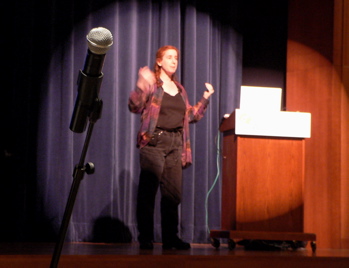
Dori Smith, a well known programmer and author of Javascript books (published by O’Reilly and others), led the first session. She told us how the term "widget" isn’t really well defined — it means different things to different people. Dorismith
In the Apple world, for example, there’s the "widget object," while in the Vista world, there’s the "system.gadget" object — but they’re different things.  She also called the industry on the "write once, run anywhere" claim — calling it a myth. "Unless it’s something really, really basic," she said, "you’re going to have to tweak the widget for different platforms."

So, what should your considerations be when creating your first widget? Dori set out a great list:
• what do you want to do?
• is it community-oriented and viral? or maybe just something simple, like a countdown to an event?
• is is static or dynamic?
• will it require frequent updates?
• is it for a web page or not?
• what platform will you use?
• what does your audience want?

Dori said cross-platform woes can be best dealt with by separating content from style and behavior: HTML for content, CSS for style.  She recommended you start by making your widget work without Javascript, then add JS functionality without touching the HTML. She said DOM (Document Object Model) lets you manipulate with Javascript without affecting the HTML.

The biggest complaint about widgets is that they’re slow, Dori said. The solution?  "Better written widgets!" Let the page finish loading, she said, adding that there’s a simple workaround to this problem. (Presumably, you have to read one of her books.)

What’s Dori’s crystal ball?  First, she’s really looking forward to Leopard coming out on October 26.  She’s seen a lot of the new stuff coming in this OS upgrade, but can’t talk about it.  One thing she could mention: "Dashcode" — a development environment for widgets. "I love this product!"  Audience question:  "But is it only for Mac OS dashboard widgets?"  Dori’s answer: "Yes, but you can create graphics you can use on other platforms."  She also really likes the new "WebClips feature of the new Leopard OS.  "It allows people with no interest in code to make their own widgets."

Programmers are increasingly understanding the impact of widgets, Dori said. "And users are more willing to install widgets."  She warned, however: "Platform incompatibilities will get worse before they get better…The standardization process will help," she said, "but it will take a long time."

Since this was a session on Javascript, what about that other kind of widget?  "Could you comment on Flash?" asked an audience member. "There are lots of people out there with iPhones," she said, "which don’t support Flash!"  The questioner countered: "But Javascript doesn’t work on MySpace."  Dori countered back: "Yes, but you can use DHTML. It really depends on what you want to do."  Flash is much more visual, she allowed, but it’s also an expensive product to buy.  And the final good insight from Dori: "Anything you can do in Flash you can do in Javascript — on one platform.  The problem comes with multiple platforms."

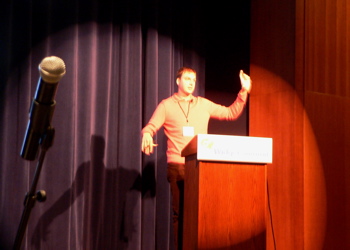
But, as if this session wasn’t enough on JS, there was more coming. Joe Smarr, the young, animated chief architect at Plaxo, jumped right up on the stage to continue the fun.  [Joe is the son of famed computer scientist Larry Smarr.]  Plaxo, Joe reminded us, was doing Ajax iframes in 2004. It now has 20 million users. "Why is JS special?" Joe asked. Joesmarr
"Because you’re downloading real source code and running it in the browser," he said. And downloading and running JS blocks the browser, and the UI thread. "Code from different domains is executing together," Smarr said. "You can do a lot of good with Javascript, but you can do a lot of harm, too."

The biggest piece of advice from Joe: "Make your widget NOT slow the page down — or open any security holes. Make it fast."  He also put in a plug for Firebug (a Firefox plug-in for coders): "It’s the web hacker’s best friend. Makes it really hard to keep developing in IE."  Joe gave us his secrets for high-performace widgets:

• write less code

• draw HTML efficiently

• yield early and often

• profile like crazy

He had this opinion as well: "innerHTML is way faster than DOM manipulation." On the subject of best practices in Javascript, Joe stressed, "Give your functions unique names! You’re in a shared namespace. Otherwise, you can clash with others." For security, he said, "use JSON and callbacks for third-party API calls." For more info, Joe said to check out his blog — two specific posts to look for there have "OScon" in the title. He’s also pointed to a video of him presenting on this same topic at OScon. An audience question: "What about multiple widgets on the same page?" Joe’s answer: "You have to worry about those widgets fighting each other. Each one should have its own ID….And don’t assume too much about the host environment."

More to come later from me — one more post, wrapping up the rest of Tuesday’s program.

Krugle Bags Amazon Deal

We interrupt this coverage of Widget Summit for news about code-search site Krugle announcing a deal that will help software developers more easily find code within the Amazon Web Services developer network. Krugleamazon
I was just sitting here in the lobby of the Palace Hotel, where the Web 2.0 Summit is getting underway, killing some time before I head for SFO, when the news popped up.  Steve Larsen, Krugle’s CEO, just told me by email that his company’s code search tools are now "in front of one-third of the world’s 14 million developers."  That’s big, dude. Congratulations. 

« Older posts Newer posts »