Reflections & analysis about innovation, technology, startups, investing, healthcare, and more .... with a focus on Minnesota, Land of 10,000 Lakes. Blogging continuously since 2005.

Category: IT/Software (Page 52 of 58)

More Good News re: Minnesota Startups

Another of our local startups has announced a $5-million early-stage funding. The Mpls/St. Paul Business Journal published this article online on December 1 (may require subscription to their print edition–booo!), about Swarmcast receiving an initial round of funding from Japanese VC firms. Why Japan, you might ask? Well, because there’s even higher interest in the company’s technology for downloading HD-quality video in that country than in the U.S., which is behind Japan in broadband technology and adoption.

I’d actually known about this funding for close to a year — which would make it the worst-kept secret in the Minnesota startup community. But I chose way back not to break any news about it, deferring to my friends at the company, who had some reason for delaying the announcement. Perhaps their thinking was they were way out in front of the market, anyway, so why not let it catch up a bit? Or maybe they picked up on the fact that BitTorrent was announcing its own financing on the same day — this one for $20 million — and decided they should synch up with that, for better PR value or something. [Note: regarding BitTorrent, the Business Journal article states that the swarming technology developed by SwarmCast’s predecessor company, Onion Networks, “has since been modified and used by popular peer-to-peer file-sharing company BitTorrent,” but that “the product Swarmcast now plans to launch is based on entirely new technology.”]
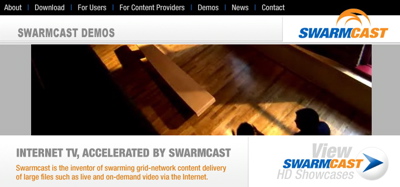
Swarmcastsiteclip

Whatever, this is more great news for Minnesota’s startup community! It proves again that money finds us, and that such fundings don’t always mean startups have to move to either coast to get their growth-fueling booty. [You know I’ve been chronicling the determination of another startup, Flyspy, to also disprove this commonly held theory.]

SwarmCast’s funding comes on top of two other $5-million+ Series A rounds for MN companies, which were announced almost back-to-back in the early summer: Jumpnode and HotGigs. I blogged about both companies here. Which makes me think…let’s see, that means at least three pretty big deals were brewing as much as a year ago (such financings typically are in the works for months before they’re announced). And — with the vibrancy of the tech sector having picked up markedly all year — just what all else may now be going on behind the scenes here locally as far as renewed venture financing interest in Minnesota’s Internet and IT startups?

That, my friends, is where a large part of my focus will continue to be. In fact, I’m already onto one such story you will find very interesting — another positive sign that the climate is indeed getting better. [Okay, I’m not talking about our weather! 🙂 …]

In the meantime, congratulations to my friend (and former client) Justin Chapweske, founder of locally grown SwarmCast, for making Minnesota proud. Justin, SwarmCast rocks!

Tags: , , , ,

Turning Tourists Into Travelers

Just heard a speaker I have to blog about: Rod Cuthbert, CEO of Viator — an Aussie surfer who gave a really great talk (easily the best so far this first day). There’s a difference between the terms “tourist” and “traveler,” said Rod, who splits his time between Bondi Beach, Sydney, and his company’s US office in San Francisco. Viatorbanner “Travelers want to experience their destination, not just visit it,” he said. “They want to understand the local culture.”


Rod’s firm (the name is Latin for traveler) was actually founded in 1995, so he’s been coming to this conference for many years. It fits — Aussies are some of the world’s biggest travelers. Viator raised an additional $6 million in Series B financing a year ago, led by Carlyle Venture Partners, with participation by Technology Venture Partners, putting the total the firm has raised at $10 million.

Rod said that most important thing when people travel is what they plan to do when they get there — destination activities — not the “mechanics” that so much of the travel industry is focused on (flights, hotel rooms, rental cars). “Teach your customers the ‘Art of Travel’,” he said, referring to the title of a book he recommends.

“Getting people hooked on travel is perfectly legal,” he said. “And true travelers will travel even when prices are high. They need to! They generate more revenue for you.” In the on-stage interview following (see photo), he talked about the “power of anticipation” and how travel sites need to appreciate this mentality of the true traveler. Viatorrodcuthbert_1

Viator is a comprehensive online resource for travelers to plan “the things you do when you get there,” featuring more than 4,500 destination activities in 450 cities in 75 countries. It helps travelers with a variety of tastes and preferences to research, plan, and book their trips. The company has 3,500 affiliates, including Priceline, Travelocity, Opodo.com, SideStep, Zuji, AirFrance.com, and Wyndham Hotels & Resorts, and is headquartered in San Francisco, with offices in Sydney and London.

Tags: , , ,

Travel 2.0: ‘Social Networking Floodgates Have Opened’

So said Phil Wolf, CEO of PhocusWright, in kicking off his firm’s 13th annual executive travel conference. “Travel 2.0 is soon to become accepted practice. Last November, we celebrated Travel 1.0’s swan song. It started in ’95 was dominated by price,” he said. “Now we have other factors like consumer collaboration, recommendations from friends, and friends of friends.” Of the price factor, he made a significant point: “It’s now about complete transparenecy in data and pricing — which is code for ‘truth’.”

Wolf noted that ony 10% of online travelers now belong to an online community site to help them plan their trips. But he ended his opening remarks with this prediction: “Interaction with others will expand exponentially.”

I thought the bump music that came up loud at this point hit the mark: “Break on Through to the Other Side” by The Doors…who, incidentally, became famous not far from here. [Jim Morrison, you still rock…]

Tags: , ,

Qloud Kicks Social Music Into New Territory

Frederick, MD-based Qloud (pronounced “cloud”) took the locks off its online social music site a few days ago to open a new chapter in “music discovery.” I met with Mike Lewis, one of the cofounders, a couple of weeks ago here in the Twin Cities. Mikelewis Mike grew up in Edina, MN, just about a mile from me, though we hadn’t met till he looked me up on his latest trip home. A veteran of online music, having worked at AOL and Ruckus after college at Dartmouth, he joined with former coworker Toby Mordock to found Qloud, and the pair received funding several months ago. [It’s from a notable source who must remain unnamed, or they’d have to kill me :-)…]
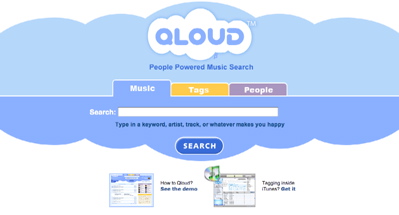
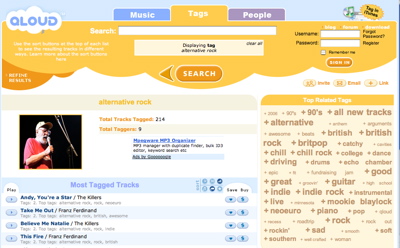
To use Qloud, you download a free plug-in for iTunes (Windows only right now). The site also works with the open-source Songbird player, which has Windows, Linux, and Mac versions [though I can’t find anything about that on the site right now]. “Our key points,” said Lewis, “are these: (1) we make your iTunes experience better by allowing you to organize it using tags, (2) we make it easy to search for new tracks, and (3) we make it easy to keep track of what your friends are listening to.”

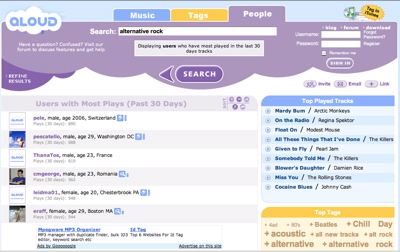
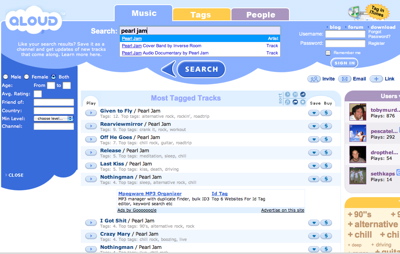
Here’s a screen shot of the home page, and three others showing the main views, which are Music, Tags, and People. Qloudhome

Qloudmusic_1

Qloudtags_1

Qloudpeople_1

For more, view the Qloud demo here. And here’s the launch press release. Blog coverage has already appeared at GigaOm and Mashable. Qloud was also named Lifehackers Download of the Day on October 11.

Biggest issue for now? Well, on top of the initial bugs that any beta release has to deal with, which Lewis assures me are being dealt with very quickly, is the fact that only a PC version of the plug-in is available right now. “We’re hoping to have the Mac plug-in before the end of the year,” said Lewis. Actually, he told me it’s basically done and working, but it’s the testing that takes time — working the bugs out. “We know we need it and we’re pushing forward.” So hang in there Mac lovers….me included!

But, Hold On — Qloud’s About More Than Sharing Music
“Something we haven’t even talked about yet,” said Lewis, “is that, over time, people develop lots of data in their player – plays, playlists, tags, ratings, etc. And every time they get a new player, they have to start all over. What we hope to be is a repository of metadata for a user’s music. In the future, we’ll let them push their information down to other players and other sites. That’s a big idea that’s coming from Qloud, and I think it’s cool.”

If you’ve ever seen the stats for the number of music players the average online music junkie has already gone through — a number that will only be rising — I think Qloud is onto something here.

Tags: , , ,

Gugle, Kroogle – What’s the Diff?

I asked Steve Larsen, CEO of Krugle, Menlo Park, CA, for his reaction to the big news today….that Google was launching “Google Code Search.”

Tech~Surf~Blog: What’s your take on this bomb, Steve?

Larsen/Krugle Inc.: We’ve been saying for 18 months that Code Search is an important new category. Stevelarsen The massive benefits that can be realized by both developers and corporations when robust code and technical search is available is becoming increasingly obvious. Google’s entry, along with O’Reilly’s entry a few months back and the existence of koders.com — it all signals we’re on the right track.

Tech~Surf~Blog: What are some other reasons you believe that?

Larsen/Krugle Inc.: Well, for one, developers spend 20-25% of their time just looking for stuff. Krugle users report saving significant time due to us helping them find code and technical information fast. Second, code search is the key to making code-reuse a reality. Vast amounts have been spent to modularize and make code componentized, but little has been spent on how to find and connect the modules. Good code search fixes this. Thirdly, companies who care about developers — like IBM, Sun, Microsoft, and others — have spent the past several years attempting to provide better access to their code archives and high-value technical information. This is a big issue for them. We’re helping.

Tech~Surf~Blog: What do you have to say specifically about Google’s code-search product?

Larsen/Krugle Inc.: First, it could be characterized as a better version of koders.com. While it does simple code search, developers tend to be more exploratory in the search process. They first search and review potential answers, then research these answers to better understand the project and review the technical documentation. Our three channels — code, tech pages, and projects — are based on how developers really use search.

Second, searching and finding code alone is not all that compelling. To be truly useful to developers, you need to show code in the context of its project, the meta data around the project, as well as license information. Krugle does this with an easily browsable project directory and rich technical information that relates to the code and project.

Thirdly, search engines ultimately are judged on the accuracy and relevancy of their results. The same indexing and page-rank algorithms used to search text, images, video, and books come up short when faced with the demands of professional programmers. At Krugle, we’ve found the key to great search results is to parse the code, collect and analyze project information and statistics, and use all of this to more accurately order our code search results.

Fourthly — is that a word? — we think collaboration around code is very important. And we provide users with the ability to create, add, and save notes to code and sets of related results, providing a level of interaction with code that developers heretofore have just not had.

I even have a fifth point: While other code search engines offer the ability to search for a code file if you know its name or something about it, Krugle goes well beyond that by supporting common programmer use cases that revolve around: (a) exploring a new technical project or concept in an effort to quickly “come-up-to-speed”…(b) finding code or code snippets to use or to have as an example…or (c) helping find what’s wrong when your code doesn’t work and you need to know how to fix it.

There you have it, friends. Krugle should be liking all this attention. I think this code-search game is just now beginning to get interesting…

Tags: , , ,

« Older posts Newer posts »