Reflections & analysis about innovation, technology, startups, investing, healthcare, and more .... with a focus on Minnesota, Land of 10,000 Lakes. Blogging continuously since 2005.

Category: Startups (Page 29 of 29)

Gluecon 2010: A Chat With OxygenCloud


OxygenCloud-logo OxygenCloud wants to solve corporate end-users' file management problems with cloud storage. To date, the latter has been used mostly by developers creating applications, not by corporate IT to address end-user file management. Thus, the company says cloud storage lacks easy end-user access, security, and the IT admin tools needed for corporate deployment.

But OxygenCloud is out to change that, by way of a company file network that brings all storage clouds the company uses — public and private — to the desktop of the corporate end-user. 
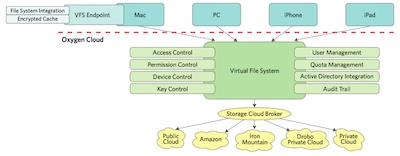
OxygenCloud-diagram From an intuitive desktop interface, users can access any file, in any cloud, as if it were in local storage.  These files can be shared with anyone, including external users, within an encrypted and secure environment. 

A spinout of LeapFile, OxygenCloud describes itself as a "cloud storage broker."  Its customers can store and secure their files using any cloud provider.  Its service combines these multiple public and private
OxygenCloud-Peter+Alex clouds into a single synthetic cloud, allowing users to balance their cost and performance requirements. Here's my interview with Peter Chang, CEO, shown at left in the photo, with Alex Teu, director of business development.

Download or listen to Graeme's interview with OxygenCloud (MP3)"


Gist Gives You the Context You Need for Meaningful Engagements


Gist-diagram
Today, I had an opportunity to meet with a couple of the good folks
from Gist, a startup based in Seattle that helps you "Know More about
Who You Know."  It's a neat app that I've been using for some time, and
that includes their native iPhone app — which is a great way
to stay in touch when I'm on the go with what my network is up to.  I
also love the daily email updates I get from Gist that give me all the
latest content from my most important contacts. 

I sat down for breakfast with Robert Pease, VP of Marketing, and Jenn Pitts, Marketing Operations Manager, who were in town for a conference. My friend Buzz Bruggeman in Seattle was nice enough to give me a heads-up that Robert and Jenn were coming to Minneapolis, and I thought it would be a great
Jenn+Robert-Gist opportunity to get an update on the company.  I had previously met the CEO, T.A. McCann, last year at a couple of conferences I attend in Denver, Defrag and Glue, where I had first learned about the company's app.

Here's the audio interview I recorded of our conversation, which is about 22 minutes long. Excuse the sound quality, because we were in the very large lobby restaurant in the Hyatt downtown, and there was a fair amount of background noise. At one point, there was even a loud clap of thunder outside that interrupted our chat! But it was good to hear about how this startup is doing in advancing its mission of helping people improve their relationships with the people and companies that matter most to them.

Download or listen to Graeme's interview with Gist (MP3)"

Minnesota Mobile Developers Clocking Millions of Downloads

(Note: This post first appeared at Minnov8.com, on May 2, 2010.)

CrowdOfPeople-circle Local developers of apps for mobile devices, especially those
designed for Apple’s platform, are quietly amassing large numbers of
users for their creations, I’ve been learning.

This past week, I thought it would be an interesting little project
for me to do a survey of sorts as the basis for this blog post. What I
did (totally unscientific, I admit) was ask all the Twin Cities-area
mobile developers I happened to know just how many apps they have on the
two major platforms, Apple and Android, and how many users have
downloaded their apps to date.  It turned into a bigger project than I
thought!  It required a lot of back-and-forth emails to clarify all
their current offerings.  But I’ve sorted it all out as best I can, and
you’ll see the results of that survey in the second half of this post.

The two most-experienced mobile app development firms in Minnesota I
have known quite well for some time, having been a consultant to both in
the past: DoApp and CodeMorphic
These two firms began developing for the iPhone platform as soon as
Apple released the SDK in March 2008, and had their first creations in
the App Store from the get-go, in the case of DoApp (July 2008), and
CodeMorphic soon after. So, it was no surprise to me, then, that these
two have the largest numbers of downloads locally. But many more
Minnesota developers jumped in after them, and still are jumping in. In
fact, I learn about a new one almost weekly. Some publish apps in their
own name, some only for clients, and some do both. (For apps developed
for-hire for client companies, developers cannot track ongoing download
numbers in real time — only their clients know, unless they tell them or
otherwise publicize the numbers. But the developers can certainly make
educated guesses, which some of them did for me for my survey.) What
triggered this idea for a post was a news announcement one of the two
big local development firms just put out …

DoApp Inc. Announces One Million Downloads of Its “Mobile
Local News” App

Actually, it’s not one app; there are more than 100 of these DoApp “MLN”
apps out there, because that’s how many customers (media outlets) have
signed up with DoApp to date to use what is really an “app platform.” 
DoApp-Mgmt-250w
It allows DoApp’s customers — TV news stations, newspapers, online
publications, and radio stations — to easily brand the app for
themselves and deliver their content via smart phones and other mobile
devices, including the Apple iPad.  (DoApp has not yet submitted to
Apple an app designed specifically for the iPad, though its many iPhone
apps do work on that new device.)  In its recent announcement, DoApp
counted downloads for all its locally-branded Mobile Local News apps,
including both Apple and Android downloads, in saying they have
surpassed the one million number. The company first made the Mobile Local News
app available in April 2009. For more about all of DoApp’s products,
see the company’s web site.
  (In the photo: Joe Sriver, center, Founder; Wade Beavers, left,
CEO; and Dave Borrillo, VP-Software Development.)
I conducted an
email interview with DoApp founder Joe Sriver to learn more about the
current status of his company’s Mobile Local News app business.

First, here’s a map showing U.S. coverage of DoApp Mobile Local News
apps. For a list of all the
media properties that have the company’s app, see the lower portion of this page.


MobileLocalNews-map Minnov8:
Just out of curiosity, Joe, what percentage
of the one million downloads you’re announcing for Mobile Local News
are iPhone vs. Android?
Sriver: “Currently, the breakdown is about 60/40 in
favor of the iPhone. Android has really been gaining a lot of ground in
the last year. 2010 is a big year for Android.  We are seeing over 49
different brands of Android phones that are tapping our MLN app — a
challenge to maintain.”

Minnov8: How many of your existing customers for
this app offer both iPhone and Android versions? Does our local WCCO-TV,
your first customer, offer both?
Sriver: “Our platform offers the native iPhone and
Android versions for all our media outlet customers — WCCO included. We
will also have a Blackberry WAP version debuting in the next month. 
We’re seeing a new influx of iPad users accessing the news, too, so
let’s just say we will have an iPad solution soon.”

Minnov8: Most all your customers for this app
appear to be TV stations. Are any radio stations or newspapers signed up
yet? Do you expect more of the latter two?
Sriver: “We have been signing newspapers as well.  In
the last few months, we signed Journal Communications, which includes
Milwaukee’s Journal-Sentinel, and the Los Angeles News Group, which
includes several newspapers in the LA area. Our SBT News app serves the
newspaper in South Bend, Indiana.  We have also signed Swift
Communications, whose properties include many newspapers in the western
and northwestern U.S.  With our recent announcements, a flurry of radio
stations are contacting us, and our first radio station app will be out
in the first week of May.”

Minnov8: How much are you seeing media outlets
developing their own custom, native apps for mobile devices — as opposed
to simply skinning your app and configuring it for use with their local
audiences?  What’s the difference in time and money with your approach?
Sriver: “We’ve talked to many media outlets. A few of
them have decided to do development in-house. Many of them call us back a
few months later after they realize all the development requirements
for iPhone and Android. They tell us our Mobile Local News solution is
the fastest, cheapest, and most efficient method to bring their content
to mobile. The money difference is huge for them because its the support
that kills them, and we have a solution that fits to scale.  We’ve done
nine major enhancements in 12 months already, and for a property to do
so is a huge resource drain.  It’s just tough to keep up with
technology.”

Minnov8: How does DoApp Inc. make money from this
app — licensing?  Revenue share? Where does your “Adagogo” ad platform
fit in here?  What portion of your customers for this app have ads
appearing on it?  What revenue do you make from ads that appear on the
app?
Sriver: “We offer a subscription model where stations
can receive 100% of revenue from advertisements, or an advertising
revenue share model, where news organizations pay a small set up fee and
then share advertising revenue with DoApp.”

Minnov8: Are all current customers for the app in
the U.S.? If so, any plans to pursue business in other countries?
Sriver: “Yes, all current news entities who use Mobile
Local News are in the U.S.  We do have plans for news organizations in
other countries. We can support translations right now, and we are
working to reach out to the growing Spanish-speaking consumer market.”

Minnov8: Your original partner for the Mobile Local
News platform was Inergize Digital Media of Minneapolis — and I remember
having the initial discussion with them on your behalf in the fall of
2008. What role do they play? What percentage of the media outlets that
have signed up to use your app were existing customers of theirs?  And
what revenue split does Inergize get from this partnership?
Sriver: “Inergize brought many of their existing
stations who used their web solution to the mobile platform via DoApp’s
Mobile Local News. We’re working to establish other relationships and
also extending our direct model to TV news/radio/newspaper properties. 
The relationship works like this: DoApp provides Inergize’s partner
stations with the DoApp Mobile Local News mobile publishing solution. A
percentage of ad revenue goes to the station or newspaper, Inergize, and
DoApp.”

Minnov8: What does 2010 hold for DoApp? What portion
of your overall revenues do you expect will come from the Mobile Local
News and Adagogo combined?
Sriver: “We will continue to build our base of news
entities who use Mobile Local News.  MLN is the most popular platform
for mobile news delivery in the U.S.  Our Adagogo ad platform is
currently being used on all Mobile Local News apps. We will continue to
grow Adagogo as well. DoApp is also focusing on mobile real estate. We
have created what is arguably the most advanced real estate solution,
combining cost savings capabilities for agents with simplicity for their
clients — allowing mobile access anytime, anywhere via smart phones and
other mobile devices.”

So, what about DoApp’s total stats, for all their apps?  Here are the
numbers I got from Joe:

What is the total number of apps DoApp has had accepted into the
App Store?
iPhone: 125 (all but about 15 are Mobile Local News
apps). Android: 110.
Paid vs. Free? iPhone: 4 are paid apps, the rest are free.
Android: all are free.
What is the total number of downloads of all your apps?
iPhone: 4.5 million. Android: 600,000.  Total= 5.1 million.

So, where do other Minnesota developers stand as far as downloads? 
Well, here’s that unofficial survey of mine, with respondents in
alphabetical order, by company name.  The first happens to be the other
large player in the iPhone market I referred to earlier, who may in fact
have the largest number of downloads of all, although that cannot be
verified:

CodeMorphic
– Bill Heyman, Founder

What is the total number of apps you have had accepted into the App
Store?
50. (All under the names of clients.)
Paid vs. Free? 20 paid, 30 free.
What is the approximate total number of downloads of all your apps?
CodeMorphic provided a conservative estimate (because its clients have
the download figures): 3-5 million.  The most popular of CodeMorphic’s
apps has been the NPR Public Radio Player, which the firm said had 2.5M
downloads as of two months ago. It also did MPR’s app. Its other popular
apps include the “Smarter Agent” real-estate app. Some national brands
CodeMophic has done apps for do not allow the firm to publicly disclose
them as clients, but these apps have broad reach, too. To see a
selection of some of  CodeMorphic’s apps, see the firm’s portfolio page.)
Do you have apps available now in the Android Market? None
yet.

Mentormate
– Bjorn Stansvik, CEO

What is the total number of apps you have had accepted into the App
Store?
1 (“MigraineMate”).
Paid vs. Free? Free.
What is the approximate total number of downloads of all your apps?
858.
Do you have apps available now in the Android Market? None
yet. (“LocationMate app to be launched, for both iPhone and Android.”)

Mobile On Services Inc. (BuildAnApp.com) – Scott Pearson, VP-Business
Development

What is the total number of apps you have had accepted into the App
Store?
22. (“We’re still in beta.”)
Paid vs. Free? All free.
What is the approximate total number of downloads of all your apps?
4,000 iPhone, 500 Android. (“Will be a much different story in a couple
of months.”)
Do you have apps available now in the Android Market? Yes, 12.

MobileRealtyApps.com,
and Performant Design LLC – Aaron Kardell, CEO

What is the total number of apps you have had accepted into the App
Store?
4. (“Soon to be 5.”)
Paid vs. Free? 2 paid, 2 free. (“Soon to be 2 paid, 3 free.”)
What is the approximate total number of downloads of all your apps?
20,000.
Do you have apps available now in the Android Market? No.
(“But coming soon.”)

Mobile
Roots
– Lynn Smith, CEO/Founder

What is the total number of apps you have had accepted into the App
Store?
5. (Three are under Lynn’s name; two apps were developed by
Mobile Roots for clients: “Margaret for Governor” and “Brazelton for
House.” Two more apps are in development for political candidates.)
Paid vs. Free? 1 paid (“What the Funkytown!” – $0.99), 4 free.
What is the approximate total number of downloads of all your apps?
3,270.
Do you have apps available in the Android Market? No. (“But
releasing our first next week.”)

Recursive
Awesome
– Justin Grammens, Cofounder

What is the total number of apps you have had accepted into the App
Store?
7 public apps in the App Store; also 5 private apps for one
client, which are installed using the limited “AdHoc” distribution
method, whereby each app is manually installed on individual Apple
devices.
Paid vs. Free? 1 paid, 7 free.
What is the approximate total number of downloads of all your apps?
Estimate provided: 850,000.
Do you have apps available in the Android Market? Yes, 6 — 1
paid, 5 free, and 1 in private development. Estimated total downloads
for these: 60,000.

Refactr
Ben Edwards, Founder

What is the total number of apps you have had accepted into the App
Store?
2. (“And 2 more submitted.”)
Paid vs. Free? All free to date.
What is the approximate total number of downloads of all your apps?
One app built for Mayo Clinic: download number not known. The firm says
its own app, “Flashbang,” has been downloaded about 20,000 times.
Do you have apps available in the Android Market? None yet.

Tiny
Mission
– Bekki Freeman, Founder

What is the total number of apps you have had accepted into the App
Store?
3.
Paid vs. Free? 2 paid, 1 free.
What is the approximate total number of downloads of all your apps
to date?
1600.
Do you have apps available in the Android Market? No. (But
“working on it as fast as we can type!”).

One thing that occurred to me as I was working on this survey over
the past few days: it isn’t just software development firms that doing
mobile apps — many of those being firms that do development-for-hire,
and some of which are doing self-publishing of their own apps.  But
there are also other types of local firms that are developing their own
apps, some in-house, including startups whose initial product is a
mobile offering, or has a mobile version. One such startup I just
learned about is this one, based in Stillwater:

Nibi
Software
– Troy Peterson, CEO

What is the total number of apps you have had accepted into the App
Store?
1. (“An educational app called Nibipedia, which mashes all
the educational Youtube channels with Wikipedia articles — so that, when
reading an article, the app recommends relevant videos. It also tracks
your research path for you so you can review later. We have several
other apps in the queue. Apple makes taking an idea from conception to
market so much easier than with traditional web apps. We’re stoked.”)
Paid vs. Free? Paid – $1.99. (“But we’re offering it to
teachers in our Facebook Group for free.” Presumably, that would be via
the AdHoc distribution method.)
What is the total number of downloads of all your apps? No
specific number reported. (“It was just released, and has not been
promoted. But we’ve had several hundred downloads already from people
who became aware of it in the educational marketplace. It’s really
designed for the larger display screen of the iPad, so we are setting to
work to promote that in the next few weeks.” Presumably, that would
mean an iPad-specific version of the app is coming.)
Do you have apps available in the Android Market? Not yet.
(“But we’re going to, for sure.”)

A footnote: I only contacted firms that I
know to be developing for the Apple or Android platforms, but I make no
claims that this is a complete list. One firm I contacted that chose not
to report its numbers at this time was Handcast Media Labs, creators of
the “SparkRadio” app (one of my personal favs), which is available for
both the iPhone/iPod Touch and iPad platforms. Another developer I
contacted did not respond: Dan Grigsby, who was head of
MobileOrchard.com, a company he announced recently he was shutting down.

Now we want your input: Who have we missed?
Are you a developer doing mobile apps? Do you know of a Minnesota
company that has released iPhone or Android apps?  Is your mother doing
iPhone apps? How about firms based outside the Twin Cities? If so,
please tell us in the comments!  Also tell us what apps you like.  And,
lastly… is the iPad better than sex?

Note: See the comments to this post where it originally appeared (Minnov8.com) here.

Bootstrapping: Why Do Entrepreneurs Do It, and How?

The term “bootstrapping” has applicability to many things, according to Wikipedia. But, at least in business, it means “to start a business without external help (capital).” You can read more about that specific meaning, also called  “bootstrap funding,” on this Wikipedia page — lots of helpful information there.

bootstrappingBut what got me thinking about bootstrapping was a few things: first, I posted recently on the topic Raising Startup Money? Here’s 20 Ways — and a large number of those ways qualify as bootstrapping. Yes, the money you save by bootstrapping is real money! But, after that, I saw a blog post by Jeff Cornwall, who heads the entrepreneurial studies program at Belmont University (and used to teach here in the Twin Cities at the University of St. Thomas). In his blog post, which was called “Why Do We Bootstrap?”, he said he’d just begun working on a new book on this topic. The interesting thing Jeff has found in his work is that entrepreneurs bootstrap for a wide variety of reasons, and only some of them relate to necessity.

The other reasons I find the topic of bootstrapping interesting are (1) I’ve practiced this religion myself for many years, and (2) I think there’s especially a need here in Minnesota for startups to get more educated on this topic. Why?  Because, try as we might, startup venture funding is never going to flow as freely here as it does in Silicon Valley, or Boston, or Austin, or you name it. Entrepreneurs in these parts, and in so many areas of the country away from the major VC hubs, have to be one thing above all else: clever. And there’s a lot they can learn from people who study this phenomenon (like Jeff), and people who’ve practiced it for a long time. We have tons of those here in Minnesota (and all over, really), including serial entrepreneurs who’ve proved bootstrapping works, over and over again. Many of these guys (and girls) are friends of mine, and they have accumulated a large amount of knowledge on bootstrapping based on hard experience. The key, of course, if you’re a budding entrepreneur, is to learn how to tap into the expertise of those folks.

There’s an easier way to begin getting educated, though. In addition to Jeff Cornwall’s book, when it comes out (UPDATE: it was published in January 2009), you might want to start with a book Jeff recommends by Seth Godin, called the “Bootstrapper’s Bible.”  It’s not new, but it is definitely a classic — here’s some background on it from Seth’s blog.bootstrappersbible

But here’s the big tip: DON’T BUY IT! That’s right, you can download the FREE ebook version — a “manifesto” as Seth calls it — as a PDF file, right here.

Is that cheap enough for ya??  Better go grab it while you can, before he changes his mind. Then, read up, go forth, and continue bootstrapping!

Raising Startup Money? Here’s 20 Ways

This is not the first post I’ve done that mentions Tech Coast Angels, one of the largest and oldest angel investing organizations in the country, which is of course in Southern California. (Here’s another good one from about 10 months ago.) Interesting that the term “angel” originated in the techcoastangelsentertainment business, but TCA has little to do with Hollywood. It sure has a whole lot to do with funding technology startups in that part of the country, though! (I also had the good fortune to do an extensive interview in early 2007 with the founder of Tech Coast Angels, the late Louis Villalobos, which was later published in The Angel Journal.)

This organization is actually comprised of four networks of angels covering a large part of the SoCal geography, from Santa Barbara down to San Diego. One of my favorite places, Orange County, is where the largest and oldest of these networks is situated.  And that’s where the subject of this post hails from.

Frank Peters, a successful, now semi-retired software entrepreneur (he marketed his product to Wall Street firms starting back in the ’80s), has been active as an angel investor for 10 years, and at the time of this post he’d been with Tech Coast Angels for five years. On the side, he produced a great podcast for a few years called “The Frank Peters Show” — subtitled “Startup Stories in Angel Investing and Venture Capital.” He was prolific — averaging about 60 podcasts per year for a while. Pretty amazing! These episodes provided some great listening for both entrepreneurs and angel investors. He had some excellent interviews with really interesting subjects. It was a podcast that definitely helped people better understand angel investing.

Frank did one great episode that was an interview with two experienced fellow TCA angels: Dave Berkus (how many angels do you know who’ve done 60 deals?), and Sid Mohasseb, who runs Venture Farm, which he described as “an equity funding source that adds hands-on experience to the execution process.” The topic of the podcast was “20 Ways to Fund Your Startup” — a list that Dave Berkus developed, but which all three guys discussed in this one-hour+ episode.  Here’s a quick rundown of the gist of that discussion:

THE BIG LIST: 20 Way$$ to Feed Your Startup Habit
Of the various ways to raise startup capital, angel financing is about in the middle of the continuum, Dave said. Some founders, however, try it too early — they don’t bootstrap enough first.  If you do, say the panelists, you’ll have a better chance of getting an audience in the first place to be considered to receive funding. So, here’s the rundown, courtesy of Dave, with some points noted by him and the others as he went through the list:

1) Credit cards – this can be $20-30k, even $50k in some cases, which will require a personal guarantee (but not mortgaging your house).
2) Securing arrangements with suppliers to slow down payments – assuming the business is started – or seeking deferred payment – lawyers typically do that – many even do pro bono work as a way to give back to the community.
3) Take out another mortgage – scary for many, perhaps, but rates remain quite low; it shows the founder has significant belief in what he or she is doing.
4) Wealthy relatives – “if you were born lucky” – they’re more likely than others to invest.
5) Friends – “means you’re getting lucky, if you have good ones!”  – can be on your board of advisors, too, which costs you nothing.
6) Take on consulting work – even let your company be both a consulting and product development business at first.
7) Affiliate with an incubator – whether physical or virtual – they can help build your management team and more.
8) Well-connected attorney – angels listen to their recommendations.
9) A “Rented” CFO – they don’t get paid for just getting the money, but for the financial systems they set up – the analysis of the data is what they deliver, and credibility.
10) Recruit a professional CFO – angels feel much more comfortable then.
11) Get prepaid licenses for your technology – a combination of selling service as well as product – maintenance agreements can be part of this (16-20% of list price of software) – recurring revenue –  customers are essentially paying for the engineering and product development – helps refine the value proposition – you don’t need to give it away for free.
12) Accelerated payments – of course, you have to have a revenue stream first.
13) Royalties for very specific projects – let those fund your product development – seek out anyone that can benefit from the technology (not just your main target customers).
14) Angel financing – “later the better” to approach them, because you’re then more likely to get funded – however, can be anywhere on the continuum – the later it is, the more likely you’ll get funded (angels will look at what you’ve done so far – how many of the above you’ve taken advantage of) – if you go to angels earlier, your valuation will be lower.
15) Bank line of credit – $50k is available to almost anybody with good credit (with personal guarantee).
16) Strategic partnerships – customer or supplier, helping to develop, promising to distribute, etc – helps to define channels for later sales and distribution.
17) Venture capital, pension funds
18) Private placements
19) Professional restructurers
20) Investment bank, public offering

Dave pointed out again that angels are more in the middle of this continuum — they aren’t where you start.  “They’re an avenue for the sophisticated entrepreneur that understands all the other sources and where the risk is, and how fast they need the money.”

In the closing discussion, Frank commented that TCA was ten years old at that point, and was getting more sophisticated.  Yes, the others agreed — and “more prudent, cautious, and jaded.”  But Dave added that it was certain they were much more powerful as a group than as individuals. Frank noted that the angel financing business, at least for TCA, things slow down towards the end of the year — until around mid-January.

Then, the three discussed a recent university study, in which certain TCA members participated, called “Angels in Groups,” for which a large amount of data on angel investments was gathered.  One of the biggest surprises of the study, they agreed, was the average length of time to a liquidity event. Many angels think of it as generally 3 to 5 years, but they noted that was not happening for those deals studied.  Dave said the study found that 61% of the angels surveyed had returns greater than the amount they invested, “meaning 39% didn’t!”  The conclusion is that angel investing is more risky than most people think. A diversity of investments is important “before you can count your chickens,” said Dave. Luis Villalobos, the founder of TCA, thought a portfolio of 25 or more investments was a minimum to expect good returns. The study showed that success happens when the angel is involved in the business. The entrepreneur benefits from the sharing of the experience of angels. Finally, the study found that it doesn’t tend to pay for angels to reinvest, which is somewhat worrisome, the panelists noted. “TCA traditionally funds 2-3% of deals they see,” said Dave. “But when we’re ready to take deals to VCs, those firms only invest in 1% of what they see, on average.”  Therein lies a problem, because angels often to have to invest a second or third time to keep the business going before it’s ready for the VCs. ‘”It’s a game of patience,” Dave said.

Frank Peters concluded this particular podcast by saying he thinks there’s a need to “start testifying more about angel investing, more education, chewing over issues.”

I like the list of 20 sources of startup money, though — it’s a list that all new and aspiring entrepreneurs need to know. There really are a ton of ways, and most of them do qualify as bootstrapping… or just plain being clever!

Newer posts »