Reflections & analysis about innovation, technology, startups, investing, healthcare, and more .... with a focus on Minnesota, Land of 10,000 Lakes. Blogging continuously since 2005.

Category: The Web & Web 2.0 (Page 33 of 41)

Firefox Users, You’ll Love the Cool, New “BlueOrganizer Denim” Plug-In

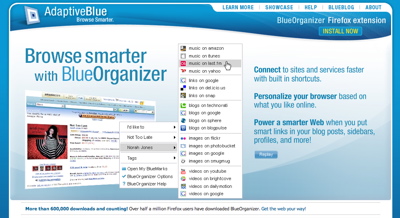
AdaptiveBlue, a company we covered here and here last September when they debuted at DEMOfall, today launched the latest version of its BlueOrganizer plug-in for the Firefox browser, which it calls Denim. Alex Iskold, the founder and CEO, is a friend of mine, and a fellow writer at Read/Write Web. (Okay, I’ve written two posts there and he’s done what seems like 50 or more, and they’re all amazingly good.) How he finds time to do all this writing and run a startup, I don’t know. I’m threatening to start calling him Superman. Alex’s firm is based in New Jersey and was funded in a Series A round last fall by Union Square Ventures of New York City.

Anyway, I downloaded and installed the plug-in in about 30 seconds on my Mac. It’s an elegant solution — and the web site is very clean, well functioning, and informative, with good demos, graphics, and explanations. The plug-in worked flawlessly for me right from the start, and I’m now thinking it could turn me into more a Firefox user… 🙂
Blueorganizer
Duncan Riley reported on the launch today on Tech Crunch, noting that “Adaptive Blue also enters the widget market. The new ‘sharing links’ feature allows users to embed semantic links into any web page, include bookmark style lists in a sidebar, or just embed a traditional widget. Affiliate programs are fully supported with no revenue sharing; if a user includes their affiliate code for programs such as eBay and Amazon they keep 100% of any associated revenue.”

Richard MacManus also published a post today on BlueOrganizer on Read/Write Web, under the title “Semantic Web In Action?” He explained that BlueOrganizer “aims to provide extra contextual information to you while browsing the Web. Basically, after you install BlueOrganizer in Firefox, it enables you to discover all kinds of relevant content while you’re browsing – such as books, music, links, related information, etc. Essentially then, it adds personalization and semantics into the browser.”

How’s the new version of the plug-in different? “First,” says Alex, “it’s just much more fun! Its lighter, more clickable, and takes less space both in the toolbar and in the sidebar. There’s also a new BlueMenu right in the toolbar. This makes the menu much easier to use for people who are not into right-clicking.” He also says that the latest context detection algorithm “is a huge improvement over the previous versions. Try it on blog posts about books, music, wine or another topic and see for yourself.”

Probably the most important new feature is SmartLinks, according to Alex. “These are web links that feature contextual shortcuts. They carry all the smarts about the objects right into blog posts, web pages, and social network profiles.” With SmartLinks, he noted, you can share the power of context and semantics with your friends, family, or readers.

“This is fundamental and big,” Alex proudly points out. “We’re bringing semantics into the most basic element of the web – the link. Imagine the web where links no longer point to pages, but point to things….users can get to information faster; information that’s contextual and relevant.” While some people might call this the Semantic Web, “we would not be so presumptuous,” Alex says. “But we think BlueOrganizer and SmartLinks are powering a smarter web and that, in turn, paves the road to the real Semantic Web.”

Time for “Life 3.0” in the Valley?

Back in late 2002, in the doldrum years after the Tech Crash, my friend Rich Karlgaard (the Publisher of FORBES) became compelled to start writing a book about a phenomenon he’d been observing in Silicon Valley. People were leaving in droves — entrepreneurs and other business people, tech workers of every stripe. Good people, successful people, and so many of them disallusioned. Life20cover They’d had it with the expensive living and the rat race up and down the 101, and they were determined to find a better life elsewhere. It’s a great book — called “Life 2.0” — and it’s on my recommended reading list in the right sidebar. He came to Minnesota to interview me when he first began writing it.

Well, hold on, but another book could be in the offing here, from somebody, based on what we read yesterday from two leading Valley-based technology bloggers. First, Michael Arrington launched this bomb on Tech Crunch: Silicon Valley Could Use A Downturn Right About Now…the most telling sentence of which was this: “Times are good, money is flowing, and Silicon Valley sucks.” Here’s another excerpt, his concluding paragraph:

I left Silicon Valley at the peak of the insanity last time around, and I was pleasantly surprised when I returned in 2005 to see so much goodwill and community surrounding innovation. Now, it’s just like the old days again, and Silicon Valley is no longer any fun. In fact, it’s turned downright nasty. It may be time for some of us to leave for a while and watch the craziness from the outside again. In a few years, things will be beautiful again. The big money will be slumbering away, and the marketing departments will be a distant memory. We can focus, once again, on the technology. And the burgers and beer.

The post had 210 comments(!) at last count, so it’s obviously hitting a nerve. But, as if that wasn’t enough, Robert Scoble then chimes in essentially seconding the motion. I like Robert — he’s one of the nicest, most likeable, down-to-earth guys you will ever meet in this business. (And his wife, Maryam, is a real sweetheart, too.) So, when Robert talks, I listen. I respect what he says. Well, yesterday, he further enlightened all us unwashed masses of Valley outsiders with what it’s really like to be an insider there these days. And it does not sound particularly pleasant. His post was titled Why I’m in a malaise…, and here’s an excerpt:

I too look wistfully back at the days when we had almost the entire Social Software industry in one little coffee shop back in 2002 — none of whom were talking about making billions of dollars. Back then it was more like the Homebrew Computer Society, where geeks came to show off their stuff (and everyone was pretty much not getting paid anyway so of course we were doing it just for the love of it).

It seems to me that both Robert and Michael are tired of the grind — the relentless parade of me-too companies and legions of PR people and VCs trying to get their attention, and the hellish treadmill they’re on producing content day after day, night after night. You can only do that for so long before you get burned out — and it seems both of them have reached that point.

Then again, who knows, maybe they just need a vacation? What I do know is that I wouldn’t want either of their jobs. Sure, I’m a blogger, but these guys are hardly your typical bloggers anymore. They’re both part of serious, money-making publishing businesses (Robert also being a VP at PodTech), and both inextricably caught up in the big-money world of tech VC. Now it seems they’re both wondering, “Is this all there is?” And it begs the question: is this crazy Web 2.0 startup world getting closer and closer to a bubble burst?

Makes me glad I live in Minnesota, where things are a great deal more sane. And I know Rich Karlgaard would be the first to agree with me.

UPDATE: To add book link.

They May Not Be Evil, But Their Tagline Is Hellish

Google has finally done it — come up with a tagline. No, I’m not talking about the motto (“Don’t Be Evil”), or the mission statement (“to organize the world’s information”). As Danny Sullivan reports today on his blog, SearchEngineLand, the company has gone and uncorked the phrase to end all phrases. Saywhat Okay, are you ready for it? Are you sure? Okay, drumroll, it’s…..“Search, Ads & Apps” !! No, I’m not kidding — that is it, friends. I know this really tugs on your emotions. But, please, try to control yourselves … from tearing up with brand euphoria.

I’ve always maintained that writing a tagline is like writing poetry. It may be the highest form of advertising writing there is. (And Google, we’re told, is an advertising company!) But this one, I’m sorry. This is no tagline — it’s a three-part laundry list. Okay, Google, great — you do all these things. Got it. Three of ’em. Check. Like we didn’t know that?

This is like Coke saying “Water, Sugar, and Fizz.” Or Nike: “Soles, Laces, and Uppers.” How about Apple? “Pixels, Pods, and Jobs.”

Got any more? Hey, this is fun….play along.

Widgets…Gadgets…Wadgets?

Could another Web 2.0 technology fusion be on the horizon? As in, widget meets advertising, new love affair blossoms? That would seem to be the gist of the latest online advertising development, with Google now saying it will do a full launch this summer of its Gadget Ads. Wadgetgraphic It didn’t take the 800-pound gorilla long to figure out that advertisers were coveting all the space that content publishers have been devoting to widgets. Many of these advertisers would naturally like to push their wares inside little embedded, interactive pieces of web real estate, too. It’s not just about getting a click-through; these things offer great branding possibilities as well.

Steve Rubel reported yesterday about this latest move on his Micropersuasion blog under the headline, Google Widgetsense Is a Reality. He based his post on a piece Niall Kennedy did a bit earlier, called Google Gadgets Are Now an AdSense Unit. That, in turn, was based on news broken at an event by Tameka Kee of Online Media Daily: Google Tests ‘Gadget Ads’. And it was all later breathlessly reported by Pete Cashmore at Mashable thusly: Gadget Ads!. Got all that? Such is the blogosphere — and all that reporting happened in a matter of a few hours!

Just a few weeks ago, in a guest post I did on Read/Write Web from the Web 2.0 Expo in SF, entitled Widgetsphere: New Playground For Marketers, I raised this question of where does a widget stop and an ad begin? Well, it appears the line is growing fuzzier as we speak. Capitalism marches on!

UPDATE: To accurately label Google as an 800-pound gorilla, not an 80-pound one. 🙂

Web 2.0 Expo: My Recap on Read/Write Web

Just saw the post up on Read/Write Web that includes my recap of the Web 2.0 Expo event last week in San Francisco. Web2expo Richard MacManus published his take earlier, then followed with this one that includes my thoughts and those of two other writers that contribute to R/WW and happened to be at the event.

By the way, congrats to Richard on the fourth anniversary of Read/Write Web! He’s come a very long way since those early days — from spare-time sideline to media property. Quite an entrepreneurial story, and one with a international component, too, since Richard has more of a global bent being based in New Zealand. Readwriteweblogo
Richard also used to blog for ZDnet, but now is fulltime on R/WW. What makes the blog so well followed is that it does analysis, not just news bursts about the latest deals and startup launches (though it covers its share of those, too). It’s been amazing to watch its growth.

« Older posts Newer posts »