Reflections & analysis about innovation, technology, startups, investing, healthcare, and more .... with a focus on Minnesota, Land of 10,000 Lakes. Blogging continuously since 2005.

Category: Venture Capital/M&A/Angels (Page 35 of 54)

‘Defrag’ Conference: Brainstorming the Next Big Thing

Next Sunday, I’m off to Denver for a really cool conference called Defrag. (Here’s the blog, which will tell you what’s really goin’ on.) I’m looking forward to it, because it’s different — a smaller, more intimate kind of event. The kind of event "where you send your brains for a workout," say the producers. Defregconf
There’ll be a couple hundred really smart people participating, many whose names you would know. Folks like Esther Dyson, Jerry Michalski, Clay Shirky, David Weinberger, Doc Searls, Paul Kedrosky, Brad Feld, Jeff Clavier, Chris Shipley, Steve Larsen, and a couple of new players I’ve met in the semantic web movement, Nova Spivack and Alex Iskold. Denverhyatt
And that’s just a few I can remember — there are many more smart Internet minds who’ll be there.  We need this kind of event after Esther Dyson retired her great "PC Forum" conference after the 2006 edition. (I’m so glad I got to cover that one. It was soo timely, and everybody-who-was-anybody was there.)

Defrag is being held at the very cool, new Denver Hyatt. Here’s an invitation to all my friends here in the Minnesota technology community:  please join me at Defrag!  (At least two already are, and we’re flying out together.)  Denver’s not that far — and, hey, you guys need to get out of town once in a while! 🙂  I even have a special discount code that will get you $500 off.  But you have to act fast, since that expires soon: the code is "DefragMN"…and you can use it when you register right here.  I guarantee you, you won’t be sorry you attended this conference!  Check the agenda.

One of the three producers of Defrag is a guy I know named Eric Norlin, and I’m looking forward to meeting the other two. I met Eric back in ’99 through my work with Net Perceptions, and he’s become an even more plugged-in guy since then. He’s been in the digital identity business and has run other conferences, such as Digital ID World.  He lives in Florida now, but was in Colorado for many years, so has lots of contacts there. (He also was based in the Twin Cities for a couple of years, quite some time ago.)  Early on, Eric even worked with the NSA, so he’s just an interesting cat to say the least. It’ll be fun to see him again. Here’s how Eric and friends describe their newest creation:

Defrag is the first conference focused solely on the internet-based tools that transform loads of information into layers of knowledge, and accelerate the “aha” moment. Defrag is about the space that lives in between knowledge management, social networking, collaboration and business intelligence …. it’s a gathering place for the growing community of implementers, users, builders and thinkers that are working on the next wave of software innovation.

The sponsors of Defrag are BEA, Yahoo, Me.dium, Newsgator, ThinkFree, Adaptive Blue, AOL, Dapper, HiveLive, Lijit, Near-Time, Siderean, Microsoft, ZDnet, ProQuo, and Collective Intellect.  For more on the sponsors, see this post on the Defrag blog: All the Cool Kids Are Doing It.

And here’s more insight into what this inaugural Defrag is all about, from another of Eric’s blog posts,  Inter-Twining at Defrag:

One of the earliest phrases that I hit upon to help describe Defrag was ‘networked knowledge’ … That idea — that knowledge is not simply a passive, managed asset, but an active agent in a system that is working for me — is the core of what we’re exploring.

I’m pumped!  Watch for my live blogging next week — Monday and Tuesday, November 5 and 6. Take a look at the agenda and tell me what you like. I especially like "Social Networking in the Enterprise." Cheers.

Widget Summit, Day 1: Advertising & Widgets

[Okay, it’s actually Day 2 now, and I’m sitting in the main hall getting ready for today’s sessions to get rolling.  But I still have posts to do about Day 1! So, please bear with me (bad wi-fi in my hotel, you know….in SF??), while I keep playing catch up…]

"Monetization" is what this panel is about, said Saar Gur, a partner with Charles River Ventures. He introduced Lance Tokuda, the CEO of RockYou, to kick things off — and Lance was happy to brag up his business to no end for us. "We offer 40 widgets…one of every four online users has one…and we’re number-one in engagement," he said. A very key point that Tokuda made is that networks with an API give your widgets "seven times the distribution."  Widgetadvpanel
That’s Facebook now, of course, "but more are coming soon." He said that RockYou is "the largest CPI widget ad network."  What’s CPI, you ask?  Cost per install. "Widget distribution is hard," said the RockYou CEO. "Only 1% succeed."  But, he wanted to make sure we all understood that "third-party ad networks enable better distribution" — specifically, he said their experience is 30 to 100 times better with ad support.

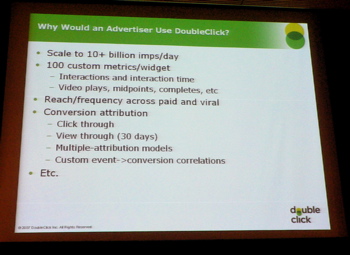
Doubleclick’s VP of rich media, Ari Paparo, says his firm is "enabling widget advertising." They’re helping advertisers take campaigns viral by putting elements like an "Ad to Google" or "Share" button in their ads. "We offer 100 different custom metrics per widget — the advertisers are demanding these."

Doubleclickwhy
Peanut Labs CEO, Murtaza Hussain, said his firm "helps widget companies monetize through market research."  With a Facebook app they designed, they allow people to earn money by taking surveys. They have 120 research clients, and an industry-leading 29% response rate.

Moderator Gur jumped back in to mention some other ways that people are looking at monetizing: "affiliate links, the iLike model, and using virtual currency." Then he popped  a good question to the panel: "How much are all widget companies now generating, in total, in the way of revenues?"  Are you ready for the answer to this one? "Maybe $1 million per month," said RockYou’s Tokuda, causing a collective yet silent gasp to go up from the crowd. "Those who try to get installs by themselves fail," he said. In the next breath, he said it works much better, of course, to get a firm like his to advertise for you, to get those installs.  The moderator pointed out that, when we talk monetization of widgets, the majority of revenues is very definitely now coming from advertising.  What were some ideas for future monetization, he asked?  Peanut Labs: "Premium models." Doubleclick: "It may sound boring, but commerce." RockYou: "Delivering games into social networks."

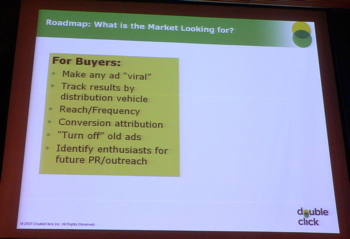
Next question: "Who are the first-mover types of advertisers in this space, and are they more brand focused or direct response?"  Doubleclickroadmap
Doubleclick’s Paparo jumped in: "Definitely brand advertisers," he said. "And we see the first-movers especially in the theatrical (movies) and auto categories."  Peanut Labs’ Hussain: "Any advertiser looking to understand the Gen Y demographic." He said his firm asks 16 demographic and psychographic questions of its survey respondents.

The moderator then asked: "What kinds of packages are you selling, with what metrics?" RockYou: "Most just want to know the clickthrough to their site — Dell, for example. We’re also seeing a preference for Facebook buys."  When asked what the going rate was for an install, Tokuda said anywhere from 50 cents to $1.00 is the CPI rate for RockYou. He said a blogger his company follows recently reported that RockYou is getting double what others are charging, which he obviously takes great pride in.

"Before a widget maker launches, what advice would you give him or her?" moderator Gur asked. Peanut Labs: "Do market research!" He also would advise looking at virtual currencies, "which are strong." Doublclick would recommend using just standard ad units. "Collecting demographic data is over-rated." RockYou said to get your page views maximized, and that the demographic of young girls is a great way to do that.  "How do you scale?" the moderator followed up.  "You’ll start with an ad network, then eventually go to a direct model," said Doubleclick. And what do you need to support ad sales?  "You’d need an ad server of your own. But you’re probably not going to go direct for a while.  I mean, if annual revenues in the whole widget industry is only $12 million right now, then it could only support 10 sales people!"  The moderator switched gears: "As your widget develops, what’s a good time to start advertising?" RockYou: "I’d say maybe one million impressions per day." At that point, he said, it could make you $1000 a day." Speaking of sales people, Peanut Labs said it’s stopped accepting more publishers because it doesn’t have the sales people to support them.

In the panel followup and audience Q&A session, moderator Saar Gur said he thinks the real business models for widgets are still three to five years out. Doubleclick’s Paparo offered up some more insight into the current advertising picture. "It’s no secret that banner ads on Facebook aren’t selling well right now," he said. "The successes of banner ads on social networks in general are fairly spotty."  But perhaps the most interesting comment he made was this last one:  "Ads can’t be widgets — they’re different things. That’s how a lot of the brands I’m talking to are thinking."

Widget Summit, Day 1: How Do We Measure ‘Em?

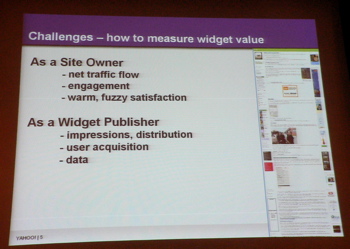
Ian Kennedy, product manager for MyBlogLog at Yahoo, was a great moderator for this panel on how to do audience measurement of widgets. The writeup of this session tantalized us with talk of new “engagement metrics” — though little new was revealed, despite the moderator’s atempts to drag something out of the panelists. Widgetmeasurement1
We did learn, however, from Jeff Gillis, that Google will drop us a piece of news on us Tuesday via his analytics blog — he said 12 pm, and that would appear to mean noon, since nothing’s there yet.

Hooman Radfar, founder of Clearspring, kicked things off with a commercial about his widget platform and distribution service. He said more than 75 brands are now using it, and “thousands of developers.”  He also said his is the only company that provides real-time metrics. Clearspring’s original engine was built with RockYou, said Radfar, “which is the largest widget provider in the world.”  He said a new metric Clearspring has is “placement,” so you can track the sites where your widget is appearing. Looking forward, Radfar said his firm will be at Launchpad in November to introduce its new “open platform.”

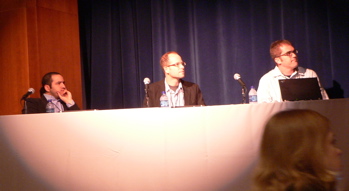
Introduced next was Eyal Magen, founder of Gigya, who said his widget distribution network is used by 7 of the top 10 widget sites, and that it’s only a “30-minute integration.” He said what’s new from his firm are “Widget Usage Reports.” Widgetmeasurementpanel

Google Analytics’ Jeff Gillis followed with his hint-hint, wink-wink, that he’d have news on his blog on Tuesday. (He couldn’t have dropped the news on us on Monday? The team must be working all night….) He said we could sign up for the beta with a secret code, only for attendees. (Yeah right — ask me if you want it.)

Moderator Kennedy popped the big question at this point, “What do each of you have for measuring interactions within a widget?” Stunned silence. Gillis rambled about how Urchin Tracker measures “15 dimensions.”  But what about interaction within the widget, Kennedy repeated, “like tracking which specific buttons users are clicking on.”  No, Gillis said, they’re not able to do that.  Clearspring’s Radfar saw an entry here to say “we have ‘interaction analytics’ coming out.” No word of when. He said they “won’t be dependent on Flash.” He also admitted there are other things as well that aren’t being measured yet, including “viral spread and most popular,” among others.

Are there any best practices yet, asked Kennedy, regarding placement of a widget on a site?  After all, “there’s a whole science of where best placement is in other media” — certainly for print, to name one. Google’s Gillis said it’s too early, but eye-travel studies (the so-called heat map) show an “F” pattern, which would suggest left-side placement as best. Gigya’s Magen said something to suggest that top placement might be good. Clearspring’s Radfar commented to just “keep it simple….people have a tendency to cram a whole web site in a widget.”  He also stressed a key point: that advertisers expect different metrics than publishers. Gillis said it’s “user-specific metrics” that many want.

“Where will we be in a year?” asked moderator Kennedy. “Will we have a definition of ‘engagement metrics’?” Google’s Gillis: “The term can mean many different things to different web sites.” Radfar: “A big issue will be how are you going to collect data in a non-intrusive way?”  Moderator Ian Kennedy closed the panel with a take of his own: “People will want to measure direct revenue and indirect revenue.”  Ah, the elusive monetization.  More on that later.

UPDATE (10/16, 10:30 am Pacific):  This just in, as promised — the latest Google Analytics news.  Now I know why they held it till today….there’s an eMetrics event in Washington, DC, where they’re making this multi-part announcement.


Minnedemo – Hot Damn!

Oh, was the joint a-jumpin’ Thursday night, gang. For those of you who weren’t there, that joint was O’Gara’s Garage in St. Paul. For those of you who were — lucky you (especially if you were smart enough to get there early). The crowd had to be 350 or 400 — it was basically shoulder-to-shoulder at its peak. Minnedemoogarasmichaellehmkuhl
The schmoozin’ was in high gear, the kegs were flowing (7 kinds!), and there wasn’t even any entertainment!  Well, I guess we were our own entertainment — and six of our community’s latest, hot startups got up on stage halfway into the evening to pitch their wares. [Photo of O’Gara’s courtesy of Minnedemo attendee Michael Lehmkuhl.]

Don’t let anyone tell you the Minnesota tech community isn’t hotter than a pistol! You could feel the energy, the entrepreneurial juices flowing.  You know we have something special going on here in Minnesota when you experience one of these BarCamp events (which we call Minnebar and Minnedemo) — and when you see how we keep attracting more and more of the important players from the community with every meeting.Minnedemocrowdstefanhartwig
And it’s not just the Twin Cities — we had people there from Sioux Falls, Fargo, St. Cloud, Wisconsin, and more.  [Photo of the crowd early-on courtesy of Minnedemo attendee Stefan Hartwig, of sponsor Electric Pulp — one of those dudes from Sioux Falls! Yes, this is the outfit Guy Kawasaki has made famous.]

What was the coolest thing I heard at the event? That was from Robert Stephens, the illustrious founder of Minnesota’s own Geek Squad (acquired by Best Buy in 2002). See my recent coverage of Robert being named MN Entrepreneur of the Year. And, yes, he was just interviewed on 60 Minutes, too! I had a great chat with Robert, during which I mentioned that I’d heard Best Buy was hosting an event that very day in Silicon Valley, just for VCs.  He said, yeah, that he was supposed to be speaking there. I asked why he wasn’t. "Because I’d rather be here. I really believe in the Minnesota tech community."  Now, is that freaking cool, or what?  Screw the Valley, he’s more interested in the action here! Robert is a major supporter of our state’s entrepreneurs — a hero in our midst, for sure.

What else really impressed me?  Well, besides the great startups that pitched and just the huge energy of our collective developer/entrepreneur/interactive/marketing community, I have to say that I continue to be really pumped about the quality of new players we keep drawing to these events. We had partners from at least two major VCs firms (and three more I knew really wanted to be there but had schedule conflicts), another from the largest "network of angel networks" in the country, an investment banker whom I know is currently raising a large chunk for a local startup, and more major, local angel investors than I’ve seen at any of our previous meetings. Yes, that’s right, the guy (or lady) you were standing next to could be one — so, don’t spill beer on ’em!  🙂  Seriously, they were there to catch the buzz on what’s new, who’s starting up what, and to schmooze with their colleagues about the latest deals circulating. [Unfortunately, some of the newer ones didn’t realize how noisy these gatherings get, and how hard it can be to hear the presenters, unless you move right up near the stage. But, hopefully they’ll follow up with individual entrepreneurs for one-on-ones — that’s really the intended outcome, anyway, for the startups pitching at these events.] And there were major dudes present as well from some of our state’s largest Internet-related businesses — trust me, I know these people! And I brokered at least two key introductions of local startups to some of these guys. They definitely wanted to know more about some of the technologies pitched. And, there’s more — we even had an NBA player, formerly of the Timberwolves (and a serious geek), in our midst! Not to forget our local media people — I know the Business Journal was present. Not sure if the Trib or the Pioneer Press made it (I was just too busy to see everyone I wanted to).  And, you just know that Minnesota’s best and brightest tech bloggers were there — Steve Borsch, Ed Kohler, Ben Higginbotham, and….well, you know. And so many of the developer attendees have great blogs of their own as well!  (See the links in the list of attendees on the Minnedemo site for those.)

So, who were the startup founders that pitched?  Well, it was an awesome combination of really smart developers, serial entrepreneurs, a major ad-agency producer, a female entrepreneur with a company just coming out of stealth, even a former Silicon Valley researcher that holds a patent on the technology he was pitching.  Minnedemoadaptiveave
People, you would be amazed if you drilled into the backgrounds of these folks — I can say that because I know many of them. There was a huge amount of experience and expertise represented on that stage on Thursday night — a proud moment for Minnesota entrepreneurship. Here’s a quick rundown on who got 10 minutes each to pitch to this raucous crowd:

•CrashPlan (Matthew Dornquast) – a virtual appliance for automatic, off-site backup
•FanChatter (Marty Wetherall) – mobile sports fan chat, photos, more (see news release)
•SOTAcomm (Gary Doan) – plug-and-play appliances integrating best-of-breed open-source "unified communications" apps for running a small business
•Wonderfile (David Carnes) – tag-based file management and collaboration
•Pokeware (Maryse Thomas) – monetizing video streams by giving consumers extensive access to products and information within them (see news release)
•Adaptive Avenue (David Quimby) – distributed commerce, "site within a banner," enabling a whole new category of clicks ("engagement" clicks)

[Photo of David Quimby presenting courtesy of Ben Wallace.]

But did you think we only have six startups here in Minnesota worthy of presenting?  Wrong, bucko! There were sixteen more — count ’em, 16!! — who were stacked up on the waiting list in case someone dropped out. They’re definitely worth a look, too….and they’re all listed here on the Minnedemo site, with links so you can learn more.

Remember to say thank you! (My daddy taught me that!) What an awesome event — and we owe it all to the event co-organizers, who donate a huge amount of their time to these things: developers Dan Grigsby, a successful entrepreneur who really knows how to give back to the community, and Luke Francl, a developer at local hot shop Slantwise Design. And the sponsors who pay the freight to make these events happen. We love ’em!  Read about ’em and support ’em. They keep coming back, too — all are repeat sponsors:
•Kinetic Data
•Split Rock Partners
•New Counsel
•ipHouse
•Electric Pulp

What’s the takeaway? Minnesota’s startup and Internet community is a one exciting place to be! You like it here, and I know the vast majority of you want to stay here. I’m proud to be a part of the community, and each and every one of you out there should be, too. It’s great to know that if you can work hard, think big, and make good stuff that improves people’s lives or work, or just helps them have more fun online — whatever! — that you can make a real contribution to our economy, and advance your own lot in life as well.

I can’t wait for our next Minnedemo or Minnebar event.  Meantime, keep building on the energy…and keep on networking!  🙂

Compellent: Three Guys in a Basement to an IPO

Ever wonder how a tech startup gets from a standing start to an IPO in just five years?  Well, it doesn’t often happen that quickly — or easily(!).  But we actually have quite a strong history here in Minnesota of tech firms that start as just an idea and go on to become big industry players in a relatively short period of time. Going back a ways, my former employers Control Data and Medtronic certainly come to mind. A more recent example would be e-commerce industry infrastructure leader Digital River, now heading for a billion dollars in annual revenue.

Compellenthomepage
Compellent is another Minnesota technology firm that now appears to have an exciting future ahead of it — as a public company, starting yesterday. The founding team is certainly not new to this game — well, the fast-growth part of it, anyway, if not the going-public part.  Compellent is also just the latest in a long string of data storage companies in Minnesota — going back to Control Data in the ’60s, and Seagate, which has had a presence here almost as long as well. (Seagate still employs more than 3000 in the state, and builds its thin-film heads just a few miles from where I sit). IBM’s Rochester, MN facility has long been a center of disk-drive innovation (though Hitachi acquired that business from IBM in recent years). In addition, there are several other storage-industry players of significant size that had their beginnings in these parts: VTC Inc. in disk-drive chips (acquired in ’99 by Lucent/Agere, and now part of LSI Logic)…Hutchinson Technology in disk-drive suspension assemblies (still here, and a public company)….OnTrack Data in data recovery (now part of Kroll, but still here)…Qlogic in SAN switches, which acquired MN firm Ancor Communications (still here)….Imation in optical and tape media….and Veritas (acquired by Symantec) in backup software, still with an office of 500+ people in Roseville, MN.  And that’s just to name a few — I’ll cover another one, Xiotech, below.

We like storage here in Minnesota! It’s like the Energizer bunny…it just keeps going and going, growing and growing!

The Path of Minnesota’s Newest Up-and-Coming Storage Startup
I’ve known many people who are now at Compellent going back several years, and I had an opportunity to meet Phil Soran, the CEO and one the three cofounders, in about 2003, a year after Compellent opened shop — to develop a new, simpler kind of storage networking harware and software system. One of my colleagues at a company where I was serving in an interim role as VP Marketing at that time (which was also a storage-related startup) had worked with Phil at IBM earlier in their careers.  I also know the VC firm that co-led the original round of funding for Compellent in 2002, Crescendo Ventures (with offices in Palo Alto, Minneapolis, and London). So, with that background, I’m going to tell you what I know about the story of how these guys — the three serial-entrepreneur founders of Compellent, who were just working in a basement in 2002 — got to where they are today, a public company with a market cap now hovering somewhere around $1 billion. I think you’ll find it interesting.

Back in the mid-’90s, Phil co-founded Xiotech with John Guider and Larry Aszmann. John and Larry had both previously been executives at Tricord Systems — John was the co-founder and CTO, and Larry was the Director of Intelligent I/O Subsystems at Tricord.  The folks at Crescendo Ventures knew John and Larry from Tricord — where Investment Advisers Inc. (IAI), Crescendo’s former parent company, was the largest shareholder. When they moved on from Tricord, Guider and Aszmann teamed up with Phil Soran to found Xiotech, which developed a storage hub product to alleviate many of the I/O bottlenecks that kept disk-drive performance from keeping up with advances being made in CPU speeds and disk capacity. Xiotech pioneered the concept of virtualization in server utilization, which was very, very forward thinking at the time. The company enjoyed early commercial success before agreeing to be acquired by Seagate Technologies in late 1999 for $360 million. Based on the forward-looking vision and hard work of the Xiotech team, its investors did very well. I know that Crescendo Ventures achieved a return of nearly 11x its investment in less than three years. And the success of Xiotech really helped to re-establish the Twin Cities as one of the country’s leading storage technology centers.

After Phil and his team left Seagate, they wanted to start another company and approached Crescendo about providing first-round funding. Not surprisingly, Crescendo found it very easy to reach a decision to invest in the team again. They had seen Larry, John, and Phil in action before and knew that they had both an exciting vision for the new company, as well as the experience and operational chops to turn the vision for Compellent into a reality.  Over the years, Crescendo Ventures has worked with a number of entrepreneurs who have started multiple companies. Such serial entrepreneurs benefit from a unique blend of start-up experience, grassroots pragmatism, and ambition to do something bigger and better than what they have done before. For all these reasons, as Crescendo tells the story, they were eager to work with Phil, Larry, and John again as they embarked on their second Minnesota storage startup.

What’s Compellent’s unique approach to storage? Here’s how investor site The Motley Fool recently put it:

Compellent develops storage solutions targeted for
small-to-medium-sized enterprises (SMEs). To attack this prickly
market, the company has focused on affordability, ease of use, and
minimal maintenance.

So far, the formula is working nicely. As of the first half of 2007,
revenue doubled to $20.9 million and there are more than 600 customers,
which include Munder Capital Management, Rivals.com, and even the FBI….

…Compellent does have one compelling aspect to its technology: a simple point-and-click interface. In the age of Amazon.com and Facebook, this may seem like a no-brainer, but it’s hardly common
in the complex world of storage. That gives Compellent one important
differentiation…

So, what role did Compellent’s lead VC firm play in the company’s early years? Crescendo Ventures not only enabled the firm to grow quickly and build a strong market presence, by providing the company with its initial funding (they co-lead the Series A with El Dorado Ventures). It has also been active at the board level since the beginning, and, as good VC firms always do, has engaged its entire team to add value for Compellent. Over the five years since the founding, at least three different Crescendo Partners have been actively involved as directors. Jeff Hinck (now with Vesbridge Partners) led Crescendo’s investment in Compellent (with Charles Beeler of El Dorado ventures), and provided valuable support in the company’s early days. More recently, Crescendo’s Jeff Tollefson (Minneapolis based) and David Spreng (Palo Alto based) have also served as Compellent directors.

Is an IPO an End or a Beginning?
So, now, we have a new public tech company in Minnesota — something our technology community can and should be very proud of (specially how it performed on opening day!).  I suspect, however, that both the founders and their VC backers are not stopping long to pat themselves on the back.  The real work, the real growth starts now.  But, what’s next for Crescendo Ventures, the Minneapolis-born VC firm that still has close ties to its hometown. They tell me they remain very interested in Minnesota and are actively seeking new early-stage investments here. Though most of the firm’s people are based in Palo  Alto, two of its five partners are Minnesotans, along with other professional staff who are from the state.  And I know for a fact that the firm always says it has a soft spot for exciting projects in the Twin Cities!

Stay tuned for more about Compellent, as its growth story plays out this year and beyond, and also for more about how Crescendo Ventures intends to continue to help build growth companies in our state. [Note: I’m proud to say that Crescendo has been a client of mine from time to time, even going back some 17 or 18 years if you count when I first worked with their original parent firm, IAI.]

UPDATE (10/14): To add some clarification.

« Older posts Newer posts »