I’m off on an adventure tomorrow morning, flying to San Diego again, this time for the O’Reilly Emerging Technology Conference, where I’ll be reporting for Conferenza and posting to this blog. I’m looking forward to running into some old friends, and to an exciting program. The “magic” theme this year should be fascinating, based on the descriptions of some sessions I’ve highlighted below.

What technologies are “poised to blast off into the realm of magic?” O’Reilly asks, as it launches its sixth annual eTech event. [It will be the third one I’ve reported on, by the way.] The goal is to “balance pie-in-the-sky theorizing with practical, real-world information and conversation,” says the firm. The format consists of tutorials, breakout sessions, keynotes, and that most revered form of interaction — hallway conversations! — which “will hopefully spark enough unconventional thinking to change how you see your world.” 
The dates are Monday, March 26 through Thursday, March 29, and the venue is the Manchester Grand Hyatt right on the harbor in downtown San Diego. The promise, says O’Reilly, is for you to be able to learn which areas of technology have sufficiently advanced to the level of magic. So, I’m joining more than 1200 technologists, CTOs, hackers, researchers, thinkers, strategists, entrepreneurs, business developers, and VCs that are expected to participate in this year’s event. 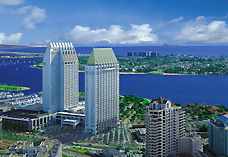 I know from years past that the attendees at eTech are top notch — many leading developers, trendsetters, founders, and VCs (definitely a lot names you’d recognize). The strength of eTech, according to O’Reilly, is how it “taps into the creative spirit of all attendees, sparking provocative encounters and productive inspiration that continue long after the conference ends” — and I agree based on personal experience. In addition to the variety of sessions and extra-curricular activities, eTech has an exhibit hall featuring a focused group of about 14 exhibitors and sponsors.
eTech Sessions That Especially Sound Good
So, what are some the talks I’ve flagged out? On the first full day, Tuesday, I plan to catch as many of these as I can (some overlap each other, unfortunately):
• Building a “Web-Scale Computing” Architecture to Meet the Variable Demands of Today’s Business (Amazon Web Services)
• Making Offline Web Applications a Reality (Zimbra)
• Movie Magic: Coming Soon to the Real World Near You (Apple Computer)
• Flickr for Office Docs – Content Syndication through ThinkFree Doc Exchange
• RSS Beyond Blogging – Connecting Applications With Feeds (nSoftware)
• Digital Disney: the Mainstreaming of Web 2.0
• Successful Open Communities on the Internet (Wikia)
• Extreme Productivity in the Enterprise: The User is the Developer is the User (BEA)
• The Myths of Innovation
• Virtualizing the Datacenter with Project Blackbox (Sun)
Then, on Wednesday, we start getting heavier into that magic thing:
• The Coming Age of Magic (ThingM) – Excerpt: “The desktop metaphor is dead … Interaction design is significantly trailing the capabilities of the technology because of how difficult it is to explain what all this new stuff does … The desktop metaphor was useful for twenty years as a way to structure and explain information-processing technology. I propose “magic” as a metaphor for structuring interactions with embedded information processing technology …”
• The Role of Ubiquitous Web 2.0 Technologies in Everyday Life (Danah Boyd) – Excerpt: “While the ‘radical’ practices of young people and the organizational fetishes of technologists are certainly a curiosity to be examined, the real shift is happening in the lives of everyday people without an ounce of reflexivity …”
• Patterns: From Fabrics to Fabrication – Excerpt: “Today, the re-emergence of craft is part of the DIY movement that is discovering new tools for personal fabrication.
And here’s my vote for best named session:
• Scalability: Set Amazon’s Servers on Fire, Not Yours (SmugMug) – Excerpt: “With companies like SmugMug, Flickr, and YouTube growing by leaps and bounds, storage is a vital but expensive ingredient. Building, scaling, and managing large storage installations is cash — and labor –intensive. Amazon provides a simple API that exposes their internal storage architecture at utility prices. Suddenly, anything is possible. Unlimited, always-on storage everywhere in the world.”
• Sufficiently Advanced Magic (MIT Media Lab) – Excerpt: “…magicians and scientists often play on the same borders of the unknown. Magicians, however, do not have to kowtow to the constraints of reality as technologists do … If technology is man’s search to express control over his environment, scientists should look to magicians for inspiration and guidance as to what has engaged people for millennia … they continue to be successful by adapting their techniques and presentations in order to affect people profoundly.”
• Engaging with Web 2.0 Outside the Browser (Adobe) – Excerpt: “Web 2.0 is more than a social networking phenomenon. It’s a renaissance in web development … Rich Internet applications (RIAs), which break out from the traditional page-based web paradigm and currently run in the web browser, will soon be able to run on the desktop, both on and offline, with the ability to access local data and use web services to present an integrated and unique user experience … best practices and techniques that leverage existing web development skills to build and deploy Web 2.0 applications that bridge the Web and desktop … a new application model for content delivery and collaboration … how HTML, JavaScript, PDF, and Flash are coming together in a new project, code-named Apollo.”
• Pipes: A Tool for Remixing the Web (Yahoo!) – Excerpt: “Developers can use Pipes to combine data sources and user input into mashups without having to write code.”
• Web Scale Computing (Amazon Web Services) – Excerpt: “Web 2.0 business models are about competing on ideas, not on resources. Yet over 70% of most startup development effort goes into undifferentiated “heavy lifting”! … Using AWS, developers can build software applications leveraging the same robust, scalable, and reliable technology that powers Amazon’s retail business … 200,000 developers have registered on Amazon’s developer site to create applications based on these services.”
• Ajax Unplugged: Architecture and Tips for Taking Your Applications Offline (Zimbra) – Excerpt: “Looking back, 2006 may have been the year of Ajax … But despite its game-changing hype, Ajax is limited in its usefulness, it only helps people when connected to the Web. Surprisingly enough, people want access to their applications even when they aren’t connected to the Internet …”
And…drum roll…my vote for the funnest sounding session at eTech:
• 1/2 Baked (panel: 500 Hats, Feedburner, First Round Capital, August Capital) – Excerpt: “Half-Baked Dot Com is a participatory exercise in entrepreneurial improv theatre conducted by five teams of startup addicts and judged by an estranged panel of venture capitalists…or several crackpots and D-list bloggers, whomever shows up first … Half-Baked is the latest Web 2.0 craze that’s sweeping the un-conference circuit. Show up early and bring your A-game if you’d like to participate, otherwise bring your camera to record the heinous crime perpetrated on an audience who paid good money to attend this event.”
Finally, on Thursday, I’m seeing several more sessions that I’d like to catch — if I can hang around that long before hittin’ the waves:
• Apollo: Bringing Rich Internet Applications to the Desktop (Adobe)
• Silicon is Invading Medicine (Andy Kessler)
• Lessons Learned in Scaling and Building Social Systems (Yahoo!)
• Web 20-20: Architectural Patterns and Models for the New Internet (Adobe)
• Your Web App as a Text Adventure (Stikkit)
• Web Feed Workflows – Getting the Right Information, to the Right People at the Right Time (Attensa)
Let me know your thoughts about the sessions above, questions you’d like answered, etc. Watch for my blog posts and Flickr pix, too. And, by all means, if you’ll be at eTech yourself, please look me up!

 Richard MacManus published his take earlier, then followed with this one that includes my thoughts and those of two other writers that contribute to R/WW and happened to be at the event.

 Lots of great questions and input from several people. I’m convinced that promoting Minnebar on the GetGo site contributed to the record attendance. The biggest turnout yet for a BarCamp in this country! Yeeeee-haww!!!
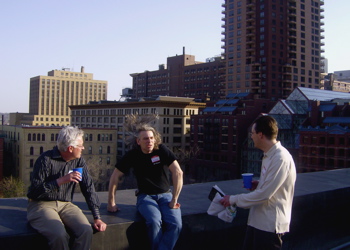 Photo: Beers on the roof with event sponsors John Roberts (left) and Harold Slawik (right) of New Counsel plc, and Bill McLeslie of ipHouse. The event wi-fi was awesome — Bill hooked us up with 7 megabits of bandwidth. Gorgeous day in the Twin Cities — the high hit 83 F!
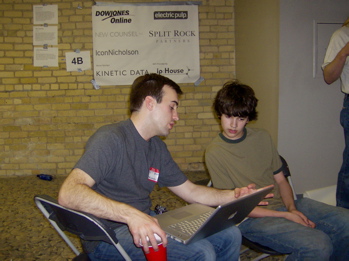 My favorite photo at the event: We start ’em young here in MN. Matt Bauer, ace developer just recruited to MotionBox in NYC (but he didn’t have to move!), shows a developer-in-training how it’s done. Matt had just finished his session on Adobe Flex.
 But I was able to bop right into one session before lunch: “Open Source Business Models for Web2.0.” John Roberts, CEO and cofounder of SugarCRM, told us about the non-traditional way his company started: really as a project, then it wasn’t incorporated for almost two years. Funding came even later. “Companies are starting differently these days,” he said. Now, SugarCRM has 100+ employees, 1200 customers in 30 countries, 100,000 users, and 7000 registered developers. How are they 2.0? “We sell subscriptions, not licenses,” he said. “And, as Tim O’Reilly would define it, we trust our users as co-developers.”
Recent Comments