Reflections & analysis about innovation, technology, startups, investing, healthcare, and more .... with a focus on Minnesota, Land of 10,000 Lakes. Blogging continuously since 2005.

Category: Venture Capital/M&A/Angels (Page 51 of 54)

Flyspy Goes to School

This is a story about how a Minnesota startup utilized one of our great local institutions of higher learning to enhance its business plan and leverage its future. But, what started out as a post limited to that has turned into…well, kinda the whole life story of this startup, going back a few years, and the background of its fascinating founder, Robert Metcalf. [No, not that one, as TechCrunch likes to say.] It’s maybe my longest post ever, but I think you’ll like it.

I first met our homegrown Robert Metcalf, founder of Flyspy, back in May of this year. His company is a new breed of airfare search site that changes the game. (See the sample chart.) Flyspylogo_1 I’d read the original TechCrunch blog post about Robert and his firm, and a followup they did a few months later, and I couldn’t believe Robert and I were located so close by and hadn’t yet met. Within a few days, we did meet, and I was immediately impressed, both with him and the fledgling company. As pure Internet startups go, this looked like one of the most exciting I’d seen in these parts in a long, long time. Certainly since the early ‘Net days of 1995, when I first met J.J. and Jeremy Allaire of Allaire Corp. fame. This harked me back to those days. Pure, unadultered Internet moxie and adrenaline. Samplechart And on top of that, with Flyspy, I was able to immediately identify with what it could do for me personally as well. How many startups have an immediate bond with consumers like that?


So, what I decided to do was interview Robert about his experience with Flyspy being a case study for a recent MBA class at the University of Minnesota’s Carlson School of Management. This was after he’d let me sit in on the final class session to hear the presentations of the ten teams. But I wanted the interview to provide background information, too, so I asked him a broad set of questions. Ready for the definitive lowdown on this exciting, new, Minnesota-grown startup? It’s fitting to launch this post on the same day that Robert will be demoing Flyspy at MinneDemo. Here we go….

Tech~Surf~Blog: Robert, first please tell us about your previous experience in the technology community here in Minnesota, prior to your founding of Flyspy.com.

Metcalf: My technology experience goes back to the 1970s. During high school, in Northfield, Minnesota, I regularly took math and computer courses at Carleton College. That’s when I got hooked. I’ve always been intellectually curious, especially around the rigor of software development – defining a problem, working on it, understanding the nuances of “systems,” working on tough problems that a lot of people might give up before solving, and finally producing a tangible piece of work that others can use and enjoy.

For the first part of the 1990s, I did Fortune-50 consulting work. My clients were in California, Iowa, New York City, and Texas, and I was on the road 50 weeks a year. In November 1993, I met with Ed McCracken (CEO of Silicon Graphics) and we talked about the emerging Internet and the impact of a networked society. By the end of the year, I had stopped all consulting work and formed an Internet company, Internet Broadcasting Corporation, here in Minneapolis. [Ed.: Not Internet Broadcasting System, or IBS, based in Mendota Heights, MN.] At first, we developed web sites and then later moved into developing e-commerce sites and Internet applications.

During this time, Silicon Valley held a great allure for me. If you were in the Internet or technology business in the 1990s, then Silicon Valley was, in my opinion, the center of the universe. In 1999, I took a job as a CTO for a startup company in San Francisco. That company was sold to a firm in Los Angeles in 2001. I returned to Minneapolis in 2002 and worked with a group of friends that I’ve always wanted to work with. That company was based in Austin, Texas, but had a St. Paul office. Late in 2002, all development was consolidated in Austin, putting five of us out of work. From 2003 until now I’ve either worked on Flyspy or done consulting work to support Flyspy.

Tech~Surf~Blog: How did Flyspy come about?

Metcalf: In 2003, I went to visit my brother in Williamsport, PA. Williamsport is in the middle of the state and there are 10 or 12 airports you can fly into. No matter which airport you choose, the total travel time is about the same – non-stop and a car trip vs. a one-stop and long layovers. I spent about eight hours researching various date, city, and airline combinations. At some point, my head was swimming from all of the data I encountered. I started to record salient data points in Excel in order to understand the combinatorial explosion problem (multiple departure dates X multiple return dates X multiple web sites X multiple connections, etc.)

That got me to thinking… “Why was this search process so difficult and time-consuming when can I find almost anything with Amazon or Google in a few seconds?”

My intellectual curiosity got the best of me. I decided to spend a weekend researching the problem. After all, how hard could it be to figure out where airfares come from and why the process was so slow? That research turned into nine months of 10-hour days! What I found was an incredibly complex system of players and processes and relationships. It was, and is, easily the most complex industry I’ve encountered.

One day I woke up and understood how the entire system worked. My intellectual curiosity had been satisfied. I had the answer to my question and I knew why the airfare search process was so slow. That day also coincided with getting back to consulting work in order to pay the bills.

Within a few months, my mind went back to working on the problem. I knew what the problem was, and having the skills to devise a solution, I gave up consulting and went back to working on Flyspy for another nine months. At this point I’m almost two years into the process and no one was seen anything. Only a few friends knew what I was up to.

In 2005, I started to show Flyspy to close friends and slowly expanded it out from there. My initial solution was totally wrong, as were the second and third solutions. None was a sustainable business. Iterating through three solutions took about 15 months. The difficult part wasn’t the technology, although that was really, really hard. It was removing a piece of the airline industry puzzle, crafting a solution that no one else had thought about, and replacing the puzzle piece. Everything I touched had to remain the same while the internal workings all changed.

During this time, almost 40 months since I’d started, most friends told me to give Flyspy up and move on to something else. They figured that if the industry hadn’t changed in 30 years, and I hadn’t found a solution in 40 months, then there was no solution. Basically, thousands of others must have thought of this, and worked on it, to no avail.

In February 2006, I was at the end of my wits. I never thought I’d solve the Flyspy puzzle. In order to get my creative juices going again I decided to attend a gathering called “MashUp Camp” in Silicon Valley. My goal was to expose myself, not Flyspy, to a broader audience of people on the cutting edge of technology. I thought that being around them would stir something inside.

MashUp Camp was held on a Monday and Tuesday. On the Sunday evening prior to the event, an informal group of 20-30 participants gathered to drink beer, eat pizza, and show what each other had been working on. Most of the group knew each other, so I felt a bit like an outsider. The group gathered around a big table with a projector. They took turns hooking up their laptops and showing “mash up” applications like WiFi locations overlaid on Google maps, or eBay items alongside Amazon search results for the same product. There was lively discussion around each application.

At the end of the evening, when it appeared that everyone who was going to present had presented, someone asked if there was anything else someone wanted to show. I raised my hand and told them I had developed a new type of airfare search engine, which brought blank stares. I borrowed someone’s laptop and showed Flyspy. I talked for about five minutes and not once did anyone utter even so much as a peep. I felt like no one liked it, because every other showing had prompted a good round of conversation. At the end of showing Flyspy, someone started to clap, and then another joined in, and soon the entire room was in applause.

Someone standing in the back of the room asked if they could include the web site URL in their blog. I told him no if it was going to draw a lot of traffic. Everyone but me snickered. That person was Nik Cubrilovic, who was writing for TechCrunch. I was the only one in the room that had never heard of Nik or TechCrunch. I would later find out that a single mention in TechCrunch would bring 100,000 users to a site in a few hours, resulting in a meltdown. At that point, Flyspy was running a single server that was years old and any type of traffic would have taken the server down.

When I walked into the conference on Monday morning, I was surrounded by people congratulating me. Others wanted their picture taken with me, saying I had created a disruptive power within a billion-dollar industry. I had no idea what they were talking about. It wasn’t until I checked email that I realized that Flyspy was the main article on TechCrunch.

MashUp Camp was about creating applications from other applications. Even though Flyspy isn’t a mashup per se, it took third place in the voting. All day Monday and Tuesday, I was swamped with demo requests and interviews. When I flew back on Tuesday night, I knew I had been rejuvenated and threw everything I had into bringing Flyspy to market.

Tech~Surf~Blog: Could you summarize the current state of your business – where are you with financing, business model definition, timing for your formal beta launch, etc?

Metcalf: Flyspy has been self-financed to date. Recently, I’ve had two written offers and one verbal offer for funding. One offer was the wrong type of partnership. Another required moving to California. The jury is still out on the verbal offer.

As a result of the recent PR, a number of VCs have contacted me. Many assume that the business is fairly well developed — i.e., a management team in place, prior round of funding, developer’s implementing more airlines, cities, and features, industry expertise on-board, and someone orchestrating a PR campaign. They are a bit dismayed when they find out that Flyspy is the result of one individual with determination. Most (but not all) ask to be contacted when the aforementioned milestones are met.

On the surface, the business model is very straightforward – a combination of advertising and affiliate, or commission, fees. You’ll see this on almost every web site. What you don’t see are the various ways to monetize Flyspy through strategic relationships and various forms of business-to-business offerings.

Early on, when I was researching and developing Flyspy, I had the advantage of being an industry outsider. I then went through a period of time where I realized being an outsider was a disadvantage, because I didn’t know all of the ways to derive revenue from the business model. Only recently have I found out that our business model is fairly unique within the industry, as we’re able to leverage data in ways most people have not thought of. It’s a rich offering and most investors smile when they see all of the ways to bring in revenue. But we could run the business and be profitable if we just stick to advertising and affiliate fees.

As far as launch timing, the first, alpha version of the site has a single airline (Northwest) and routes from Minneapolis fanning out to 50 cities. I consider this “proof of concept,” providing some validation in the marketplace. The next version — I’m not sure if we’ll even call it a beta version — will include at least a dozen airlines and many more origination cities. I would want to see this next version launched by October 1, 2006. It requires a complete overhaul of the base architecture and the serving platform — a lot of work.

The version after that will be a major release. We’ll try to coincide that release with a large PR campaign to create general awareness of Flyspy in the market. The timing of this product release will depend on how fast we can form relationships and monetize all aspects of Flyspy. I would like to roll out a new feature every 6-8 weeks. You can assume from this quick-release schedule that we’ll incrementally update the site instead of waiting for major releases. I view Flyspy as an Internet-based application that’s updated regularly.

In regard to the first, proof-of-concept version of Flyspy, these are typically throw-away systems that you want to learn from, not implement as a production system. The system is being re-written from scratch to deal with scaling issues and data integrity. Going from one airline and one city to multiple airlines and multiple cities is a difficult issue. One false step and a wave of traffic will take the system down.

Tech~Surf~Blog: Where are you with respect to your decision to locate Flyspy in Minnesota or Silicon Valley?

Metcalf: I live in Minneapolis and I’d like to see Flyspy succeed here because it seems that we have so very few successful Internet companies here (relative to Silicon Valley, Austin, and Boston). This area is due for another big “win,” and it’s my hope that Flyspy can be a catalyst that launches another 100 wins from this area. It’s not ego-driven at all. I’d like to see talent stay here instead of migrating to Chicago or either coast. After all, the Twin Cities has historically been very instrumental in the computing business. I’d like to see some of that come back.

I’ve lived in San Francisco, and my mother and sister currently live in Silicon Valley. So the allure of that area is strong personally and professionally. I like the energy, the abundant talent pool, and the startups that emerge from the primordial ooze we call technology. I think we could create a slice of Silicon Valley here in the Twin Cities, but we first have to want it, not just wish for it. It won’t occur without someone or something kick-starting the process. I wish I could be that person, but I’m not charismatic enough to lead that parade. Maybe Flyspy will be successful and be a part of this change.

Tech~Surf~Blog: Please tell us a bit about your market exposure so far – you mentioned your participation in the key conference early this year, but what about the media attention you’ve had to date?

Metcalf: Yes, the first exposure was MashUp Camp, and the TechCrunch piece resulted from that. If you had Googled ‘Flyspy’ prior to MashUp Camp, you’d have found maybe 50 references. Three days after MashUp Camp and that first blog post, there were more than 140,000 links to Flyspy. I took that as market validation that Flyspy could solve a pain-point for many, if not millions, of users.

There are about 300,000,000 people that fly in the U.S. every year – that’s 820,000 people every day, 365 days a year. If you’re like me, you look at flights and fares at least three times before you buy a ticket. Let’s say that two million people look for flights and fares every day. My inexact market research says that people spend about 30 minutes on the process, but it’s only five minutes if you use Flyspy. If you can save even a fraction of those two million people some time, then you’ve solved a really big problem for a lot of people.

The next “major” mention of Flyspy was in the July 2006 issue of Fast Company. I had no idea this blurb was going to run. I was sitting on the sofa reading the issue when I saw an article about new sites for finding airfares. I was stunned when I saw Flyspy named, because they’d never contacted me. Incidentally, after every mention of Flyspy in a popular blog, a magazine, a podcast, or an online article, the number of emails that I receive goes right through the roof.

Wired.com just ran an article about Flyspy and another new site, Farecast, on Friday, August 18. I must have received at least 500 emails that day. There were another 200-300 that came in over the next week. Tom Peters (author of In Search of Excellence) also picked up the article and featured it on his web site.

On Friday, August 25, Information Week ran an article about new methods of finding airfares. And once again the number of emails I received went through the roof.

I’ve also had interview requests from the NY Times, Fortune Magazine, USA Today, the Washington Post, the Dallas Morning News, and Modern Bride. I’ve put these off until a more mature version of Flyspy is ready for a larger audience – that is, more than just Minneapolis to 50 cities on Northwest Airlines.

As far as upcoming events for Flyspy, in September I’ll be teaching an MBA course at Pepperdine University in Los Angeles – Malibu actually – with a colleague from Minnesota who took a faculty position there. Most MBA courses are organized around the “case study” approach. The one for this course will be how to leverage Flyspy and create new ways to monetizing traffic and data. In mid-October, I’ll be presenting Flyspy at The Collaborative’s 20th Annual Venture Finance Conference. Then, in November, I’m speaking at one of the largest annual travel conferences in the country, which is being held in Los Angeles.

All of this publicity is well appreciated, but it seems a bit premature. I can’t fault all the media interest, because Flyspy truly seems to connect with people, and therefore should be in the public eye. I had always hoped for a rush of PR right around a major launch point when I would be able to capitalize on the traffic and keep customers coming back. But with limited airlines and cities at this point, the “come on back” factor is low.

Tech~Surf~Blog: What level of consumer traffic are you expecting when you launch your beta site, based on the continuing publicity you’re likely to get? What is it about Flyspy that really seems to resonate with consumers?

Metcalf: As far as traffic, you can segment travel sites into one of two major categories: “the big three” (Expedia, Orbitz, and Travelocity), and everyone else. Traffic for the big three is huge. They all rank within the top-50 web sites in terms of visitors per month. I realistically don’t think Flyspy will have that type of traffic. I suspect that, within a year of launching, we’ll be in the middle or middle-to-top range of the second tier of travel web sites. Other players (and I tend to stay away from the term competitor) in that tier are Farecast, Kayak, Sidestep, and Yahoo Travel.

I don’t like the term “competitor” because each site addresses a different market niche or target audience. The big three try to be everything to everyone: good at most things, but not great at any one of them. Kayak is the best aggregator out there, period. It’s perfect if you want a large number of options and some certainty that you’ve seen every option available. Of course, it’ll take you quite a bit of time to wade through the results and look at various date combinations. Farecast answers the question, “Do I buy now or wait?” If that’s your question, then Farecast is your site. Flyspy just wants to answer the question “What are my options?” – letting you understand the market for airfares in a few minutes. I think we serve a large segment of the flying population, but I’m also realistic enough to realize that, if you don’t like charts, then Flyspy may not be for you – unless you just want results faster than any other web site. Our goal is to get people through the research phase in a few minutes, versus 30 minutes or so with almost every other option.

I also tend to stay away from categorizing Flyspy as a travel site. We’re a search engine that does airfares (cars and hotels later) — better than anyone else. We’re a vertical search engine and we’re the fastest one out there. No one matches us on breadth of data and speed. Think one of the “big three” mated with Google.

I’ve come to realize that Flyspy really does resonate with people. I think there are a number of reasons why people feel so strongly about Flyspy. A marketing consultant from McKinsey told me it was one of the five best brands she’d ever seen. There’s something about the name “Flyspy” and the logo/icon that attracts people. In a way, it reminds me of the Jolly Green Giant – cartoonish, loveable, good name, good brand recall. In an era where most travel sites are big and corporate and serious, Flyspy is light, whimsical, easy-to-use, refreshing, and blazingly fast. It’s a counterpoint to a large, bureaucratic travel agency. And that may be the reason the airlines and larger travel agencies just don’t “get it.” But most people root for the underdog.

The one thing people like about Flyspy that I never saw coming is the benefit I call “no buyer’s remorse.” That is, it eliminates the feeling of “I could have found a better flight/fare if I only had another 20 minutes.” With Flyspy, people are satisfied with their purchase because they knew all the options and made an intelligent decision. Every other site leaves you feeling like you missed something — you just don’t know what you missed. And those feelings, in my opinion, are accentuated with the information overload we have today with the Internet.

Here are some quotes from others that say it better than I can:
• “I’ve been using the Flyspy alpha site to research flights and fares for some time now, and can’t fathom going back to any other site.”
• “It has the mark of a great entrepreneurial idea – something that you don’t know how much you need until you have it, and then you can’t live without it – and it’s such a simple concept.”

One goal that has always been in the back of my mind is to reverse the Pareto Principle (also known as the 80/20 rule) when searching for flights and fares. It appears to me that, when you use Expedia, Orbitz, or Travelocity, you spend 80% of the time searching and 20% of the time making sense of the search results. My goal was to that people would spend 20% of the time searching and apply the remaining 80% to understanding the market and their options. Since searching is time-consuming and analyzing is fairly quick, by dropping search from 80% to 20% you would dramatically speed up the overall process. Hopefully, I’ve come close. I think users feel that their use of time is different with Flyspy, and that resonates with people in a positive way.

Tech~Surf~Blog: Getting back to the main topic of this blog post – how did your participation in this Carlson School MBA class competition come about? What type of class was it, and what kinds of students did it attract?

Metcalf: Well, let me tell the story of how I found an expert in my own backyard. A few years ago, when I was researching Flyspy, I wanted to understand the affects of market transparency. How did it affect pricing? Who benefited and who was hurt? What was the difference between price transparency and product transparency? Specifically, I needed to know if market transparency had a downward-spiraling affect on pricing. If it did, then I was in for a pretty rough ride gaining acceptance from the airlines.

I found an individual, Nelson Granados, who is an expert in market transparency in electronic markets. He happened to live two miles from me and was completing his Ph.D. at the University of Minnesota. Nelson has a Ph.D. in Information and Decision Sciences, a Ph.D. minor in Applied Economics, an M.S. in Applied Economics, and an MBA. And he worked at Northwest Airlines for seven years in the roles of Senior Analyst – Pacific Pricing, Pricing Specialist, Specialist, Pacific Revenue Management, and Manager, Revenue Management. [Ed.: The impressive resume of Nelson Granados is here. Nelson recently accepted a faculty position at Pepperdine University in Malibu, California, and I hope to learn soon that he’s taken up surfing… 🙂 ]

On the topic of price and product transparency, Nelson and I worked together for a few years to understand the affect of transparency in the air travel markets. Bottom line: in a market with only transparent pricing, you’re in a race to the bottom line and there are no winners. If you have transparent prices and transparent product information, then pricing is supported by innovative mechanisms that display product information.

For example, any travel site, Flyspy included, has very transparent pricing for the parameters you specify (departure and return dates). What the others miss is product transparency. You cannot see beyond your selected parameters and, therefore, you cannot see other products the airline has to offer. A product to an airline is a seat on a plane, departing at a specific time, returning at a specific time, and having a specific number of stops. Those attributes make up the ”product.” Other sites have minimal or no product transparency – therefore, all they can compete on is price. Flyspy has the ability to show a wide range of products, via the 30-day chart and, in theory, that negates a downward spiral in pricing.

Flyspy has never been about finding the lowest cost ticket, although you can. It’s about understanding the marketplace for airfares, knowing your options, and, for loyal travelers, finding a product on an airline you’re loyal to and not buying a ticket on another carrier because you ran out of time or had too much frustration.

As far as my relationship with the University of Minnesota’s Carlson School, Nelson was teaching an Information Technology Management (core IS) course. We met one day for lunch and he was talking about his ideas for a case study. He asked me what I would do, and I said I would give the class an assignment that revolved around monetizing Flyspy in the context of Technology Management. He liked the idea because it was relevant to the class, drew on Nelson’s expertise, and worked on a real-world problem in an area that excites a lot of people. We then worked on a course outline and syllabus. I taught a few classes and judged the final presentations. I exposed the students to everything I knew about Flyspy, with a heavy dose of IT management and cost structures. They needed the cost structure in order to defend their decisions as economically feasible or not.

The class consisted of 40 students divided into 10 teams of 4 each. Very few of them had an IT background, which was great for me because it exposed me to business ideas that would never have occurred to me. Most of the participants were in their late 20s to early 30s. Only a few had just graduated from college. Their work experience played heavily on their focus.

Tech~Surf~Blog: How did the “Case Competition” work? What were the rules and guidelines for the teams?

Metcalf: Each team of four had to come up with a way to monetize Flypsy. There were no rules because I didn’t want to limit any ideas. I had a hunch that two or more ideas, when combined together, would yield some pretty good results – so I was looking for some “far out” ideas. There were a few guidelines:
• Loosely stay within the current business sector – i.e., we get data, we display data, we sell stuff.
• Give a slight preference to monetizing historical data. I wanted them to think about ways to generate income from historical data, because a) no one else collects it, b) we’ll have a lot of it, and c) it may be a barrier to entry for a competitor if they have to build up 6-12 months of prior data.

Each team created a 20-30 page business plan laying out their ideas and giving specific examples of how they integrated IT management into their solution. After all, this was an IT management course. In addition, each team also created a PowerPoint presentation for the final class. Each team was given 15 minutes to present their case.

At the end of the class, Nelson and I had the top three finalists come forward as we talked about why we liked their ideas and business plan. We then announced a winner. The winning team will be featured in a Carlson School print publication. The Director of Communications for the Carlson School is writing an article about the integration of business and academia, and is submitting the article to some major IT journals for publication.

[to be continued soon….watch for Part 2]

Flyspy (not even out of alpha) Gets More Media Play

Wired.com just published a great piece called “Casting the Net For Better Airfares”, giving a huge play to Minneapolis-based fare search site Flyspy.com, which is still only in alpha! Flyspylogo This is amazing. My compliments to my friend Robert Metcalf, who came up with the idea for Flyspy two years ago. But he hasn’t sought out this media attention — they find him. For a company that isn’t even launched yet, to be getting this kind of coverage is hardly the norm. [Other major major media outlets are just waiting, too, till the full beta is launched.]

It all started with a piece on TechCrunch in February, then another mention there a few months later, plus a blurb in Fast Company magazine last month (among others mentions along the way).

Watch for more from me soon on Flyspy, which I’ve actually been working on for some time, including an interview with Robert. A lot of people are waiting for this launch, that’s for sure.

Startups in the Middle of Nowhere

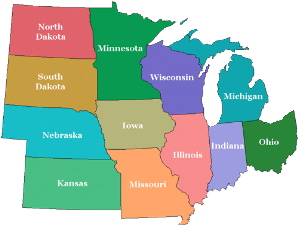
Caught a great front page article in the August 7 issue of Network World: “Middle of Nowhere: The burden of the Midwestern network start-up”. Ah, yes, the incredible burden of being in the sticks. Something we know a lot about here in Minnesota (even though we live in the one of the top 15 metro markets in the country, very often ranked as one of the best places to live and work). Writer Carolyn Duffy Marsan picked up a lot of nuances in this piece, which is based largely on looking at the stats for the 12 states considered “Midwest” from the latest PwC MoneyTree report. [Note: most of the examples she cites are in Ohio, but the article is instructive for any Midwestern startup.] Midwestmap

The biggest news was that Minnesota got a #2 ranking. But don’t look for that in the online version linked above; it’s in a sidebar that appears only in the print version. This sidebar ranked VC funds received by the 12 Midwestern states so far in 2006 (only for “network startups,” considering the focus of this publication). Minnesota, at $32M, was second only to Illinois, at $44M. The next closest, Wisconsin, was way down the list at only $7 million. A pretty solid ranking for the Land of 10,000 Lakes. Actually, there are at least 15,000 lakes here, and we border on the largest one in the world, but I digress…

A few stats from the article: there have been only 25 network startups in the Midwest to sign venture deals so far in 2006, compared to 822 nationwide (of which California alone had 371). The average deal size in the Midwest was $3.7 million. compared to $7.7 million for deals in California, Massachusetts, and Texas, the three leading states for network startups. [According to the aforementioned sidebar, however, Minnesota’s average so far this year is a heady $8 million.]

As more proof that those on the coasts don’t get it when it comes to the heart of the country, Tracy Lefteroff, managing partner of PwC’s VC practice in San Jose, was quoted as saying. “They have research institutions. They don’t have the venture capital and the experienced entrepreneurs to help build those companies.” Wrong on the last two counts, Tracy: we have plenty of entrepreneurs who’ve done it before and are not about to move elsewhere. And we have tons of VC money, too; the firms just choose to invest it elsewhere while giving lip service to how wonderful Minnesota is! [Sorry, my Minnesota VC friends — couldn’t resist.] Lefteroff goes on to say, “The first thing a venture firm will do if it’s investing in a Midwest startup is to move the company.” Wrong again, oh California one. There have been many notable tech startups funded here in recent times that have no intention of moving: HotGigs and Jumpnode (per my previous post), Travanti Pharma, and such other earlier notables as Paisley Consulting and Compellent. Smart VCs from elsewhere are discovering Minnesota, and startups here are discovering ways to go find them, and I think that’s very encouraging. Okay, so our locally based VC funds keep going where they think the grass is greener…let em go. It’s a national market.

The article mentions PrairieGold Venture Partners in Sioux Falls, SD, which still likes the Midwest, although they focus only on investments of less than $2 million. Partner Paul Batcheller says, “Life here tends to be a little easier. For a focused entrepreneur who doesn’t want to deal with traffic, high competition for talent, and expensive cost structures, there are a lot of advantages of doing business in the Midwest. Companies tend to be more focused. Employees tend to be more loyal.”

Another Midwesterner quoted in the article, who’s also worked in Silicon Valley, was Jeff Mills, VP-channel development for Bluespring Software in Cincinnati: “We’re much more grounded here in the Midwest. The venture capital community is tougher on us from the standpoint of due diligence vs. more faith on the coasts. The advantage is that we’re selling less vaporware here.”

Take that, rest of the world! 🙂

Minnesota IT Startups Score Big Bucks

Will wonders ever cease? In what can only be described as one long dry spell, Minnesota IT and Internet startups may now be finally starting to see the flow of venture capital pick up — at least if two recently announced fundings are any indication. [As I’ve written before, lots of money flows to the state’s med-tech startups, but it’s been a tough climate here for IT despite it being a strong sector in the past.]

On July 17, HotGigs, a Chanhassen, MN-based on-demand staffing exchange for contract and full-time employees, announced it had secured a $5.3 million round of Series A financing from Updata Partners, a technology-focused venture capital firm based in Virginia and New Jersey. Hotgigslogo It’s the first round of VC funding for HotGigs, which said it would use the funds to expand its management team, hire more employees, develop new product/service offerings, and launch national sales, support, and marketing efforts.

Here’s the significance of this news: the HotGigs funding is the biggest single round for an early-stage IT or Internet startup in these parts that I can recall since the pre-crash days of 1999/2000. [Note: I don’t consider a certain local storage startup, first funded in a big way about four years ago, to be in this category.]

And, just a few weeks prior to this announcement, another Minnesota tech firm announced a round of funding almost as large as HotGigs. Minneapolis-based Jumpnode Systems, which makes a plug-and-play appliance for IT monitoring, announced it had secured a $5.1 million round of Series A equity financing from Apple Core Holdings and Opticality Ventures, two tech venture capital firms based in New York. Jumpnodelogo It was also the first institutional round of funding for Jumpnode, which had secured its initial funds from angel investors in 2005. Jumpnode said it would use the new capital to expand its executive team, accelerate product development, and expand its sales and marketing programs on a national basis.


Second Time Around
To get a little more perspective on this big news for Minnesota startups, I had coffee last week with Doug Berg, the CEO and founder of HotGigs. Doug had previously founded Techies.com in the 1990s, another online staffing services firm, which was a real rocketship — growing to 600 employees and coming ever-so-close to a big IPO in 2000, before….well, you know. Techies was a client of mine in the late ’90s, and I began talking with Doug about his latest startup in 2002, listening to his ideas and discussing them before he’d even decided on a name for the firm, and also helping him identify competitive offerings and so forth. As a longtime independent contractor myself, I thought his plan to focus on contract employees was right on. [Free Agent Nation, baby!] So, it was exciting for me to learn about Doug’s progress with this recent announcement. He deserves a lot of credit for his persistence.

After Doug whiteboarded his plans for HotGigs in late 2003 with an old colleague of his from Techies.com, Peter Braskett, in early 2004 he obtained an initial round of angel funding in the amount of $250,000 from a family who’d previously invested in Techies.com. By March 2004, he and his small virtual team had launched the initial HotGigs web site. Doug said he began by talking a lot with his old Techies clients to learn their needs. He soon discovered that a really hard problem employers were having was recruiting and managing contractors, which has been becoming a larger component of the workforce in many job functions (not just IT). What these employers needed was a site that could search all their recruiting/staffing firms that dealt with contract employees at once. Also, he learned that the recruiting/staffing firms were quite inefiicient in marketing their people; they needed a lot of help, too. Doug said he realized that no single staffing firm could pull off the online-exchange type of site he had in mind. So, he’d found his opening — the big problem that needed solving.

He realized, however, that there was some educating to do in his marketplace. Many recruiting firms would initially fear such an exchange, much as real estate agents did with the introduction of the MLS listing system. But that proved to be unfounded. And he began to sign such local corporate clients as Cargill, Blue Cross/Blue Shield, and ADC Telecommunications. “The message,” said Berg, “was that what we were doing was a natural evolutionary thing. We needed to bring these people into a marketing mindset. We were now in the Google era — database search.” He said the employers needed a lot of help screening candidates — “going through 500 resumes to five good ones,” he said.

Berg pointed out that it isn’t the employers that pay for his services (and he now has some 2500 such corporate users); the recruiting or staffing firms are the ones who pay. HotGigs first tried a price of $4000 per year, but he said that didn’t work. Later, he hit on $200 per month, and that pricing model took. The firm now boasts 9000 staffing firms as clients, and is adding them at a clip of 1000 per month.

“The business-to-candidate model, like Monster, had already been done,” said Berg. “But nobody was doing the business-to-business model — like Ariba in supply chain management.” There was a huge market at stake, said Berg. “It’s a $129 billion industry now, and will grow to $200 billion by 2010.”

I learned that HotGigs is far from a one-trick pony, however. It has added related service offerings. “We started at the marketplace level,” said Berg. “Now we’re going to contingent workforce management, with a service we call ‘Contract Central’.” Part of this offering is handling all the invoicing and paperwork for corporate clients. The firm is also hosting special intranets relating to this, the first for ADC. But that’s not all. HotGigs recently began offering a service it calls “Career Site Optimization” for its corporate (employer) clients — helping them greatly improve their own job-listing sites for full-time employees, according to Berg. He said HotGigs is already providing this CSO service to Health East and Cingular.

What are Berg’s plans for hiring after the latest funding? He said HotGigs would grow from its current 12 employees to more than 60 by yearend. And he’s already got the same recuiting firm engaged who helped him add 50 employees a week when he was growing Techies.com to 600 employees — so it’s a task he knows well. Doug said 10 web producers would be part of the new contingent, but most of the new hires would be “sales and support people.”

Lesson Learned
Doug noted that his chairman, Ken Holec, a successful Minnesota software executive and entrepreneur, played the key role in finding the investors for HotGigs’ successful Series A round. What advice would Doug give aspiring entrepreneurial fund-raisers out there? “Find a VC that knows your market!” he urged. “Ours was the original investor in CareerBuilder.com. Obviously, Ken and I didn’t have spend a lot of time educating them about our industry.” He pointed out another important thing, too. “These VCs are measurement guys. You have to turn your company into a dashboard so they can monitor how it’s running.”

And Doug Berg seems to have HotGigs’ engine humming along real nicely.

Minnesota Angels Say Seed-Stage ‘Gap’ Is Closing

A favorite sport for entrepreneurs in the last five or six years has been complaining about how hard it is to raise early-stage capital — especially for the very early stage of a startup, sometimes called the prototyping phase. But, at an investment conference I attended a few days ago here in Minneapolis (conducted by NetSuds.com under the auspices of the Minnesota Association of Angel and Venture Capital), I heard some experienced investors talk about how things are changing for the better. Attendees numbered 136, including angels and VCs from throughout the region, as well as hopeful entrepreneurs considering the launch of a new startup and founders of tech firms that are somewhat further along. The program included several startup CEOs pitching their companies.

Time was, Minnesota had a reputation as a pretty good hotbed for tech startups, including IT, but it’s now much better known for its med-tech startup community, of course, especially medical device firms. At this event, however, I noticed a good mix of both IT and medical technology folks amongst the attendees and presenting companies. Here’s a look at what was the agenda for the event.

Bucks in the Boonies
The opening speaker was a longtime contact of mine, Brian Johnson, who’s been a VC with smaller, early-stage venture firms here in the Twin Cities for more than 20 years. Since 2005, he’s been an EVP with RAIN Source Capital, which is is a multi-state network of angel funds. (RAIN is an acronym standing for rural angel investment networks.) It brings together like-minded angel investors to form individual RAIN funds, which share expertise, deals, and experience between and among RAIN Source Capital’s multi-state network to support growing companies throughout the area. It’s now working with angel investors in communities within Minnesota, Iowa, North Dakota, South Dakota, Montana, Idaho, Washington, Oregon, and other states. Its funds range in size from seven to 61 members, who have pooled anywhere from $500,000 to $2 million in each fund. Each individual RAIN fund determines its industry focus, and the type and level of financing to provide based on the interests and expertise of its members. And each uses the organization’s proven model for identifying potential deals, performing due diligence, making investment decisions, and monitoring those investments, said Johnson. The RAIN fund network currently has more than $20 million invested in 40 companies.

“The gap is starting to be filled by angel funds across the U.S., ranging in size from $500,000 to $5 million,” said Johnson, referring to the void created when traditional VC firms began reducing their early-stage investing after the dot-com collapse. RAIN Source Capital already has 13 funds in various out-state communities, and Johnson said the number will hit 20 by the end of 2006. “That will be more angel funds than any other organization,” he said. There are about 225 formal angel funds in the U.S., almost all of them in urban areas, according to Johnson. “Only one is primarily active in rural communities,” he said, referring to his own organization. But he noted his firm is moving to add more urban funds as well, including several soon in the Twin Cities area (one is a women’s angel network). A key thing his organization has learned is that its members see their networks as a “profitable, fun, social activity,” said Johnson. “It’s a big deal for them.” Each member’s minimum investment ranges from $25,000 to $100,000.

A speaker visiting from a neighboring state was Mike Jerstad of Prairie Gold Venture Partners, an early-stage investment firm based in Sioux Falls, South Dakota. Jerstad, whose firm is currently investing a $10 million fund, presented two interesting profiles: that of the ideal seed investor, and the ideal seed money recipient. He said the investor represents smart money, meaning he or she has both industry and entrepreneurial experience. “In addition, they’re value-added money, meaning they’ll roll up their sleeves, be an active board member, and provide business development assistance.” Finally, they’re “coordinated money,” Jerstad said, because they understand their role in the financing continuum, and how they help achieve the ultimate financing objectives. And the profile of an ideal seed money recipient? “He or she has spent a great deal of time perfecting the business plan,” he said. “They can speak in detail about needs and strategy, and recognize the need for both money and expertise — they really believe that.” They also must have a willingness to turn the strategy and business in a different direction — “and it’s best to do that early in the life of the business.” Finally, Jerstad said, “They realize the angel process is like the VC process — they’re ready for scrutiny. And they take a rifle approach to finding the best investors, being careful not to become a ‘shopped deal’.”

Jerstad, who was formerly based in in the Twin as an attorney and an investment banker in healthcare for Piper Jaffray, went on to talk about where a new startup should look for money today. “Regional angel groups are expanding. Regional VCs are not,” he said. “And get a referral — that is most important.” What should you expect? Jerstad stated the brutal reality: “Initial failure. Then more failure. But then you can get a break — typically through a connection.” And you have to be ready when it’s time for that “critical initial meeting.” Jerstad’s firm, Prairie Gold Venture Partners, will do seed funding, but typically prefers Series A. Its investments are in the range of $250,000 to $1 million, and the firm can lead $2.5-3.0 million deals. They have an Upper Midwest focus and consider themselves generalists, but they like life sciences, IT, food, and ag.

Words from the Wisest
Big draws for this event were a couple of very experienced, successful Twin Cities angel/early-stage VC investors. The first of these legends to speak was Norm Dann, who’s had a long career in the business, having been early in the game with a medical device firm that was acquired by Medtronic back in the ’70s. [And I remember him being an executive at the company when I worked there. He also has a son in the VC business, Mitch Dann, a former client of mine.] Norm went on to serve for many years as a partner with Pathfinder Venture Capital, funding all sorts of successful firms. He focused his talk on “Why don’t VC firms do more startups?” First of all, Dann said, “It’s a lot of work! A small deal is just as much work as a large deal.” He also pointed out that, as VCs’ funds have gotten larger, the number of partners has not really increased — meaning the workload of the typical partner has gone up greatly. “Another big problem is there’s just not enough info to determine valuations,” he said. He recommends putting in a dilution clause early, “because no one really has any idea what the real valuation is.” He also spoke about the role the investor plays in building the management team. “There are likely parts missing early on, and investors must fill that in.”

The other big draw was Ron Eibensteiner, a 30-year-plus seed stage investor with an enviable record — the closest thing in this town to the Midas Touch. Though Ron reminded us he’s had his share of dogs, moderator Matt Noah was quick to point out some of Ron’s successes: Stellent, Big Charts (acquired by CBS Marketwatch), Optical Solutions, and NextNet Wireless (acquired by Craig McGaw), just to name a few of the biggest. Eibensteiner made his first investment in a startup called Arden Medical Systems in St. Paul in 1983. [This was about the time I launched my startup consulting firm, and I’ve followed Ron’s career ever since. I never had the chance to work with him, but sure wish I would have.] Arden was soon acquired by Johnson & Johnson. After that, in 1988, he essentially became a full-time angel investor. His firm is Wyncrest Capital; here’s some directory info (there is no web site).

“We need a lot more early-stage funds!” crowed Eibensteiner. “When I started, there were a lot more.” He said his perceptions of the Twin Cities area is that “it’s almost dead compared to the ’80s and ’90s. It just hasn’t come back since ’01 and ’02.” Which makes raising money here tough — “One of the toughest things you’ll do. People are just reluctant to get involved.” In some respects, he said, “there’s too much money in venture capital” (causing the big firms to naturally want to fund the bigger deals). “But somebody has to fulfill the needs of early-stage companies.”

Eureka! Solution Found
Eibensteiner gave an example of a recent startup he’s actively involved in as an angel investor and board member: Travanti Pharma. The firm makes a wearable, disposable electronic drug delivery device, among other products. “First, we raised $1.5 million, which was hard,” he said. “Then, a couple of years ago, we needed more.” Lacking sources locally, he called an old contact of his, a retired principal in the San Francisco investment bank Robertson Stephens, who was living in Mexico at the time. He liked the idea and helped the company raise another $2 million. More recently, the company set out to raise its next round. “But this time it was $3-5 million, and we were now stuck ‘in between’,” said Eibensteiner, referring to the infamous gap. What he discovered, however, was a very interesting new state program in Missouri, which began about four years ago. It gives a tax break to insurance companies to invest to benefit their local communities, and the program has caused a number of new early-stage investment companies to spring up in the state. “Thirteen other states have done this, too,” he said, “We also got money from the state of Florida.” All told, Travanti Pharma ended up raising $8.5 million in its latest round, and had to turn away another $3 million.

Yet another example of one of Eibensteiner’s investments is a very recent startup called Yugma (Indian for “come together”), which offers a universal desktop sharing application in a hosted model. First, Ron showed it to the founders of locally based content management software firm Stellent (old buddies of his, of course). “They loved it — saw it as better than WebEx,” he said. They agreed to invest, but wanted the option to buy the technology if the rest of the round couldn’t be raised. That proved unnecessary, however, because Yugma ended up raising $1M instead of the $500,000 they originally sought (which bought half the company). “In two weeks,” said Eibensteiner, “we’re going to San Francisco to prepare for the next round.”

So, where does this leave early-stage investing in Ron Eibensteiner’s mind? “In the last year, it’s getting a little better.” But he still thinks it has a long way to go in Minnesota. So, recently, Ron — who has served as chair of the Minnesota Republican Party — made a proposal to Governor Tim Pawlenty. “I told him we’re at a critical stage,” said Eibensteiner. “We’re already falling behind as a tech state. It’s a job creation thing. The big companies aren’t adding jobs — it’s the early-stage ones that do that.” The proposal he made offers a real solution, he believes. “The state investment board currently has $50 billion under management. All I’m proposing is that 3/10ths of one percent of that — $150 million — be set aside for fostering more early-stage investing. Let’s do what Missouri did! Start 5 to 10 early-stage investment companies here in Minnesota.” Eibensteiner said “We should be on a per-capita basis with California and Massachusetts, but we’re nowhere near yet.” He thinks his proposal will become a reality in the next legislative session. And he even encouraged the launch of a new web site for some grass-roots support of his proposal — essentially a discussion board on the topic: InvestInMinnesotans.com. [I say get on it, sign up as a member, weigh in, and spread the word! And be ready to call your representatives when the bill comes up for a vote. This is the right move at the right time for our state.]

The Road from Seed to VC
The next session featured two relatively younger turks from VC firms that lean toward smaller deals. The first was Tom Erickson, a partner with Bluestream Ventures, which is based in Minneapolis but also has an office in the Bay Area. Its current fund is $280 million (2000), and it has six investment professionals. “We focus on the go-to-market stage in select IT sectors,” said Erickson,” so we like Series B or C.” The firm is particularly focused in data center, utility computing, and security technologies, and its average investment is $5 million over the life of the portfolio firm. “Oftentimes, one of our partners will participate as a member of the management team.” Their terms, not surprisingly, include “liquidation preference,” a fancy term for preferred shares. Earlier, both Ron Eibensteiner and Norm Dann had noted this is a fact of life in any deal, despite some founders being leary of it. Erickson said, however, that it can lead to a higher valuation.

Next up was Vimal Patel, a partner with Sierra Ventures in Menlo Park, CA. Founded in 1982, Sierra’s current fund is $500 million, and it typically invests $3-15 million per company, counting both initial and follow-on investments. “We do Series A, but our sweet spot is B and C,” Patel said. The firm’s focus is in general IT and Internet, and also (for Patel) materials science. The biggest thing about Sierra Ventures as relates to us here? “Two-thirds of our current investments are outside the Bay Area,” he said. “We’re invested in 45 companies, in Massachusetts, Florida, Texas, and elsewhere. We’d love to have a beachhead in Minnesota.” [Music to Minnesotans’ ears, indeed!] What are his firm’s needs? “We need proof of concept, customer validation, market size and competitive analysis, and the team at least somewhat identified,” said Patel. One final key point he added later: he actually reads cold emails! Fire yours off when ready to vpatel@sierraventures.com.

The Master’s Tips for Pitching to VCs
Ron Eibensteiner wasn’t done — we got a bonus: he gave the entrepreneurs in the audience a short-list of key points on how to pitch their startup, netting out what he’s learned over a lot of hard years of trial, error, failure, and success. Four things: (1) The concept — does it makes intuitive sense? It should not require a lot of explanation … (2) Is there an immediate sense of huge market size or need? … (3) What is the solution, including the marketing solution? How many obstacles are there? You need a marketing scheme that’s unique … (4) Execution — which gets right at the management team. People say this is the most important consideration, but only if the other three things are in place first, Ron pointed out.

“And do it all in 20 minutes,” he said. “Even if you just get through points 1, 2, and 3 successfully, you’ll get invited back.” He also gave advice about another kind of preparation: “Learn about the VC first!.” If it’s a larger size firm, you’re less likely to be successful. “Know their area of expertise, go for specialization.” Another point he made that drew some laughs was this: “If the VC firm’s decision-maker is under 35, forget it!” — meaning MBAs without operating experience. “Look for partners with entrepreneurial and operating experience,” said Eibensteiner. He harked back to his success raising funds for Travanti Pharma at the early-stage investment firm in Missouri — there, he worked with a 52-year old who’d been in immunology all his life and had just recently become a VC.

Highlights from the Q&A
Some audience questions addresssed to the panelists afterwards were of interest. “What about ‘Minnesota Nice’?” (Meaning the style of local entrepreneurs compared to the more hype-laden West Coast approach.) Erickson of Bluestream said that honesty is always the best policy. Eibensteiner said, “Paint enough of a picture to see the possibilities. Watch out for unrealistic expectations.” Patel of Sierra Ventures noted that his firm doesn’t so much pay attention to revenue projections, but looks for realistic market size. “What about those who say to double the amount you think you’ll need?” Patel said his firm looks at comparables in the same sector to get the best feel for how much you’ll need. “What about the exit strategy?” Eibensteiner said that’s a “total turnoff when brought up by a company early on.” Another question was “What about syndicated deals?” Erickson of Bluestream said they’re a must due to uncertainties. Patel of Sierra said they’re not a must for his firm; they do deals both ways, and will serve as a new lead in Series B or C. Ron Eibensteiner had a point to make from hard experience: “If you accept a syndicated deal, make sure the ‘lead’ really speaks for the group.” (He ran into a big problem with one of his investments because of this.) Finally, an excellent question from moderator Matt Noah: “How long will you give a non-realistic CEO?” (Meaning a founder who may know the technology well, but not really be qualified to run the company longer term.) Eibensteiner again offered up some wise words: “I always say ‘Put your ego up on the shelf’ for the duration of my investment.” And he cited a recent example of that very situation, where a founder agreed with him that it was time for him to give up the CEO reins.

My Take on a Big Area of Needed Improvement
Okay, now for some editorializing. [I write the blog, I get to editorialize… 🙂 ] After the morning break, the conference moved into a session of six company presentations by startup CEOs (12 minutes each), which I sat through. (There were five more firms that presented in the afternoon, but I was not able to stay for those.) To me, this was the most disappointing part of the conference. The presentations were largely lacking in content, organization, persuasiveness, and just plain-old excitement or drama. I think Minnesota entrepreneurs have a problem besides lack of available capital. They need to pick up the pace and quality of their pitches! One in the morning session that wasn’t too bad, at least in quality or appearance of the presentation itself, was NetBriefings — but it should have been, since that’s the business they’re in. All presenters could have used a serious dose of Guy Kawasaki’s “Rules for Powerpoint,” at least! That’s a basic starting point. To me, the quality of the presentation is the one big other reason why Minnesota startups don’t keep up with their brethren in other areas of the country. One need only look, for example, at how hard company presenters work at perfecting their pitches for the “DEMO” conference, which I attended in February and blogged about extensively. [Click on my “DEMO 2006” category to the right to see it all.] You can even watch videos of these presentations (including those that won a “Demo God” award) here — just click on “Watch DEMO Videos” at the right. If this doesn’t provide some inspiration for you, then there’s something wrong! And these pitches are limited to only six minutes each — which is a better exercise for entrepreneurs, I think, than stretching it out to twelve. [End of editorializing…]

Closing Thoughts and More Links
Interestingly, the day I’m about to publish this blog post, up pops a nice piece in the Wall Street Journal, entitled “Fresh Crop of Investors Grows in Silicon Valley: Start-Up ‘Angels’ Blossom Again”. Speak of the devil. But it sure is nice to know that it’s happening here in our state, too — albeit in a lesser way.

For some good local background, here’s a media piece from some months ago written by my friend Dave Beal, a business columnist at the St. Paul Pioneer Press: “Business to ‘angels’: Sow us the seed money”. The first half of the article is about the RAIN Source angel funds organization (which, at the time of this article, was still known as the Minnesota Investment Network, or MinCorp — glad they got some naming religion!), while the latter part of the piece is about Ron Eibensteiner’s proposal to get the State of Minnesota to boost seed-stage funding; you’ll note it began as a bid to get $500 million in funding from the state investment board, but was since lowered to a more realistic $150 million. [That’s cool, Ron — get what you can!]

Other events in this series of conferences sponsored by NetSuds, a MN-based networking organization, are listed here.

Finally, another resource that may be of interest to Minnesota startups is this MN Growth Capital Directory, published by the good folks at Minnesota Business Magazine a while back. It’s in need of a bit of an update now, but useful nonetheless — listing VC firms and community development agencies, though not yet the newly sprouted angel networks.

Speaking of those, yet another excellent organization just now in the final stages of formation is Twin Cities Angels LLC (the web site is not quite up as of this writing, but should be soon). It has signed on somewhere in the neighborhood of 40 angel investors to date, each investing $50,000 — making it a $2 million fund (but members will be allowed to place “side bets” beyond that, of course). The group is having its kickoff meeting on May 16. I met with the organizer, John Alexander, a few months ago, and some of my IT-oriented angel colleagues are signing on, in addition to several in med tech and other industries. It, too, is sure to bring more needed help to the fund-starved startups of Minnesota! So, stay tuned for more from me on the “Twin Cities Angels” network…

« Older posts Newer posts »