Graeme Thickins on Tech

Reflections & analysis about innovation, technology, startups, investing, healthcare, and more .... with a focus on Minnesota, Land of 10,000 Lakes. Blogging continuously since 2005.

Page 72 of 144

The Best Advice I’ve Seen Lately On Using Startup Advisors

Seth Levine is a VC in Boulder, CO, a partner with Foundry Group. I kinda know Seth, through his connections to the Twin Cities (he’s a graduate of Macalester in St. Paul), though we’ve never actually met.  We’ve emailed quite a bit about goings-on here in Minnesota, after having just missed each other at the Defrag conference in Denver last November.  Seth and his fellow partners are quite the bloggers. One of his sidekicks, Brad Feld (whom I did meet at Defrag), has a very popular blog called Feld Thoughts. And they also run another blog that has high readership in the entrepreneurial community called Ask the VC.

Seth’s blog is called Seth Levine’s VC Adventure. And, recently, he began a series of posts on startup advisors, a topic near and dear to my heart. Advicedefinition
In a departure for Seth, the posts are actually written by a guest poster, Gerald Joseph.  Part I was good, but Part II is even better: The role of company advisors (Part II).

Here’s how Seth explained how these posts came about:

“One of the things I enjoy the most about writing this blog is the discussion I engage in with readers – both through blog comments and in direct emails.  Over the past month I’ve had a particularly enjoyable exchange with Gerald Joseph.  One of the topics we’ve discussed is the role of advisors in the life of a start-up.  I generally think of advisors as non-paid ‘friends of the company’ and as you’d probably guess, advocate a pretty deliberate organization and use of advisors.  Gerald’s view is a little more expansive as he thinks of ‘advisors’ as the larger ecosystem that surrounds (or should surround) a start up company – one that includes people you pay (attorneys, CPAs, etc) and the people who pay you (your angel investors) in addition to the business and industry experts that are the typical ‘advisors’ to young companies.  I like this line of thinking and offered Gerald the chance to put his thoughts into a post.  He took me up on that idea and came up with a four part series on the topic that I’ll put up over the next few weeks.  After the final post I’ll summarize some of my thoughts as well as comments from readers.”

For entrepreneurs at any stage, I think these posts are excellent. I encourage anyone who could use some…uh…advice on how to use advisors to read them all, including Parts III and IV yet to come.

Is Twitter Affecting Blog Frequency? An Excellent Discussion…

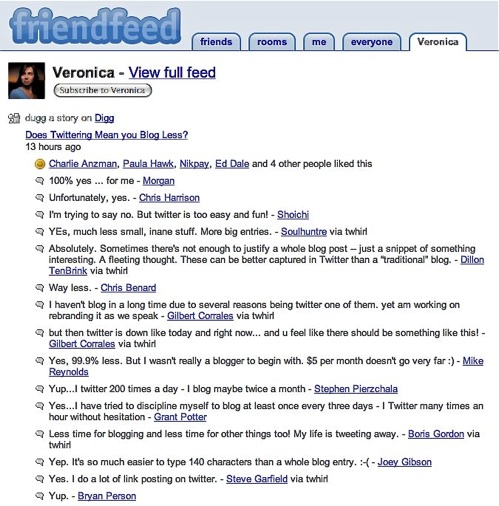
A question keeps popping up for me: is "micro" blogging (as in Twittering) affecting "macro" blogging (as in what you’re looking at here)? I say it definitely is slowing down the frequency of regular blogging, because people are just spending so much time on Twitter — well, the rabid early adopters, anyway. But many of these happen to be long-time bloggers, too. So, Twitter’s bound to have an effect on how often they blog.  I also touched on this in a post a few weeks ago: Blogging Less, Twittering More.
But then I saw a discussion on FriendFeed a few days ago, which you see here in the graphic. [Okay, it took me a few days to post it because I was Twittering….and FriendFeeding.]  Twitteringcutsblogging_2

The comments to this post certainly tell the tale, confirming my own suspicions. By the way, I don’t know any of these people, including the poster, Veronica — but, yes, through the magic of Web 2.0, they’re all my "friends" now… 🙂

The original blog post that Veronica dugg on Digg was this one from Ryan Block, the editor-in-chief of Engadget: Does Twittering Mean You Blog Less?

By the way, if you want to keep up with me on Twitter, just go here and follow me: www.twitter.com/graemethickins.  And to subscribe to my FriendFeed, go here: http://friendfeed.com/graemethickins. There quite a discussion now going on amongst the digerati as to whether FriendFeed will overtake Twitter, with all the downtime and scaling problems the latter is having.  I even questioned in a recent tweet whether FriendFeed might be bought by Google (which would be interesting, since it was founded by ex-Googlers).

What do you think? Do you like one over the other? Have you even tried either one? Does any of this matter, or it is all just about the kool kids trying to find the next fad?

Zen and the Art of Startup Maintenance: The Story of One Helluva Serial Entrepreneur

I’ve known Steve Larsen for a long time — ten years at least — and, wow, it seems a lot longer in Internet time. Steve is one of those people you feel you’ve always known. He’s one of the guys I respect most in the entire technology industry — a smart marketer, brilliant strategist, and just a top-notch people person and leader. Even though he left the Twin Cities five or six years ago for the fast-lane of the Valley, we still manage to run into each other a few times a year. Graemewstevelarsen
One of those times was at a conference several months ago, where we got to talking [okay, it was over several adult beverages] about how long we’d known each other, and I started recounting the amazing ride this guy has been on since I first worked with him when he was SVP of Marketing at Net Perceptions here in Minneapolis, back in the day. And we decided I should write about him [Steve has this way of making me feel like I’m a really good writer] — that is, track the story of what I thought was just an extremely interesting and unusual background for one guy to have in this crazy startup world, stretching over at least a decade. 

So, that’s what I set out to do: a full-blown feature on the life of a serial entrepreneur who just can’t stop, going from one cool gig to another — much like his other life of testing new motorcycles and touring all over the world. You see, Steve likes speed, in more manifestations than one, and is just always on the go. [I remember when he took me for a ride in some hot, new red sports car he’d just bought, taking it up to like 80 mph in about a two-block distance(!), on a lonely stretch of frontage road near the Sofitel. My life flashed before me.]  It seemed an interesting mix to me — motorcycles, speed, and the entrepreneurial CEO — that people could relate to. So, I proceeded to put together the basics of an article soon after we met, then continued to tweak it here and there in my extra time on weekends, adding updates along the way.  Soon, with some help from one of Steve’s very fine PR folks at PageOne PR, we set out to pitch it to some mags. Well, we didn’t get far till Chief Executive Magazine grabbed onto it, and, to our delight, decided to publish it last week as one of the first articles in its "Entrepreneurial CEO" section. Perfect. If Steve doesn’t fit that label, nobody does. Here it is: Zen and the Art of Startup Maintenance, by yours truly.

Chiefexeclarsenarticle

I’m delighted that the readers of this fine, long-standing publication are now getting to learn about this very talented guy. I think they’ll learn a lot. And, Steve, my hat’s off again to you!  It was a pleasure being about to tell just a part of your amazing story….one that’s really still being written, as the readers of this article will learn. Continued best of luck with Krugle, a company I am convinced will rock the world of code search!

Krugleappliance

You can bet I’ll be following along, and I certainly look forward to being able to relate the next chapter in this very interesting guy’s life. [Okay, Steve, you now owe me another adult beverage at our next conference! Maybe DEMOfall in September? And Defrag, too, in November  🙂 …and…and…]

General Mills, Target, Best Buy, and Fingerhut Bare Their Social Media Souls

I blogged about a big event here in Minneapolis last night, featuring four of our larger hometown brands (well, three, plus one pretty big direct-marketer you may have also heard of). The topic was social media, and you can tell it was hot by this shot I grabbed with my iPhone of the very crowed room. Mimasocmedia051408
My post about it is over at my NewMediaWise blog, because that’s where I talk more about marketing and all the changes happening in that field. The session was excellent, if for no other reason than I felt the panelists were sincere and candid in their remarks, and yet had as many questions as answers. It wasn’t fluff or BS — I think we heard what’s really on their minds, and they got us thinking about how much more still needs to be done….by big brands as well as small.

Thanks to our great local interactive marketing organization — MIMA.org — for putting on this gig.  They said it was the largest of any of their regular monthly meetings to date.  Hot topic, and lots of good networking before and after.  I had the opportunity to chat at length with two of the panelists afterwards, Jim Cuene of General Mills and Gary Koelling of Best Buy, and also to meet several other folks as well.

Tell ya what, after experiencing Minnebar on May 10 and MIMA on May 14, I’ll say this…..this town is rockin’ this spring!!

Can Twittering Add Value?

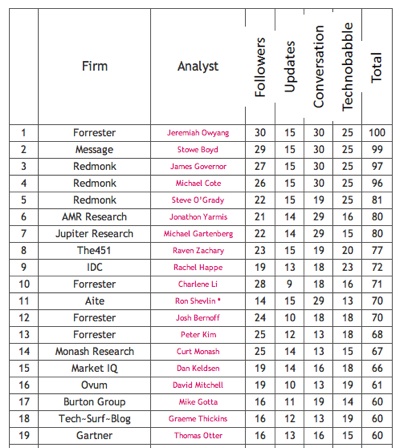
Apparently so, based on two recent studies.  In the first, I’m once again honored to be included in a ranking by the Technobabble 2.0 blog, which is written by Jonny Bentwood, an analyst relations guru at Edelman PR in the UK. His latest ranking is called the Top Analyst Twitters (Micro-Bloggers).  Topanalysttwitterslogo
Earlier this year, my blog was chosen (for the second time) as one of his Top 100 Analyst Blogs, and now it’s great to be recognized in this newest ranking — at #18. As Bentwood said in his latest post, "It is not a massive shock that the people who have scored highest are the same as those who use blogging to great affect."

Technobabble’s methodology for its Twitter ranking was based on four data points, which were then weighted. Topanalysttwitterslist_2
The data points were 1) number of followers; 2) number of updates, which is what posts are called on Twitter; 3) conversation, or how many people have engaged in conversation with each analyst; and 4) "Technobabble points,"  the only personal, subjective measure in the algorithm, said Bentwood, with those scoring the highest in this category "having frequent, relevant, and high-quality content — asking questions, posting links or commenting on discussions." The following weightings were then used to come up with each analyst’s score: Followers=30%, Updates=15%, Conversations=30%, and Technobabble Points=25%.

In an earlier study, a few weeks ago, Louis Gray asked What’s Your Twitter Noise Ratio?  He said this in his blog post, explaining how he came to do his study: "I feel there are different categories of Twitter users, from those who
have a listening audience, measured by a high ‘followers’ to ‘updates’
ratio, those who are engaging, seen with near equal ‘followers’ and ‘updates’, and those who are more noisy, with a lot more ‘updates’ than
actual ‘followers’."

He explained how he did his analysis: "Taking a look at 48 Twitter users I either
follow or engage with, I found the average number of ‘tweets’ per ‘follower’ was almost exactly 1, measuring at 1.02. But the ratio of
updates to followers varied widely, from the sleepy 0.06 to the firehose-like 9.75."  I left a comment on Louis’ post, noting I was very glad to see, upon calculating my tweets-to-follower ratio, that it was 4.84, ranking me quite high in his "Converationalists" category.

In another article just published today, How Valuable Are You on Twitter?, Daniel Terdiman of CNet examines the topic from some other angles, including Twitter coverage of the China earthquake, and citing the opinions of other some leading observers and Twitterers in regard to measuring the value of this new micro-blogging medium.

What do you think?  How do you use Twitter?  Is it valuable to you?  In what ways?

« Older posts Newer posts »