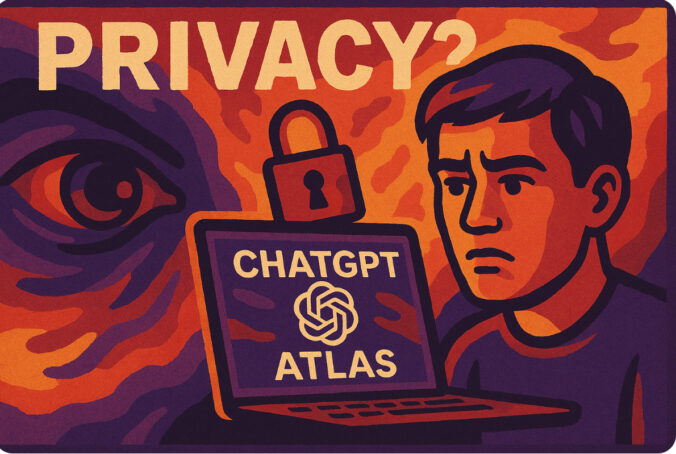
Being an early adopter of new tech for about three decades now, why wouldn’t I want to jump right into using the new ChatGPT Atlas web browser? Well, that was my thinking before I read a recent article in Digital Trends.
The following paragraphs are excerpts from that article:
ChatGPT can also connect with your Gmail inbox, WhatsApp, Slack, cloud storage services, and more.
With agent mode, you can go shopping or make reservations with just a text prompt. It works autonomously by handling the clicks and types on your behalf. It’s pretty surreal to witness in action, but that’s where the problems begin.
Can you trust an AI agent (and an integrated browser) with sensitive data, such as login credentials? In ChatGPT Atlas, for example, the browser remembers not only your web surfing activity, but also your chat history. And the way it logs all that information is extremely scary. It opens a whole new world of hyper-personalized advertisement and privacy risks.
~ ~ ~
“These tools are contextual engines trained on our behaviors, inputs, and queries. What happens when your browser knows more about you than your partner?” he adds. The risks are grave. In August, user conversations with ChatGPT and xAI’s Grok chatbot were leaked, exposing thousands of conversations on Google Search. Back then, experts pointed out that chatbots are a deeper privacy disaster than browsers.
Mixing the two sure sounds like a calamitous recipe. “If anyone is considering being an early adopter, I’d recommend using these tools cautiously, giving them minimal permissions and blocking their abilities for potentially damaging actions,” warns Feinberg, whose company works at the intersection of AI and security.
An engineer at an AI company, talking on condition of anonymity, told me that despite working on consumer AI products, they are wary of connecting all the services you use with a single chatbot ecosystem. AI assistants are a lot more personal than web browsers, and linking them to other products that you use on a daily basis — from Amazon to Spotify — is like letting an AI company profile your entire life.
One has to draw the line, one where they can balance the convenience of AI browsers with their privacy perils. The shift, however, is inevitable.
(end of excerpts)
For me, I’m happy to wait for what Apple — the reigning King of Privacy — may come up with. I’ll have much more to say then. And I predict it won’t be long. I can even wait till 2026.



Recent Comments