Kathy Sierra was one of the speakers in the morning session of this second day of ETech. She’s a perennial at this event, though missed last year. One of the few women in this largely man’s world of developers (esp on stage), but she’s very popular. 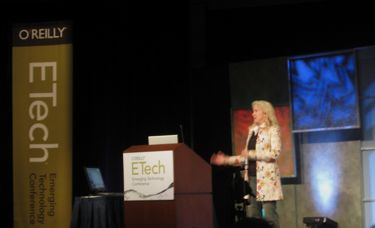
Her thing is "creating passionate users," and who can’t like that? Her talk today was titled to arouse curiosity, I suppose. What it was about, as I Twittered during her talk, is that it’s healthy to get involved in something that isn’t the main thing you excel at. She cited a guy taking pix of her in the aisle with a big camera on a tripod, and how he was a leading open-source guy, but has become a kick-ass photographer. 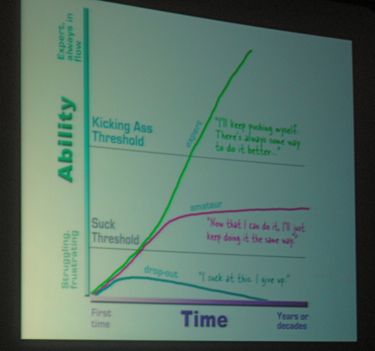
She said it’s not about natural talent, but just the ability to put in time….and not about making money at something [oh, like maybe blogging, perhaps? 🙂 ].
Fast forward to the punchline: we finally got to what she was trying to tell all the hard-working, no-outside-life developers, hackers, and assorted geeks in the audience. It was to "get unplugged," get away from all the distractions ("partial attentions") we all have in our lives, and "focus on the things you care about."
Ah, surfing…it won’t be long now. (Sorry, couldn’t resist.)
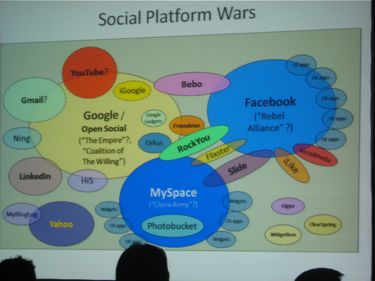

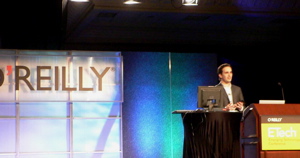 Webb asked the question, “How do we design for this generation?” Though he’s a product designer himself, he went on to say later that Generation C is capable of building products of their own, being so into social networks and mashups and things — so one wonders then why we need product designers? But that’s just the pixel side of the equation. We still need people with design sense to help us sculpt things made out atoms — plastic or whatever. Products are getting smarter and more social, with all kinds of networking capabilities, of course. And we have “new paradigms for interaction,” said Webb. He cited widgets, for example, which he said is such a great paradigm, “it shouldn’t be limited to just the desktop and web.” A key point Webb made is that experience is what counts to this generation, and “how do we design for experience?” He said in his wrapup that experience should be “treated as a design surface,” and that all of us in the room are the right people to address these new design challenges. One nice thing the O’Reilly people pointed out to us in the description of this session was that “people have been paying for plastic longer than pixels.” So, the business model is there! 🙂 It should be an exciting future for product designers, whoever they may be.
Recent Comments