Reflections & analysis about innovation, technology, startups, investing, healthcare, and more .... with a focus on Minnesota, Land of 10,000 Lakes. Blogging continuously since 2005.

Tag: Minnesota (Page 10 of 11)

Guy Kawasaki Is Comin’ to Town

Was I surprised yesterday morning to learn that Guy Kawasaki, master evangelist/author/speaker from Silicon Valley, would be speaking at the U on January 19!  After grabbing tickets for myself and a guest, I immediately emailed Guy and asked him how we could be so lucky to entice him here to Minnesota smack in the middle of winter. [I email with Guy once in a while, and we have a mutual friend in Rich Karlgaard of Forbes. See my coverage of Rich’s latest MN speech.]

Guykuofm

Well, guess what what brings Guy here? [Other than a chance to talk "The Art of the Start."] It’s about pond hockey!  Which has quietly become a really big deal, and Minneapolis is ground zero for this newly revived and now organized sport. I should have known hockey had something to do with this, because I knew Guy was huge into playing the game.  Not that he doesn’t like coming to our state on general principles, mind you. I was instrumental in recruiting him to speak at a MN High Tech Association event several years ago, and I remember hearing him speak here in the mid-’90s when he was still an Apple Fellow. Guy, as you’ll recall, was the original evangelist for the Mac starting in the mid-’80s, which he wrote about in his first two books, "The Macintosh Way" and "Selling the Dream."

So, I asked Guy in my email  if I could do a little interview to use in my blog post.  He was game, so here ya go

Me:  Guy, what did we do to deserve this?
Guy:  I’m playing in the pond hockey tournament. That was the enticement. 🙂

Me:  What’s the gist of the talk?
Guy:  I’ll be talking about "The Art of the Start" — based on my book, of course. It’s my guide for anyone starting anything.

Me:  How long will it be, and what’s the format?
Guy: Sixty minutes, top ten format with a bonus. [If you read Guy’s books or blogs, you know he loves lists of ten.]

Me:  Will you bad-mouth VCs (we hope)?  <ha, ha>
Guy:  I always tell the truth.

Me:  Will you talk story about Steve Jobs and Apple?
Guy:  Yes, a great deal.

Me:  How much will you talk about hockey? Hey, how can you NOT here?
Guy:  Depends on how we’re doing in the tournament. I think I play in a game before I speak.

Me:  Will you have books for sale?  And will you sign my entire collection ?  🙂
Guy:  I should arrange for a bookstore to be there. I’ll try to make this happen. See you soon!

What a guy!  If you haven’t yet registered, act fast — word is spreading. Complimentary tickets for Guy Kawasaki’s talk on January 19th at the U of M are available by RSVPing at www.TheGuestRegister.com/start. You can register yourself and guests at the same time. Or call 888-889-7787, Event #932.  Mucho thanks for this event go to the sponsors: the U of M’s Venture Center, the Center for Entrepreneurial Studies at the Carlson School, the James J. Hill Library, SDWA Ventures, and PR firm Haberman & Associates. I see Haberman is a co-producer of the U.S. Pond Hockey Championships here in January. Way to go, guys!

[By the way, Guy’s latest blog post is an interview of my friend Marti Nyman at Best Buy.]

Tags: , , , , ,

‘MinneDemo 2’ Was One Hot Ticket!

Hot, as in…could you find a parking place? Then could you get in the door? And could you believe the freaking great weather outside? For those of you not in Minnesota, we’ve been basking in 45-50 degree temps of late, haven’t seen a snowfall yet (and it’s mid-December!), and we actually had a light rain/mist goin’ on outside Monday evening for this second MinneDemo event. I had to pinch myself to believe I wasn’t in San Francisco! And the scene, a high-energy gathering of Internet entrepreneurs and developers, made it even more reminiscent of the City by the Bay, back in days of….well, you know.

Minnedemologo200w

But, hell no, this is no bubble! Web 2.0 is different, folks. And this group is great evidence of that. It proves that smart developers can live and work anywhere they want….even in now-subtropical Minnesota [if this is global warming, bring it on, baby!]. And the new, open tools and platforms of the Web 2.0 era let them build their stuff quickly while they stay right where they prefer to live. It’s hard convincing Minnesota folks to leave. Something about quality of life, snow (hah!), lakes, fishing, hunting, the local music scene, the culture, and, doggone it…“Minnesota Nice” in general.

What’s interesting, too, about this new breed of startups is that they don’t need much to bootstrap and get their businesses going and up on the Web. Rapid development platforms like Ruby On Rails help a lot in that regard [and I’m hearing we have an excellent community of those developers here]. The hope of these entrepreneurs, of course, is that word will spread “virally” about their new sites…kind of the comeback of the age-old ‘build-a-better-mousetrap’ concept. But they’re smart enough to realize they don’t need to be hunting down big VC dollars for these businesses — they wouldn’t know what to do with such money, anyway. They understand, however, that angel funding is a good fit for their needs. [And, yes, there were definitely some angels present! Of course, not a single VC showed, but my radar is picking up that this will change soon.] Think of our local Web 2.0 phenomenon as a kind of giant caldron of experimentation: build ’em fast and get ’em up on the Web! Then, hey, if people like ’em, they just might catch on and turn into real businesses….
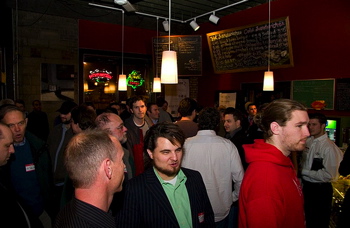
Minnedemo1

[Note: The event, by the way, was held at at the Arcadia Cafe at Franklin and Nicollet. Photos shown are courtesy of Minneapolis’ own Jamie Thingelstad, VP/CTO of Dow Jones Online. He and his crew run all the awesome sites of this global leader from right here! Yes, 110 people downtown, in the original MarketWatch offices. Jamie is also affiliated with one of the sponsors, Road Sign Math. The photos, in order, are of the bar, organizer-extraordinaire Dan Grigsby, the demo room, and Mike O’Connor getting ready to pitch.]

Minnedemo2

Net-net: anybody who’s anybody in the local developer community was at this schmoozefest, either to demo their wares (there were six companies/projects pitching), watch their peers demo, or just catch up with their fellow developer friends, advisors, potential employees/employers, look for contract talent, angel connections, etc, etc…. I saw and heard all that and more. I was in awe being around so many smart people. We have one really, really great developer community here, folks! Some of my best friends are developers, and I’m very happy to say that. Get to know ’em. This is where this state’s next generation of company-building and wealth generation will come from!

Minnedemo3

So, who’s behind organizing this MinneDemo thing? It rose up out of a grass-roots, open-source movement called BarCamp, which is actually (and fittingly) a global phenomenon. Three local developers named Dan Grigsby, Luke Franci, and Ben Edwards decided about a year ago that our local community could be a great “chapter” if someone would just get it started. Well, they seized the moment! …and actually have put in a ton of work into throwing the three events so far. [BarCamp MN and then two MinneDemos.] We salute you guys! And they had no problem finding sponsors — in fact, I hear their list is almost over-subscribed already. For this event, the sponsors were ipHouse, Mosquito Mole Multiworks, Kinetic Data, Road Sign Math, and New Counsel. [Thanks, guys! Smart marketing dollars invested.]

Minnedemo4

This second MinneDemo easily drew 180 people, which was double the first one! [That was held at a smaller venue in Uptown in September.] Not only was this one a happening, fun networking event, there was a lot of stimulating discussion going on Monday night — I can attest. As well as seeing a lot of old friends, developers and others alike — Tom Kieffer, Rob Metcalf, Jeff Pester, Mike O’Connor, John Roberts, Derek Peterson, Tom VonKuster, and several more — I met some really interesting new friends, including [the ones I got cards from, at least]: Ben Moore of Curbly (great tagline this social network has: “Love Where You Live”)….Dan Carroll of imp (that stands for “Intelligent Media Platform” and, interestingly, it’s a company that sort of grew out of the Utne Reader)….John Sandberg of Kinetic Data (one of the sponsors linked above)….and Katharine Grayson, the new technology beat reporter for our local weekly The Business Journal. She was nice enough to bring along a photographer, after I alerted their managing editor, Mark Reilly, to the event. [Note: Buy next week’s issue — lots more about our local tech community there.]

So, you get the point by now: the Minnesota Internet startup and business community is a-hummin’!! I know you’ll be hearing more from many people in this group. And I’ll continue bringing as much of it to you as I can…

Nothin’ “mini” about Minne-sota!

Tags: , , ,

Rich Karlgaard on ‘Net Disruption and Forbes

Switching back to the event I attended this past Thursday evening, the RAIN Makers Conference, I wanted to pass along some of the insightful remarks made in the dinner keynote by my friend Richkarlgaardheadshot_2 Rich Karlgaard of Forbes. [Or as Guy Kawasaki, another friend and business partner, calls him, “Brother Rich.”]

“Since 2001, the global economy has added the equivalent of the whole U.S. economy,” Rich said, as he opened his talk with reference to macro trends. But, though the fundamentals are good, experts don’t agree that it’s a good economy, he said. And, when experts differ so much, something is up. “That something is we’re living in the greatest period of business model change — ever! Companies can come out of nowhere and knock out big players,” Karlgaard said. He referred to what McKinsey & Company calls the “topple rate” of established industry leaders, which tripled over a 20-year period according to their research. Rainmakersconf_1 One industry where this is happening is newspapers, with the stock of the New York Times, for example, at half what it was in 2002. Why is the industry in trouble? “Craig’s List is one reason,” he said, “a company with 23 employees.” He noted that McKinsey said the topple rate will triple again, and he gave some reasons why this volatility will stay with us. “The backside of Moore’s Law is the part that’s important. As performance increases, prices drop 30% a year. Suddenly, hundreds of millions more people can afford technology every year.” He also cited the example of Google bootstrapping its way early on, with the founders not taking equity investment but instead maxing out their credit cards.

Another reason is that the Internet is an amazing price arbitrage system. “Today, what two students can do on the ‘Net is more than what 10 analysts could do ten years ago. Now, anybody can determine what your margins are and come in well under your prices — maybe even 10% of them. Anyone can pick up your skirt.” Karlgaard gave an example of a 17-year-old kid he wrote about in his column recently who did such a thing and grossed $400,000 over three months, just by putting together a virtual team. He talked to his worldwide team members by phone only twice, doing everything else by email or IM. “Just another example,” Rich said, “of the Cheap Revolution at work.”

A final reason he said we’ll continue to see volatility is the amount of capital available. “Forbes even took capital recently — from Elevation Partners, where Bono is a partner!” Bono Read more about that in this Reuters story. [Another Elevation partner is Roger MacNamee, who has a rock band of his own: The Flying Other Brothers. Hey, I got the t-shirt! Right from Roger a few years ago…] Just how much money is out there? Rich laid it out: “About $1.5 trillion in risk capital is sloshing around looking to cause havoc. And about a half trillion of that is in the U.S. We’ll have volatility up the kazoo — get used to it.”

“What does all this have to do with you?” he asked the primarily Midwest audience of angels and business owners. “Well, cost becomes important.” He gave the example of companies such as Intel and HP that are lucky enough to have sales of $700,000 per employee — which may sound impressive, but it’s still not enough for these employees to really afford to live in Silicon Valley. “Now, Google, at $1.4 million in revenues per employee — they can!” His point: “The cost gap between the Valley and rural America is bigger than ever. But the knowledge gap isn’t.” Media access is not a problem anywhere, either, he pointed out — citing how it was much, much different when he grew up in Bismarck, ND. “All this portends well for a heartland revival,” Karlgaard said. “It’s a great time to be a nimble, small private company in a small or midsized town.” The macro trends favor disruption, he said. And the role of the U.S. in the global economy is “systems integrator to the world.”

How the Internet Is Affecting Forbes
Karlgaard also related some very interesting numbers about his employer, in addition to the recent equity investment by Elevation Partners. The surprising stats to many will be the growth metrics of Forbes.com. Forbescomlogo “It’s growing at 70% year-over-year, and will have more ad revenue than the magazine by the end of 2007.” He said that’s what got Elevation Partners interested. “In the media business, as revenues double, valuation triples.” Forbes has very definitely become a global franchise. It’s seeing most of its growth on the Internet, and most of that growth is non-U.S. “But we’ll never give up on the magazine,” he said.

Tags: , , ,

Startups in the Middle of Nowhere

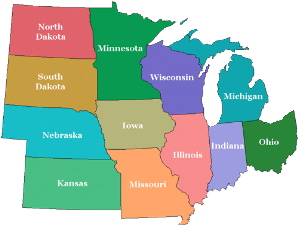
Caught a great front page article in the August 7 issue of Network World: “Middle of Nowhere: The burden of the Midwestern network start-up”. Ah, yes, the incredible burden of being in the sticks. Something we know a lot about here in Minnesota (even though we live in the one of the top 15 metro markets in the country, very often ranked as one of the best places to live and work). Writer Carolyn Duffy Marsan picked up a lot of nuances in this piece, which is based largely on looking at the stats for the 12 states considered “Midwest” from the latest PwC MoneyTree report. [Note: most of the examples she cites are in Ohio, but the article is instructive for any Midwestern startup.] Midwestmap

The biggest news was that Minnesota got a #2 ranking. But don’t look for that in the online version linked above; it’s in a sidebar that appears only in the print version. This sidebar ranked VC funds received by the 12 Midwestern states so far in 2006 (only for “network startups,” considering the focus of this publication). Minnesota, at $32M, was second only to Illinois, at $44M. The next closest, Wisconsin, was way down the list at only $7 million. A pretty solid ranking for the Land of 10,000 Lakes. Actually, there are at least 15,000 lakes here, and we border on the largest one in the world, but I digress…

A few stats from the article: there have been only 25 network startups in the Midwest to sign venture deals so far in 2006, compared to 822 nationwide (of which California alone had 371). The average deal size in the Midwest was $3.7 million. compared to $7.7 million for deals in California, Massachusetts, and Texas, the three leading states for network startups. [According to the aforementioned sidebar, however, Minnesota’s average so far this year is a heady $8 million.]

As more proof that those on the coasts don’t get it when it comes to the heart of the country, Tracy Lefteroff, managing partner of PwC’s VC practice in San Jose, was quoted as saying. “They have research institutions. They don’t have the venture capital and the experienced entrepreneurs to help build those companies.” Wrong on the last two counts, Tracy: we have plenty of entrepreneurs who’ve done it before and are not about to move elsewhere. And we have tons of VC money, too; the firms just choose to invest it elsewhere while giving lip service to how wonderful Minnesota is! [Sorry, my Minnesota VC friends — couldn’t resist.] Lefteroff goes on to say, “The first thing a venture firm will do if it’s investing in a Midwest startup is to move the company.” Wrong again, oh California one. There have been many notable tech startups funded here in recent times that have no intention of moving: HotGigs and Jumpnode (per my previous post), Travanti Pharma, and such other earlier notables as Paisley Consulting and Compellent. Smart VCs from elsewhere are discovering Minnesota, and startups here are discovering ways to go find them, and I think that’s very encouraging. Okay, so our locally based VC funds keep going where they think the grass is greener…let em go. It’s a national market.

The article mentions PrairieGold Venture Partners in Sioux Falls, SD, which still likes the Midwest, although they focus only on investments of less than $2 million. Partner Paul Batcheller says, “Life here tends to be a little easier. For a focused entrepreneur who doesn’t want to deal with traffic, high competition for talent, and expensive cost structures, there are a lot of advantages of doing business in the Midwest. Companies tend to be more focused. Employees tend to be more loyal.”

Another Midwesterner quoted in the article, who’s also worked in Silicon Valley, was Jeff Mills, VP-channel development for Bluespring Software in Cincinnati: “We’re much more grounded here in the Midwest. The venture capital community is tougher on us from the standpoint of due diligence vs. more faith on the coasts. The advantage is that we’re selling less vaporware here.”

Take that, rest of the world! 🙂

Minnesota IT Startups Score Big Bucks

Will wonders ever cease? In what can only be described as one long dry spell, Minnesota IT and Internet startups may now be finally starting to see the flow of venture capital pick up — at least if two recently announced fundings are any indication. [As I’ve written before, lots of money flows to the state’s med-tech startups, but it’s been a tough climate here for IT despite it being a strong sector in the past.]

On July 17, HotGigs, a Chanhassen, MN-based on-demand staffing exchange for contract and full-time employees, announced it had secured a $5.3 million round of Series A financing from Updata Partners, a technology-focused venture capital firm based in Virginia and New Jersey. Hotgigslogo It’s the first round of VC funding for HotGigs, which said it would use the funds to expand its management team, hire more employees, develop new product/service offerings, and launch national sales, support, and marketing efforts.

Here’s the significance of this news: the HotGigs funding is the biggest single round for an early-stage IT or Internet startup in these parts that I can recall since the pre-crash days of 1999/2000. [Note: I don’t consider a certain local storage startup, first funded in a big way about four years ago, to be in this category.]

And, just a few weeks prior to this announcement, another Minnesota tech firm announced a round of funding almost as large as HotGigs. Minneapolis-based Jumpnode Systems, which makes a plug-and-play appliance for IT monitoring, announced it had secured a $5.1 million round of Series A equity financing from Apple Core Holdings and Opticality Ventures, two tech venture capital firms based in New York. Jumpnodelogo It was also the first institutional round of funding for Jumpnode, which had secured its initial funds from angel investors in 2005. Jumpnode said it would use the new capital to expand its executive team, accelerate product development, and expand its sales and marketing programs on a national basis.


Second Time Around
To get a little more perspective on this big news for Minnesota startups, I had coffee last week with Doug Berg, the CEO and founder of HotGigs. Doug had previously founded Techies.com in the 1990s, another online staffing services firm, which was a real rocketship — growing to 600 employees and coming ever-so-close to a big IPO in 2000, before….well, you know. Techies was a client of mine in the late ’90s, and I began talking with Doug about his latest startup in 2002, listening to his ideas and discussing them before he’d even decided on a name for the firm, and also helping him identify competitive offerings and so forth. As a longtime independent contractor myself, I thought his plan to focus on contract employees was right on. [Free Agent Nation, baby!] So, it was exciting for me to learn about Doug’s progress with this recent announcement. He deserves a lot of credit for his persistence.

After Doug whiteboarded his plans for HotGigs in late 2003 with an old colleague of his from Techies.com, Peter Braskett, in early 2004 he obtained an initial round of angel funding in the amount of $250,000 from a family who’d previously invested in Techies.com. By March 2004, he and his small virtual team had launched the initial HotGigs web site. Doug said he began by talking a lot with his old Techies clients to learn their needs. He soon discovered that a really hard problem employers were having was recruiting and managing contractors, which has been becoming a larger component of the workforce in many job functions (not just IT). What these employers needed was a site that could search all their recruiting/staffing firms that dealt with contract employees at once. Also, he learned that the recruiting/staffing firms were quite inefiicient in marketing their people; they needed a lot of help, too. Doug said he realized that no single staffing firm could pull off the online-exchange type of site he had in mind. So, he’d found his opening — the big problem that needed solving.

He realized, however, that there was some educating to do in his marketplace. Many recruiting firms would initially fear such an exchange, much as real estate agents did with the introduction of the MLS listing system. But that proved to be unfounded. And he began to sign such local corporate clients as Cargill, Blue Cross/Blue Shield, and ADC Telecommunications. “The message,” said Berg, “was that what we were doing was a natural evolutionary thing. We needed to bring these people into a marketing mindset. We were now in the Google era — database search.” He said the employers needed a lot of help screening candidates — “going through 500 resumes to five good ones,” he said.

Berg pointed out that it isn’t the employers that pay for his services (and he now has some 2500 such corporate users); the recruiting or staffing firms are the ones who pay. HotGigs first tried a price of $4000 per year, but he said that didn’t work. Later, he hit on $200 per month, and that pricing model took. The firm now boasts 9000 staffing firms as clients, and is adding them at a clip of 1000 per month.

“The business-to-candidate model, like Monster, had already been done,” said Berg. “But nobody was doing the business-to-business model — like Ariba in supply chain management.” There was a huge market at stake, said Berg. “It’s a $129 billion industry now, and will grow to $200 billion by 2010.”

I learned that HotGigs is far from a one-trick pony, however. It has added related service offerings. “We started at the marketplace level,” said Berg. “Now we’re going to contingent workforce management, with a service we call ‘Contract Central’.” Part of this offering is handling all the invoicing and paperwork for corporate clients. The firm is also hosting special intranets relating to this, the first for ADC. But that’s not all. HotGigs recently began offering a service it calls “Career Site Optimization” for its corporate (employer) clients — helping them greatly improve their own job-listing sites for full-time employees, according to Berg. He said HotGigs is already providing this CSO service to Health East and Cingular.

What are Berg’s plans for hiring after the latest funding? He said HotGigs would grow from its current 12 employees to more than 60 by yearend. And he’s already got the same recuiting firm engaged who helped him add 50 employees a week when he was growing Techies.com to 600 employees — so it’s a task he knows well. Doug said 10 web producers would be part of the new contingent, but most of the new hires would be “sales and support people.”

Lesson Learned
Doug noted that his chairman, Ken Holec, a successful Minnesota software executive and entrepreneur, played the key role in finding the investors for HotGigs’ successful Series A round. What advice would Doug give aspiring entrepreneurial fund-raisers out there? “Find a VC that knows your market!” he urged. “Ours was the original investor in CareerBuilder.com. Obviously, Ken and I didn’t have spend a lot of time educating them about our industry.” He pointed out another important thing, too. “These VCs are measurement guys. You have to turn your company into a dashboard so they can monitor how it’s running.”

And Doug Berg seems to have HotGigs’ engine humming along real nicely.

« Older posts Newer posts »