 Here’s a story many in Minnesota have been waiting to hear — especially a bunch of my friends in the local developer and ad
communities who knew something was up.  Yes, Minneapolis startup FanChatter
has finally gone public with what they’ve been doing for the past four
months. FanChatter is a site that “helps sports franchises and other
businesses create a more profitable level of fan involvement through
real-time content sharing.” (More on the company’s About page.) In April, it was chosen as one of the lucky few to be accepted into the summer program of Y Combinator
(YC). Though the actual numbers aren’t announced, I’ve heard only 30
startups were chosen out of almost 1000 that applied. YC is an
organization founded in 2005 that does seed funding for startups.
Here’s how it explains what that means:
“Seed funding is the earliest stage of venture
funding. It pays your expenses while you’re getting started. Some
companies may need no more than seed funding. Others will go through
several rounds. There is no right answer; how much funding you need
depends on the kind of company you start. At Y Combinator, our goal is
to get you through the first phase. This usually means: get you to the
point where you’ve built something impressive enough to raise money on
a larger scale. Then we introduce you to later stage investors, or
occasionally even acquirers.” (More on Y Combinator’s About page.)
YC’s application process
is well explained on their site, a process FanChatter went through
earlier this year, before their selection in mid-April. After sitting
on this story for some time, waiting for the TechCrunch post to break
first (which is the normal way YC companies get announced), what
follows is the result of a phone and email interview I did over the
past few days with FanChatter founders Marty Wetherall and Luke Francl,
who remain in Silicon Valley through August. (The third founder, Norm
Orstad, was not available.)
Tech-Surf-Blog: Tell us about how you came to apply
for the Y Combinator program. Why did you think a MN startup would
stand a chance, and why did you decide to do it this year?
Luke: It was pretty much my idea, but it was
basically for the hell of it. I figured “why not?” We made a pact that
if we got in, we would do YC for sure, no matter what. Being from
Minnesota didn’t figure into my decision at all; YC doesn’t really
discriminate based on geography. As for the timing, it didn’t occur to
me to apply sooner. I think that worked out for us, as YC expanded
somewhat for the Summer 2009 class, due to the $2M investment they had
raised. [That was primarily from Sequoia Capital.]
Marty: I’d always heard about Y Combinator as this
program where only the best and brightest startups were allowed. It
just sounded cool like that, even though I wasn’t very knowledgeable at
the time about Paul Graham or Hacker News. All I knew was that
FanChatter needed something big to happen, so we went for it.
Tech-Surf-Blog: Give us the quick story on the process
— starting from when you applied, to when you were invited to make the
trip to Mountain View to pitch, and then how you were chosen as a
finalist.
Luke: The application is straightforward. The most
challenging part is the video. We spent more than two hours working on
a one-minute video. The first inkling we had that we might get selected
was when Paul emailed me to say our video didn’t work. Crap!
But that showed they were interested. April 6th was nerve wracking as
we waited to hear if we’d gotten an interview. Finally, at 7:30 that
night, we got the email that they wanted to meet with us. We picked a
time and flew out the morning of the interview. Afterward, you have to
wait around until YC calls you that evening. We got called about four
hours after our interview. YC has standard terms which everyone knows
in advance, so you pretty much just have to say “yes” or “no.”
Marty: Couple things. First, I’m a film and TV guy
with well-known Super Bowl spots on my list of credits, and this video
was the simplest thing I’ve ever done. That’s because I didn’t have
the brain space to make it into anything more than dudes talking into a
web cam — but we must have said something right because they told us it
was good! Second, there’s a photo on our blog of Luke getting the call
that we were in. It was a great moment. It felt like FanChatter had
arrived.  [Here's that photo of Luke taking the call from YC's Paul Graham, shot by Marty.]
Tech-Surf-Blog: The amount of seed capital each Y
Combinator startup gets is not huge, but give us your take on the other
benefits of being selected.
Luke: Yeah, the money is not really the main
benefit of Y Combinator for a company like ours. I think if you were
fresh out of college and used to living on ramen, $15,000 or $20,000
would go a long way, but we all have mortgages. On the flip side, we
already have customers and so we can afford to take a little time and
try to make this work. For the company, we get an incredible inside
view of how Silicon Valley works, and a chance to pitch to the best
angels in the Valley on Demo Day. For me personally, I knew I couldn’t
turn down this adventure, even though I’m giving up income and living
apart from my wife for the summer.
Marty: Definitely a once in a lifetime
opportunity. I’ve lived and worked in LA and felt how the film
industry runs that town. Colors everything about it. It feels like
that in Silicon Valley, but it’s tech. In coffee shops, what you
overhear is tech talk. Startups, angels, and VC. It’s been fun to
experience this.
Tech-Surf-Blog: Once you were accepted into the program around mid-April, how were you able to keep it such a secret — and why did you have to?
Luke: Keeping this under wraps has been incredibly
difficult, because we wanted to shout it from the rooftops. But we were
advised not to blog about being accepted to Y Combinator, because then
it wouldn’t be news when we launched, meaning we’d have a difficult
time getting covered by tech blogs. This was a tough row to hoe for us
because we’ve been around for a while. I kind of wish we’d announced it
sooner — we could have easily been the first YC launch of the summer,
but that honor went to our friends at Bump.
Marty: Once we knew we couldn’t talk about it until
we launched, we decided we’d use a new piece of business for our
coming- out party. We got that with the debut of our new ChatterBox
feature on the homepage of the Minnesota Timberwolves.
Tech-Surf-Blog: Tell us what the process was like to
apply and, then, once selected as a semi-finalist, get up in front of
the four judges to pitch FanChatter.
Luke: We spent a lot of time crafting the
application. Every time I looked at the instructions, it seemed like
there was some facet I’d missed, and I tried to hew very closely to the
instructions, especially around answer length. I also paid close
attention to the basics, like spelling and grammar, so there wouldn’t
be any excuses to put our application aside. Paul and his partners look
at hundreds of applications, so I didn’t want to give them a reason to
pass ours by.
Waiting around at the YC office for the interview was the hardest
part. I’d read horror stories about how you’d be able to get out two
sentences and then Paul was just going to savage your idea. So, I
practiced our demo, and Marty practiced our two sentences. There were a
few other people waiting around so I showed them the demo, and I got to
see theirs.
Once we got into the interview my nervousness was lifted right away.
Paul was excited to see our demo. Paul, Jessica, Trevor, and Robert
came around to the other side of the table and crowded around my
laptop. [There's more about the four YC partners on YC's People page.]
Then Paul sort of riffed on things we could do — I think he came up
with about two years’ worth of work in about 10 minutes — while Jessica
tried to bring things to a close so they could stay on time.
Marty: It’s true. Luke kept grilling me the whole
trip out here. “What are you going to do?” over and over. Not in terms
of the interview, but in terms of the company. So, we were ready. The
interview was easy once we got in there. It’s definitely the closest
I’ll ever get to feeling like a contestant on American Idol.
Tech-Surf-Blog: Being chosen as a winner required you
to move to the Valley for the summer. Marty, how did you, Luke, and Norm
handle that, with respect to your “other” lives, and how long are you
out there?
Marty: My wife and two-year-old daughter came out
here with me, which has been both good and challenging. Startup life is
round the clock, but we’ve made it work. In many ways, it would have
been easier as a young guy just out of college, as many of our YC
classmates are.
Luke: I was already doing independent contract
development work (hey, if this startup thing doesn’t work out, let me
know if you need a good Rails developer!), so I finished up the
contracts I was working on and that was about it. My wife and I had
planned to take a trip to Italy this summer (that was “Plan A”), so I
had to pass that up. We’re out here until sometime in September, and
then we’ll see after that.
Tech-Surf-Blog: Describe a typical day for you this
summer in the Y Combinator program in Mountain View. Where do all these
company founders work? Are there events where you all get together?
Luke: For me, a typical day is programming,
programming, programming. We have a quick stand-up meeting in the
morning, and then I try to hack away at our products. I don’t see the
other startup founders much, except on Tuesdays when we all get
together for the YC dinner. That’s the social highlight of the week.
Almost everyone works out of their apartments, though I know of one
group that’s living out of their office!
Marty: Our apartment is in Mountain View, just a
few blocks from YC’s offices. Those Tuesday dinners at Y Combinator
really define the program. That’s where we meet and listen to amazing
speakers from the startup world, including successful YC alums. It’s
interesting to check in with the other founders in our class to see
what they’ve accomplished since the previous week. I think it pushes
all of us to keep up the momentum. 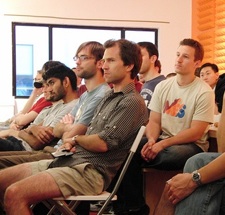 [Here's
a photo of Luke and Marty, center, at one of the Tuesday night
meetings, from a Flickr set by "socialmoth" – a YC alum named Paul
McKellar.]
Tech-Surf-Blog: We’ve heard the mantra Y Combinator
puts forth for its companies is to “Make something people want.” What
did FanChatter, which is not a brand-new startup, propose to “make”?
Did you essentially propose to improve your offering for consumers in
order to be selected? If so, how are you coming with that new work?
And when will new features be available to your existing users?
Luke: I think an increasing number of companies
coming into YC already have products or working demos. They liked that
we had customers — that was very attractive. We sort of pitched it as,
“Look how far we’ve come working on this in our spare time. Imagine
what we could do if we did this full time.” We’ve been rolling out new
features to our existing customers all summer, as well as creating the
new ChatterBox product. Paul’s been very helpful in helping us figure
out the “big picture” of where we should be going: making more revenue
for our clients (and getting a piece of that).
Marty: In our case, we’re making something that
sports teams and other businesses who have fans want. More engagement
so they can make more money. I’ve always believed that content sharing
is the path to engagement, so that’s what we’re doing with Scoreboard
Photo Sharing and the ChatterBox — and that’s just the beginning.
Tech-Surf-Blog: So, what is yet to happen in the Y
Combinator summer program, as you’re now about two months into it — and
what does the future hold for FanChatter?
Luke: “Demo Day” is what it all leads up to. [That's in late August at YC's offices, attended by many VCs and angels.] After that, we’ll see. We’re working on becoming ramen profitable, but also looking to raise some angel money.
Marty: Who knows? Hopefully we’re on to something
and fan engagement can carry us beyond sports and into music and TV and
anywhere fans come together around a common interest. There’s so much
potential for interesting things to happen, and that’s where we want to
be.
I certainly wish my friends at FanChatter all the best
as they go forward. And I love the fact that they just happen to be
doing great things for our sports teams here in the Twin Cities! [The scoreboard at the new Gophers stadium should be awesome, and I'm sure hoping FanChatter shows up there.] For
more on the company, see its news release dated August 4. And the TechCrunch story that broke August 1 is here: YC-Funded FanChatter Takes Social Media To The Ball Game. Another good story followed that on MediaPost’s Online Media Daily.
If you’re a startup thinking of taking a run at applying for the Winter 2010 Y Combinator program, there are some great tips on YC’s site, and a FAQ page provides even more insight into how you might be able to take advantage of this excellent program.
What’s your take? Will you apply? If not, why not? What are your
picks for other promising startups here in Minnesota who should apply? Or is this a complete fluke? Speak out in the comments.









 The breakout sessions include:

 Billed as "the Twin Cities’ premier technology demo
 Action Chess
 BevPost
 enStratus
 LoudClick
 Nabbit
 re-searchr
 SendOnCue
 Socialbrowse
Recent Comments