On Tuesday morning at PC Forum, the kickoff session was Esther Dyson’s interview with Bill Joy, one of the legendary founders of Sun Microsystems and longtime CTO there. “Big Swings at Big Problems” is how the session was advertised. Esther said the last time Bill spoke at PC Forum was 1995, and she 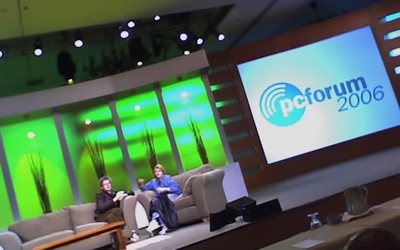 wore the sweatshirt from that event in honor of the occasion. A lot has certainly changed in those 11 years, for Sun and everyone else. In recent years, Bill made the move to VC-land and joined Kleiner Perkins — where his former Sun colleague, Vinod Khosla, has been a partner for many years.
Bill said there are still 15 years left on Moore’s Law, and that the smaller devices that will result from these contunuing technology advancements “will enable many more people to have computers and get educated — if they can figure out how to get courseware on those things.”
But what else is Bill focusing on at KP these days? “We’re looking for innovators who can get more clean water and better energy — and get everyone driving efficient cars. And I mean electric cars, not just hybrids.” [Just an aside: Bill, please call me when the torque on those things equals that of my Turbo Passat, would ya?]
Asked about recent investments KP is making, Joy said “it’s a wonderful time to be working with innovators.” One example, he said, is a still-stealth company KP has backed that’s “putting everything needed for a cheap (computing) device onto one chip.” And [yawn] they also recently did two public company investments (PIPEs). “How much is KP leaving the Valley behind?” asked Esther. “We’ve always had a life sciences group. We still have an IT group, including green tech. Vinod just announced a new fund yesterday. He’s a big ethanol advocate. And I’m working with him on biofuels initiatives.”
Joy continued: “Nanoscale technology is driving the development of new materials. The breadth of proposals is very wide these days. The great stuff always sounds like quakery. I get all those.” Bill also said that a lot of what’s happening today reminds him of 1999, except “there are bigger opportunities worldwide.”
Why haven’t there been many of these new investments yet by KP? “We’ve been looking to invest in a water technology,” Joy said, implying he and his partners just haven’t seen a good candidate yet. “We need ones with little or no maintenance.” For example, no filters to change, he said. “Clean water is the best enabler of good health (in the third world). And electricity is an enabler of many things.”
What about the “laptop for every child” program? asked an audience member. “I’d like to see a ten-dollar computer,” Joy said, “with a roll-up display.”
Esther’s closing comment was, “Bill, you were so gloomy five years ago…” (referring to his now infamous Wired article, “The Future Doesn’t Need Us,” a line of thinking he’s since moved away from). “You just have to keep your eyes on what needs to be done,” Joy said. “It’s an incredibly exciting time.”
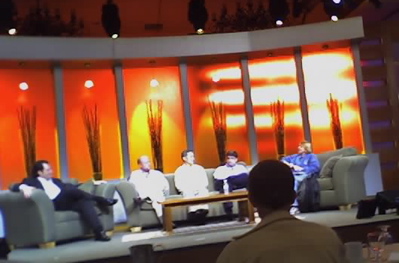 individual websites to do global broadcasting.” What’s interesting now, Jeremy said, is that his firm is encountering an incredible willingness to experiment” (presumably by the traditional video distribution businesses, and by video producers). Why? “Out of fear, to pursue new revenue opportunities, just to stay out in front.” Esther asks what friction he’s seeing…. “It’s similar to the early days of e-commerce,” he said, “where manufacturers worried about going direct, then ended up discovering that blended distribution worked best. It’s the same now.” When asked what challenges he sees, Leonard Liu of Augmentum, whose firm is providing software development services for U.S. firms via a staff of 450 in China, says the challenges are many, including language. “But China is the next big player” in this space, he said. “We’ve seen in India what can happen. But it takes a true understanding of China — for example, the young people are different than the old — as far as how the cultures work together.” Liu said 60% of what his firm does is total product development, “from beginning to end.” Intel is one big customer. And how does Microsoft react, now that it isn’t such a target, Esther asked of the fourth panelist. “How can we marry all this friction-free software to the Windows environment,” was his obvious first answer. “But we see many opportunities — advertising, subscription models, Office Live. This is an exciting time, now that we’re unleashed to an extent. We think we’re responding well to what people want and don’t want.”
 Businesses have a choice whether to lead the changes or resist them. But just deciding to respond isn’t that easy. You have to figure out how: how to put users in charge, how to listen, how to mediate among users who disagree, how to collect revenue (and for what)….and most important, how to change a culture. So, in many ways, things are easier for startups — except they lack resources and have to prove their new business models. So, the discussions will be fun. I have spent the last two months interviewing all the speakers — but I know I’ll still be surprised with what they say, especially once they start talking to one another and engaging with the other participants.
Recent Comments