Its founders met at MBA school, faced some scary challenges over the years, but kept their eye on the consumer. Now valued at $3.5B+ on the Nasdaq, Sezzle isn’t done yet embedding value into its app and platform.
(Note: This post first appeared on the blog of Great North Ventures.)
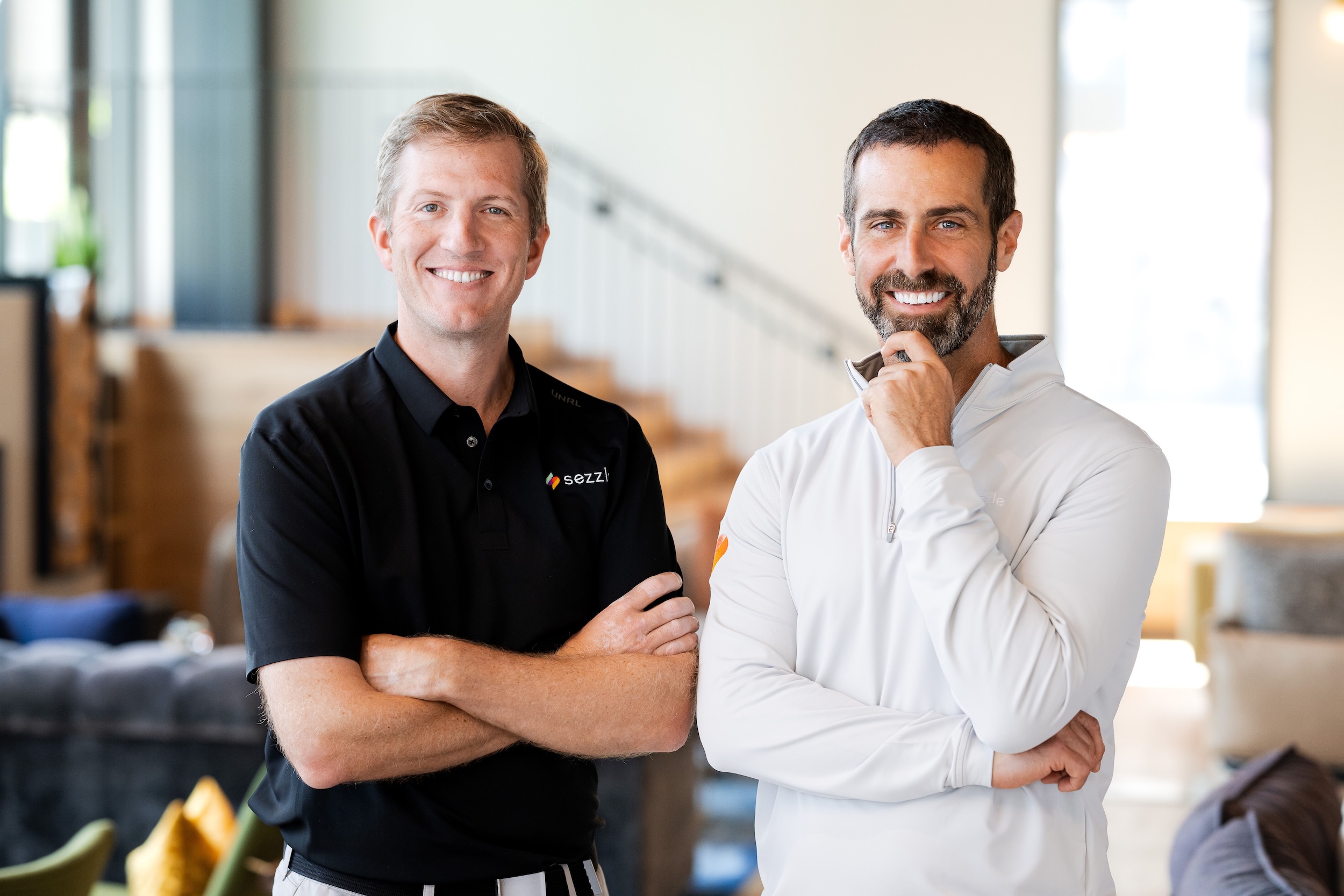
Paul Paradis (left) and Charlie Youakim, Sezzle cofounders.
I first met cofounders Charlie Youakim and Paul Paradis in 2016, just months after they had launched Sezzle. They were part of a pitch session I’d organized at a conference held at the University of Minnesota Carlson School of Management, the very place where they’d earned their MBA degrees six years earlier. Of the six early-stage Minnesota startups pitching that day, three went on to significant success, as I wrote recently. But none quite like Sezzle. The name, by the way, is a combination of “sell” and “sizzle” – and indeed they have.
This is a story about their journey over the ten years since, as related to me by Paul Paradis, Sezzle cofounder and president, with whom I had the pleasure of reconnecting at a founders dinner sponsored by Great North Ventures. Soon after, I arranged a sit-down with him to hear about many of the fascinating moments from the eventful journey of this super-successful startup.
“Sezzle in many ways is putting Minnesota’s fintech scene on the map,” said Rob Weber, managing partner of Great North Ventures. “And there are several more emerging embedded fintech startups focusing on a variety of markets that certainly can be inspired by their story.”
The Sezzle story begins with how Paul met and bonded with his cofounder, Charlie Youakim, the company’s CEO.
The Ping-Pong Partnership
Long before Sezzle became one of Minnesota’s most successful technology companies – and eventually a publicly traded Nasdaq fintech valued in the billions – its two cofounders were simply graduate students at Carlson trying to navigate one of the most chaotic economic periods in modern history.
Paradis and Youakim met at Carlson between 2008 and 2010, right in the middle of the financial crisis. Paradis recalls professors abandoning their planned curriculum to discuss the real-world collapse unfolding in front of them.
“All of our finance classes, the teacher would say, ‘Put your books away. We’re just going to talk about what’s going on right now,’” Paradis said. They had an education in finance they weren’t expecting when they signed up.
The two became close while working together in Carlson’s Consulting Enterprise program on a project for the Itasca Project, studying employment growth in the Twin Cities region. But it wasn’t just classroom collaboration that bonded them. “We became really good friends and ended up just becoming ping-pong obsessed,” Paradis said. “We would just play ping pong all the time together.”
Those early years also shaped their entrepreneurial instincts. Jobs were scarce. Internships had dried up. Traditional career paths suddenly looked fragile.
“I had the pleasure of working with and supporting Charlie and Paul as students. Both were highly engaged and did outstanding work,” said Phil Miller, now Assistant Dean at the Carlson School. “Their class really struggled with the depths of the financial crisis, but I suspect that helped them both in the long term. Paul was a motivated student, and we were able to connect him to a business development role post-graduation. Charlie was a driven founder from the beginning, passing up a traditional internship to work on the code base and business model for what became his first startup. Both of those journeys seem to have given them valuable experience on how they wanted their partnership in Sezzle to go. It’s been a joy to see them struggle through early challenges to the success they’re currently seeing.”
Youakim, a University of Minnesota engineering graduate and former software engineer, moved to Charlotte, North Carolina after business school and cofounded a parking technology startup called Passport. The company raised serious venture capital and grew quickly, but eventually Youakim and his cousin – his cofounder – had a falling out. He returned to Minnesota at the end of 2015 looking for a fresh start.
“He had a big chip on his shoulder,” Paradis said. “He wanted to show that he had something more in him.” Paradis, meanwhile, was growing restless in the consulting world. When Youakim called with the idea of building something new together, the timing was perfect.
The First Idea Failed Fast
The original version of Sezzle looked nothing like the company consumers know today. The founders initially believed they could reinvent ACH bank payments by authenticating bank accounts instantly, allowing merchants to avoid expensive credit card fees while still offering consumers cash-back rewards.
The concept attracted investors quickly. Thanks largely to Youakim’s reputation from Passport, Sezzle raised roughly $1.8 million in seed funding before launching its product – an unusually large pre-launch round for a Minnesota startup at the time. Investors included local angels, former Passport backers, a Belgian VC firm, and even a Chinese seed-stage investor.
But once the product launched in early 2017, the founders quickly realized they had a problem. “The small merchants didn’t care about saving 150 basis points on processing,” Paradis said. “They cared about growing their business. That’s number one, two, three, four, five.”
Consumer adoption was even worse. Even offering unsustainable cash-back incentives of 5% or 10% barely moved usage rates. After only two months in market, Youakim concluded the model was not working.
“He’s very good at that,” Paradis said of his cofounder’s willingness to take quick, decisive action. “In this case, it was a pivot, but more broadly, Charlie diagnoses a problem and immediately sets out to fix it. The rest of us were saying, ‘We raised all this money on this idea. It’s only been two months.’”
At the same time, Sezzle was pursuing a spot in the Techstars Target accelerator program in Minneapolis. The company reached the final interview stage – right as the team was internally debating whether to abandon its original business model. “We were literally debating whether to pitch the old idea or the new idea,” Paradis said.
They did not get selected. In hindsight, it may have been one of the best things that ever happened to the company.
Discovering Buy Now, Pay Later
As Sezzle searched for a new direction, Youakim noticed something interesting happening overseas. A fast-growing Australian startup called Afterpay was exploding in popularity with younger consumers. At the time, the “buy now, pay later” (BNPL) category barely existed in the United States. Another company, Affirm, focused only on large purchases like furniture and fitness equipment. But Afterpay had found something different: smaller installment payments that appealed to younger consumers wary of traditional credit cards.
Paradis and Youakim realized the U.S. market shared many of the same demographic trends as Australia, especially after the CARD Act of 2009 made it harder for young adults to get credit cards.
“We saw a bunch of Australian merchants promoting the hell out of Afterpay,” Paradis recalled. “And Charlie said Australia has always been a great test market for new tech because consumers behave very similarly to the U.S.”
The founders also discovered something critically important from regulators: if they structured the product as four payments or fewer, they could avoid many traditional lending regulations. “That’s when we said, okay,” Paradis said.
Their first sales strategy was surprisingly simple. “We started contacting all of Afterpay’s merchant customers that also sold in the U.S.,” Paradis said. “We basically pitched ourselves as ‘the Afterpay for the U.S.’”
It worked almost immediately. Merchant signups surged. And then Afterpay itself came calling.
“You Can Join Us or Compete Against Us”
Afterpay invited the Sezzle founders to San Francisco with a blunt proposition. “You can either join us or compete against us,” Paradis recalled. The Australian company offered what Paradis described as a lowball acquisition offer. Sezzle declined.
Within months, Afterpay officially entered the U.S. market with major retailers including Urban Outfitters and Revolve. Suddenly, Sezzle found itself in a brutal competitive battle against much larger, better-funded rivals.
The timing could hardly have been worse. Sezzle’s Series A financing nearly collapsed when a Chicago VC pulled its term sheet after Afterpay announced its U.S. expansion.
“That was a big blow,” Paradis said. The company needed a Plan B. Youakim provided it personally. He still owned a significant stake in Passport, his previous startup. When Passport investors offered to buy his shares during a new financing round, he sold all of his ownership and poured most of the proceeds into Sezzle. “He led the Series A himself,” Paradis said.
That decision would later become enormously important. Today, Youakim still owns a substantial portion of Sezzle, thanks partly to that personal investment during the company’s most vulnerable period.
Why Stay in Minnesota?
As Sezzle gained traction, the founders encountered another challenge familiar to many Midwest startups: coastal investors questioning why the company was based in Minneapolis.
“We’d go out to New York or San Francisco, and they’d all ask, ‘Why are you in Minneapolis?’” Paradis said. Some investors openly encouraged the company to relocate. Fundraising, especially for a fintech lender, proved much harder from Minnesota than it would have been in Silicon Valley or New York.
But Paradis says staying in Minnesota ultimately became one of Sezzle’s defining characteristics. “We were one of the only hot tech startups in town,” he said. “So if you wanted to work for a company like that, we had the buzz.”
The company recruited heavily from the University of Minnesota and Macalester College. Paradis also credits Youakim personally for choosing not to relocate the company.
“I have to give a lot of love to Charlie for that,” Paradis said. “I think he would have moved us, and he didn’t, primarily because of me. My family was here. Of course, his family was here, too, but he didn’t have kids yet. My second daughter was born the week I joined Sezzle full-time, and my wife worked for 3M. So I was much more tied down here than he was.”
The Australia Gamble
Despite improving traction, Sezzle still struggled to raise a strong Series B round in the U.S. Then an unexpected opportunity appeared. An Australian equity analyst visiting Minneapolis asked a simple question: Why not go public in Australia instead? That was a way to raise significant funds.
Australian investors already understood buy now, pay later because of Afterpay’s success. Better yet, Australia’s venture capital ecosystem was far less developed, making public listings more common for emerging tech companies. It was clearly an intriguing idea.
Youakim flew to Australia for a non-deal roadshow arranged by investment bank Ord Minnett. “He called me and said, ‘Paul, we’re doing it,’” Paradis recalled. “We were going to be able to raise a lot more money and at a much better valuation.”
The IPO process became a whirlwind. Paradis joined Youakim and Sezzle’s CFO for investor meetings across Sydney, Melbourne, and Hong Kong. At one point, after flying overnight to Hong Kong, the team showered in the airport before heading directly into all-day investor meetings in 100-degree heat and humidity. “It was incredible,” Paradis said. “We were actually planning to take a helicopter to Macau that night to celebrate, but Charlie fell asleep at the dinner table after we ate Peking Duck at the Mandarin Oriental. Still, it was a great ending to a great day.”
The company successfully listed on the Australian Securities Exchange (ASX) in July 2019.
The Crash
For a time, everything seemed to be working. Sezzle raised additional capital. The buy now, pay later market exploded globally. Affirm went public in the U.S., and markets soared during the pandemic-era fintech boom.
Then the cycle reversed – violently. Afterpay sold to Block for $39 billion in 2021, briefly fueling optimism that Sezzle might also achieve a major acquisition or Nasdaq listing. But by late 2021, fintech markets were collapsing.
Sezzle pursued both an IPO and acquisition discussions simultaneously. Nearly every potential acquirer backed away as markets cratered. Except one: Zip, a BNPL company based in Sydney.
The two companies publicly announced a merger. At the same time, Sezzle itself was under severe pressure. The company cut international expansion plans, terminated merchant partnerships, and laid off roughly a quarter of its staff. Its market capitalization collapsed from roughly $1.5 billion to just $40 million.
Nonetheless, Sezzle chose not to close the Zip deal. However, it produced a crucial lifeline: an $8 million breakup fee. Sezzle used that money to stabilize operations and race toward profitability instead of raising additional capital in a terrible market.
“We just slowly started digging ourselves out of the hole,” Paradis said.
Reinventing the Company Again
Sezzle’s eventual recovery required another strategic pivot. The merchant business had become hypercompetitive. Instead of relying solely on merchant integrations, the company shifted toward direct consumer relationships. Sezzle decided to focus on the subprime segment of the consumer market.
It launched subscription offerings, expanded its mobile app, and introduced products like Sezzle Anywhere and On Demand. The company also rebuilt carefully and efficiently.
Today, Sezzle employs roughly 500 people globally, including about 100 in the Twin Cities and approximately 250 in South America, particularly Bogotá, Colombia.
“We’ve found incredible talent there,” Paradis said. “Same time zone, highly educated, strong English skills – and much more efficient from a cost standpoint.”
Sezzle remains headquartered in downtown Minneapolis in the historic Dayton’s building, though like many tech companies it now operates largely remotely.
And despite Youakim now spending much of his time in Puerto Rico, a strategic location between Minneapolis and Bogotá, Paradis says Minnesota still matters deeply to the company’s identity. “He’s here every other week,” Paradis said. “His family’s here. Our roots are here.”
The company listed on the Nasdaq (Symbol: SEZL) in August 2023. It voluntarily delisted from the ASX, and its final day of trading on the Australian exchange was January 12, 2024.
Today, with Sezzle once again thriving, the company stands as one of the most remarkable startup success stories ever produced by Minnesota’s technology ecosystem – a decade-long journey shaped by pivots, near-collapse moments, international gambles, and an unusually stubborn commitment to building a major fintech company far from Silicon Valley.
A Strategy Well Executed
“Charlie and Paul’s ability to execute was very clear from the first time we met with them in January 2018,” said Rob Weber of Great North Ventures. “What was unclear in our initial meetings was how they were going to be able to compete against larger, more well-funded rivals Affirm, Afterpay, and Klarna. But their ability to adapt their strategy over time has been super impressive to watch.” He noted that it was Sezzle’s proprietary business intelligence system that enabled them to accomplish “far more with far less” than their rivals. “We benefited from that approach with our own startup, NativeX, before we became VCs. So we know what a difference it can make.”
Buy now, pay later (BNPL) in its earliest forms took roots through embedded partnerships across a wide range of merchant checkout processes. “It started off as a niche play, but is now emerging as core financial infrastructure,” said Weber, which he wrote about recently.
Recent Stellar Results
Sezzle reported a very strong Q1 2026 with 29.2% revenue growth, gross margins of 74%, net income of $51.3M, and adjusted EBITDA of $71.1M. Management raised full-year guidance, with revenue growth now expected to be 30%–35%, adjusted net income to $180M, and adjusted EPS to $5.10. Key drivers included improving credit performance, higher consumer engagement, and subscriber growth up 44k to 714k.
The company said product expansion is underway, including Pay-in-5, a virtual card in Canada, enhanced long-term lending, Sezzle Mobile on AT&T, and roadmap items such as deposit accounts and checking, positioning Sezzle to become an all-in-one services platform for value-focused consumers.
The company is embedding AI across support, product, and operations to increase efficiency and scale. And it is pursuing a bank charter, with an application targeted for this year, to improve regulatory defensibility and long-term economics.
“It’s going to be an exciting year for Sezzle,” said CEO Charlie Youakim on the earnings call. “2025 was about enhancing our current consumer ecosystem. We improved the app experience, expanded engagement features, leaned back into higher-value consumers, and continue to give our users more reasons to come back to Sezzle. But in 2026, we’re pushing that strategy further. We’re moving beyond being a product consumers think about only at checkout.”
He sums it up this way: “We’re building an all-in-one services platform for the value-focused consumer. The strategic goal is to make Sezzle more useful in more moments. The more value we provide, the more reasons consumers have to come back… We should see consumers using Sezzle more often across more merchants and across more use cases. That’s exactly what we saw in the first quarter.”
As the month of May 2026 came to an end, investment site Seeking Alpha named Sezzle the best performing financial stock of the month based on one month price performance percentage. In addition, that same week, another site published this article: Sezzle Tops the List of Best All-in-One Fintech Apps of 2026.
Learn more about this amazing fintech success story at Sezzle.com.






Recent Comments