Hundreds of participants in Minnesota’s startup community gathered at the University of Minnesota Alumni Center on Thursday for a fun, upbeat evening that included the annual Minnesota Cup awards presentation. This statewide competition seeks out aspiring entrepreneurs and their breakthrough ideas, looking for the next great entrepreneurial success story in Minnesota. It’s open to all entrepreneurs, “high tech or no tech, whether you are just putting your ideas into a business plan or if you’ve been out building your venture.” This year’s competition, the third annual, was launched on March 30, 2007, and attracted nearly 500 entrants. 
During the evening’s program, we heard remarks from the president of the U, Robert Bruininks, and the dean of the U’s Carlson School, Alison Davis-Blake. Bruininks said 19,000 companies have been founded by U of M grads over the years, employing 1.1M people in 50 states and 63 countries. I was surprised to hear that 75% of grads from Minnesota stay here after they get their degrees, and 40% of out-of-state grads stay here as well. Alison Davis-Blake said that the Carlson School’s entrepreneurial studies program is now the fourth largest major, and soon will be third. It’s grown 4x in five years, she said. She closed her talk, however, with what could only be called a sobering challenge for the state: “Minnesota is falling behind in entrepreneurship,” she said. “The energy is deteriorating.” By one measure, she said the state ranks 48th out of 50. [A collective “oooooh” went up from the crowd — as in big ouch!] She was laying down the gauntlet for all of us: “We need a dramatic improvement in innovation here.” Blake closed by ensuring us that the Carlson School is “committed to inspiring and educating the next generation of Minnesota entrepreneurs.”
A Master of the Craft
Next up was a highlight of the event for me: the “Entrepreneur of the Year” award. Gary Holmes, who’s the successful entrepreneur behind the U of M Center for Entrepreneurship, got up on stage to introduce Robert Stephens of the Geek Squad, this year’s award recipient. I’d heard Robert speak once before, and he was tremendous….funny, straight up, right from the heart. Nothing stuffy or boring about this guy! He’s exudes excitement and passion and living his own brand. Once again, we weren’t disappointed. What a great choice for a guy to be so honored, as he continues building out his business, which Best Buy acquired in 2002.  He’s still very much active in running the Geek Squad. Robert opened his talk with a great intro on what his brand is all about: “Imagine a world without manuals. Now imagine a force that dedicates itself, monk like, to reading these manuals — even for stuff they don’t own!” The man knows how to market and have fun — and, hey, does it really get any better than that in the world of marketing? To read all about the brand lore of the Geek Squad, check out their excellent Wikipedia page.
Robert went on to tell the story about how he dropped out of the U of M back in the early ’90s — to, of course, launch his business. In recent years, however, he’s invited back to the U a lot to talk to students. “I think I have now spent more time talking to students than I did being one,” he said. [He put in a hint later that, now that he’s won the Enterpreneur of the Year award, he’s hoping someday to get an honorary degree from the U as well… 🙂 ] 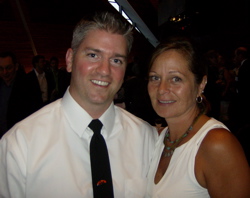 Stephens also told a cute story about how he wanted to marry his wife back in the mid-’90s, but probably wouldn’t have been able to build the business he did if he’d have done that. Instead, they held off and married a few years ago. (That’s her in the photo I took after the event. I was delighted to realize, during Robert’s talk, that she was right next to me at the table where I happened to sit down. She must be a remarkable person, too. As with all successful entrepreneurs, the significant other deserves a lot of the credit, and Robert was gracious in saying so.) By the way, in the photo, note Robert’s Blues Brothers-style clip on tie, and the Geek Squad tie pin. Always living the brand… 🙂 Maybe he and his wife even drove over in one of those cute black-and-white Beetles, too.
An amazing thing I learned about Robert is that he never took on investors in his business. “I applied for a bank loan once, and didn’t get it,” he said. He added, in a note of encouragement to the many entrepreneurs and student-entrepreneurs in the audience: “If you’re poor and struggling, you’re in the best place to be. You have nothing to lose, and you don’t owe anything to anybody.” As his business grew, he went on to look at possibly franchising the concept. But, one day, he just decided to knock on Best Buy’s door. He told them (this would have been founder and now chairman Dick Schulze, or Brad Anderson, now CEO), “Most of my people used to work for you. We can compete or we can work together. Like Reese’s Peanut Butter Cup, it could be a great combination!” The rest is history, and he said he’ll soon enter his eighth year working with the consumer electronics retail giant — where the Geek Squad is the nucleus of the company’s huge push into consumer services, and part of its growing Best Buy for Business initiative as well. Stephens said of his Best Buy experience: “I got a degree in hard knocks founding Geek Squad. Now I’m getting an MBA in the corporate world at Best Buy.” He said he finds it fascinating how the company is actively exploring why companies tend to innovate less as they get bigger. “Best Buy experienced near-death a couple of times. Now they stay paranoid, because the Costcos, the Dells, the eBays keep them that way.” At Best Buy, he said, there’s always a way to innovate.
“I have a vision for Minnesota,” said Stephens. “We have way more advantages here than meets the eye. It’s no suprise to me that so many great companies are located here … Life is harder here. But we sit by the fire and strategize. We’re innovators here!” He said he really wants to see much more entrepreneurship in Minnesota. And he even advised entrepreneurs to “hold off taking money if you can, to build your business.”
In closing, Stephens said Geek Squad now has more than 12,000 “agents” (employees and contractors). He said he likes to tell them, “You won’t solve world peace, but you might fix the hard drive of someone who will. Or cure cancer.” He said U of M staff and researchers have been big customers of his over the years.
To learn more about Robert Stephens, here’s an online bio for a conference where he’ll be speaking this fall. Also, here’s an excellent interview, and quite a detailed one, that a leading banking publication did of Robert earlier this year. The man gets PR — and there’s certainly a lesson there for MN entrepreneurs.
The Main Event
But the part of the evening everyone was waiting for was still yet to come: the announcement of the winner of the 2007 MN Cup. No one but the judges, who had met earlier in the afternoon to hear the pitches from the five finalists, knew who was going to win. It was the culmination of months of activity, with the MN Cup organization gradually culling down the applicants to the chosen few deemed most promising, and then the judges choosing just a single first-place winner. Here are brief descriptions of the five finalists, as included in the event program:
1) It’s Fresh. Our mission is to deliver comprehensive solutions focused on food freshness, designed to increase consumer satisfaction, taste, and quality through simple, easy-to-use solutions.
2) Muve. Based on a ground-breaking research study on obesity from the Mayo Clinic, Muve Inc. is prepared to commercialize products and services to cure the global obesity epidemic. (Dr. James Levine, founder of the company, led that research.)
3) Persata. A free-flowing community of users who build “crowds” around specific topics and collect quantitative information, as opposed to writing articles or blogs, in order to build a mini, topic-specific database on the fly.
4) Reshare. A “distribution relationship manangement” software and strategy company, with the only patented channel management solution that enables manufacturers and brand owners to sell online directly to end users without circumventing valuable channel partners.
5) Snap Pea. This company’s pick-up sites provide the convenience of same-day delivery of a made-from-scratch, customized, and freshly assembled meal to corporate office complexes.
We had heard pitches from each of the five earlier in the program — but only two minutes each, which seemed really short. [Hey, Dan and Scott, how about three or four minutes next year?] Now the tension was mounting. Dave Cleveland, the godfather of local small business banking, was called up on stage, with his wife Carolyn, to present the awards, starting with the third place winner, Persata …. then the second place winner, It’s Fresh …. then, drumroll, the first-place winner …. Muve!
John Montague, CEO, of Muve Inc., was called to the stage amidst a standing ovation and gave a very inspired, from-the-heart talk. As someone said later, there wasn’t a dry eye in the house. “We all like to help people,” he said, “and I decided (in accepting the position to lead the firm) that this company was going to do great things.” The two key words in choosing one’s work, Montague said, are “passion” and “purpose.”  An experienced entrepreneur, he said the key turning point for him was in January of this year when he met with Dennis Anderson. [Dennis is the godfather of local executive recruiters, and has done more for emerging companies in this state than any other one person I know. So, I was delighted to hear him get this tribute.] “Our discussion changed my life,” said Montague. This company was about more passion and purpose than I’d ever imagined. Now I can’t sleep at night!” What I also thought was cool was the way Montague paid tribute to Robert Stephens, who has obviously made a big impression on him over the years. “He’s a marketing genius, and the way he brings passion and purpose to his job on a daily basis is an inspiration.”
The other really cool thing I learned Thursday evening, actually during the networking break before the awards were announced, while chatting with a client of mine, Marc Seaberg, was that he was hired as Muve’s first employee! Marc is a 2003 graduate of the University of St. Thmas. Along with his father, John Seaberg, a former senior executive of medical device giant Guidant (now part of Boston Scientific), he founded an online business in 2006 called Wellness Choice, which I had the privilege of working with over the past year. What’s interesting is that Marc and his dad were also both motivated by a sense of purpose in launching that small business, to help people lose weight and quit smoking. While the products of firms like Guidant, Boston Scientific, and Medtronic save thousands upon thousands of lives, they felt that so many of those people wouldn’t need them in the first place if they just led more healthy lifestyles.
Tonight, we were hearing from another young guy so inspired — to make a difference for mankind through his company and his personal sense of purpose. I was reminded of an entrepreneuer from an earlier era in Minnesota entrepreneurship — Earl Bakken, the founder of Medtronic, a company I once worked for, where we were all grounded in that same sense of purpose by Mr. Bakken himself. And I’m sure I wasn’t the only one in the audience thinking about this legacy.
For more on this great new Minnesota startup, Muve Inc., see this story from the Rochester, MN, Post Bulletin, written the day before the MN Cup awards were presented. And here’s an interview of Montague by local radio station Cities 97, the morning after the event.
All in all, it was exciting evening last Thursday, and I hope I’ve been able to convey some of the upbeat feeling for those who couldn’t be there in person. What do you think about Minnesota’s entrepreneurial climate? What’s good, what’s bad, what more can be done to make it an even better state for startups?


Recent Comments