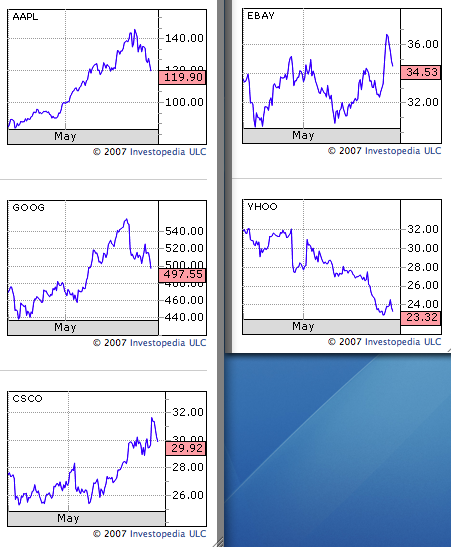
Maybe today’s charts will help you realize:

Go forth and multiply…
Reflections & analysis about innovation, technology, startups, investing, healthcare, and more .... with a focus on Minnesota, Land of 10,000 Lakes. Blogging continuously since 2005.
Maybe today’s charts will help you realize:

Go forth and multiply…
We are in a major period of disruption in the advertising industry. I have never been more convinced of it. Getting into the middle of the ad:tech conference last week (see previous posts) just helped me experience and understand it even better, up close. The online portion of the industry is on a trajectory that cannot be stopped. (See graph in previous post.) The movement toward a new world order in the ad business is a major, ongoing story, and I can’t help but get excited about the changes and the opportunity it holds for so many of us.
Let me digress a bit. This story isn’t about me, but a little background: I began my career in an advertising agency — at what was then a top Minneapolis firm, which had many people who went on to ad fame and fortune. Nothing beats starting in the mailroom, that storied beginning in the business, where you learn so much, so quickly. And I danced in and out of the agency business for several years, even joining a top-ten worldwide ad agency as an account exec for a time, on a major, Fortune 500 piece of business. Later, in mid-career, I launched of my own marketing consulting firm, actually serving as an ad agency for several of my small tech and B2B clients, among my other duties, for quite a few years.
The reason I had earlier left the traditional agency business was because I thought it was mired in old ways of doing things. It didn’t get technology. It didn’t understand systems and productivity and stuff — you know, being out in front with new techniques and computer-driven processes. It relied only on the ethereal “creativity,” and, of course, the old boy network of expense accounts and golf and long lunches. It was living in the past, on old glory. It lived and died by winning and losing accounts, of course (it still does). But where was the innovation that would move things forward? It didn’t take me long to know I had to get back into tech, which I’d gotten a taste of soon after moving on from that first job in an agency. (I had graduated to being a copywriter on the client side. Computers and software were so much more exciting.) Once I finally left behind the idea of working for a large agency and went whole hog into tech, I never looked back (though I was certainly able to apply some of what I’d learned in running the business I later founded, especially how to manage client accounts and make a profit).
Today, traditional ad agencies still control a majority of the business, and traditional media still account for the vast majority of spending. But, boy, are things changing. The light is getting brighter at the end of the tunnel. The newer breed of tech-savvy, interactive, digital agencies is on the rise, along with new technology-based services, ad networks, exchanges, behavioral-targeting technology companies, widgets, and much more. Acquisitions are flying about everywhere. The dynamics of the industry are in major flux. The old ways, the old agencies die hard, but they do die. They must evolve, or new players simply step in. I liken much of the plight of the old guard today as rearranging the deck chairs on the Titanic. Sadly, some will surely go down. But so many new players will attain leadership positions in the industry.
Nowhere is this trend more evident or interesting, I think, than in the acquisition earlier this year of Digitas by Publicis (say it with me now: poob-li-cees), whose leader, Maurice Levy, claims he started the whole recent big-acquisition binge.
It’s hard to argue that the man doesn’t see the big picture. This recent article in the New York Times tells the story very well: It’s an Ad, Ad, Ad World. And the larger story about Publicis even has a local angle of sorts, in that famed Minneapolis agency Fallon is part of that holding company.

On hard times lately, the agency recently announced that its chairman, Pat Fallon, was handing over the reins to Publicis sister agency Satchi & Satchi. The Fallon agency was a strong player early-on in interactive, but later jettisoned that department to refocus on the traditional part of the business. I never understood why.

Today, there’s no denying the ad game is changing — big time. Online is the new sheriff in town. GOOG and MSFT advertising companies? Who would have believed such a statement even six or seven years ago? Are they agencies? Well, they’re being very careful to hedge on that question. Perhaps they never will be. Meanwhile, the old guard is desparately trying to protect its flanks, preserve its share, posturing and manuevering at every turn, trying to out-smart competition coming at it from everywhere. The dollars are major, so it’s a fight worth watching.
But in this whole mix, of this there is no doubt: technology is finally coming to rule the advertising business. The Internet changed everything, and keeps on changing everything. And opportunity is adundant for new careers, new companies, and new wealth beyond our wildest dreams.
It’s about time!
Update: To add the pronunciation of Publicis….only because I love to talk Francais once in a while.

Seems a little deal has been brewing. He just got rich — again. This just in from the Wall Street Journal:
Hewlett-Packard agreed to acquire software maker Opsware for $1.45 billion as the PC giant continues to bulk up its non-hardware offerings. Opsware was co-founded by Marc Andreessen, the young brain behind Internet pioneer Netscape.
Not that he wasn’t already rich. Why does this guy even need to work, anyway? I guess he’s still too young to know any better…. 🙂
Here’s Marc new blog if you haven’t seen it yet. Where he reminds us that the deal was for all cash. Several bloggers, myself included, have been going on and on lately at how great a job he’s been doing with his blogging — really some nice, long, thoughtful pieces, tips about raising VC, etc. (I’ve cited them somewhere on one of my blogs — forget where right now). Suddenly he was being so generous with his time! Sure, he has a great CEO running his popular new firm, Ning (which, by the way, just announced a $40M+ VC infusion).
But I say, hooray! He gets richer, and we all get to benefit more from his great writing — his new career of blogging. Go for it, Marc….
PagePow Inc., a new web technology startup based in Minneapolis, today announced the launch of a private beta at PagePow.com. PagePow enables bloggers and web content owners to easily copy and paste web-based widgets into their blogs, web sites, auctions, social networking sites, and more. PagePow.com is immediately avalable as a private beta.
The startup is debuting with seven widgets:
– 5-Star Rating
– Poll
– Quiz
– Page Counter
– Google Map
– Contact Us
– Send Page to Friend

More widgets are planned. A key differentiator with PagePow is that bloggers and content owners will also have access to comprehensive reports generated by all the widgets they use. PagePow members will easily be able to monitor all the data their widgets produce through one simple interface at PagePow.com.
“Web site ease-of-use is a major focus for us, ” said PagePow founder Joe Sriver, an experienced UI designer whio worked in Silicon Valley for several years. “We spent a lot of time creating a simple, intuitive user interface to make sure people can come to the site, easily find what they need, and copy the code to their site within a couple minutes.”

PagePow allows webmasters and bloggers to concentrate on generating content without having to worry about programming to have the cool features they want on their web sites, said Sriver.
PagePow offers comprehensive reports detailing statistics from PagePow widgets. “We wanted to offer widgets that any site could potentially use. We won’t have widgets that have a very narrow user base. For example, our poll widget can be used for any question,” said Sriver.
Users of PagePow widgets will be able to track all the data they generate while using the widgets, by logging in to PagePow and seeing their ratings, comments, poll/quiz answers, etc. all in one place. “This is something I haven’t seen on similar widget sites,” said Sriver.
“We let everyone take advantage of our widgets — not just webmasters or bloggers who put the code on their pages, but any user of the widgets.” Users will receive a one-time only pop-up dialog when they confirm their vote, comment, etc., and PagePow will prompt them to log in and will briefly explain the benefits of tracking their data.

Those interested in participating in the PagePow private beta can submit their name and email address at PagePow.com. Private beta testers are invited to comment on the functionality and UI and anything else they wish, said Sriver. A stage-one Public Beta is planned for the near future.
AdaptiveBlue, a company we covered here and here last September when they debuted at DEMOfall, today launched the latest version of its BlueOrganizer plug-in for the Firefox browser, which it calls Denim. Alex Iskold, the founder and CEO, is a friend of mine, and a fellow writer at Read/Write Web. (Okay, I’ve written two posts there and he’s done what seems like 50 or more, and they’re all amazingly good.) How he finds time to do all this writing and run a startup, I don’t know. I’m threatening to start calling him Superman. Alex’s firm is based in New Jersey and was funded in a Series A round last fall by Union Square Ventures of New York City.
Anyway, I downloaded and installed the plug-in in about 30 seconds on my Mac. It’s an elegant solution — and the web site is very clean, well functioning, and informative, with good demos, graphics, and explanations. The plug-in worked flawlessly for me right from the start, and I’m now thinking it could turn me into more a Firefox user… 🙂
Duncan Riley reported on the launch today on Tech Crunch, noting that “Adaptive Blue also enters the widget market. The new ‘sharing links’ feature allows users to embed semantic links into any web page, include bookmark style lists in a sidebar, or just embed a traditional widget. Affiliate programs are fully supported with no revenue sharing; if a user includes their affiliate code for programs such as eBay and Amazon they keep 100% of any associated revenue.”
Richard MacManus also published a post today on BlueOrganizer on Read/Write Web, under the title “Semantic Web In Action?” He explained that BlueOrganizer “aims to provide extra contextual information to you while browsing the Web. Basically, after you install BlueOrganizer in Firefox, it enables you to discover all kinds of relevant content while you’re browsing – such as books, music, links, related information, etc. Essentially then, it adds personalization and semantics into the browser.”
How’s the new version of the plug-in different? “First,” says Alex, “it’s just much more fun! Its lighter, more clickable, and takes less space both in the toolbar and in the sidebar. There’s also a new BlueMenu right in the toolbar. This makes the menu much easier to use for people who are not into right-clicking.” He also says that the latest context detection algorithm “is a huge improvement over the previous versions. Try it on blog posts about books, music, wine or another topic and see for yourself.”
Probably the most important new feature is SmartLinks, according to Alex. “These are web links that feature contextual shortcuts. They carry all the smarts about the objects right into blog posts, web pages, and social network profiles.” With SmartLinks, he noted, you can share the power of context and semantics with your friends, family, or readers.
“This is fundamental and big,” Alex proudly points out. “We’re bringing semantics into the most basic element of the web – the link. Imagine the web where links no longer point to pages, but point to things….users can get to information faster; information that’s contextual and relevant.” While some people might call this the Semantic Web, “we would not be so presumptuous,” Alex says. “But we think BlueOrganizer and SmartLinks are powering a smarter web and that, in turn, paves the road to the real Semantic Web.”
© 2026 Graeme Thickins on Tech
Theme by Anders Noren — Up ↑
Recent Comments