Well, two days since my return from San Diego, let me summarize my take on the latest DEMO event and share some random images and opinions. First of all, everything was extremely well run. This is *the* most crack conference team on the planet — logistics, food, press support, absolutely flawless wi-fi, the whole nine yards — even great bumper music. 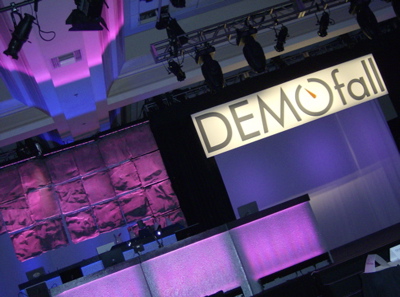 I just wish theyda told me the hotel had two towers, and that if you were unlucky enough to make your reservations a bit too late, you’d get stuck in the West Tower and have to hoof it three-quarters of a mile to where the event was held, in and around the East Tower. For the prices, there has to be a better venue in the San Diego area.
But, more importantly, what was the tenor of the event, and what were the takeaways? I touched on a lot of that in my report published on event-review site Conferenza.com the other day. But let me ramble on a bit more, now that I’m two days removed from it all. DEMOfall was definitely an upbeat affair — exhuberance was in the air at every turn. [Even if sunshine wasn’t. Now, if someone could demo a technology that would remove fog, haze, and overcast from the San Diego climate, that would really be something!] 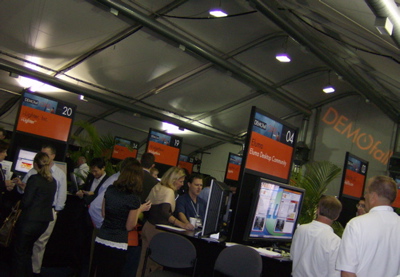 It was reminiscent of the pre-crash conference scene for sure — and I wondered how many of these people were experiencing this “high” for the first time. My guess would be a large percentage, because there were many, many young faces in the crowd.
The mix of technologies — consumer tech vs. enterprise IT, business vs. home, widgets vs. software (including another kind of widget!) — was excellent. There was something here for everybody. Almost too much — but that’s always the case at DEMO. Trying to cover it all is essentially impossible for any one reporter. Which is why outfits like Ziff Davis/CNet send multiple people — but they have separate media entities, too, which is how they can do that. 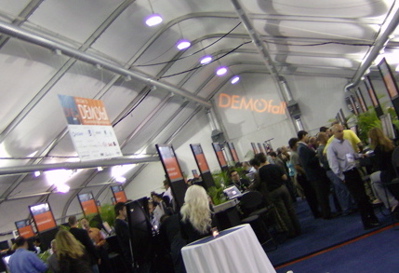 The press policy is a very democratic one, I learned: it allows only one reporter from any one media outlet, even including the WSJ, NY Times, USA Today. But let me apologize now for not covering all 67 presenting companies. Nothing against any of you that I didn’t — just not enough time. It’s flatly impossible to do, with any depth, anyway. [I did manage to blog some 37 of them, though!]
Would I recommend DEMO as the launchpad for a new startup? Absolutely, positively — if you can handle the rigor and the preparation. It’ll make a better company out of any fledgling startup, I assure you — just going through the process (starting with getting accepted). The next event, which will be #25, is in Palm Desert, CA, January 30 – February 1 (where the weather is guaranteed to be much better). It’s at the Desert Springs Resort & Spa. How does one apply to present? Read all about that here.
Let me share a few more pix I shot at DEMOfall — these with my new little HP Photosmart M425. That’s the one with the new “pretexting” feature… 🙂 Five megapixels, very compact, 3x optical — not bad for a hundred bucks. [More proof of The Cheap Revolution, as Rich Karlgaard calls it.] I’ve included a shot from the demo of the wi-fi bunny, from Paris-based Violet, a product Ed Baig of USA Today called “easily the silliest Demo product.” 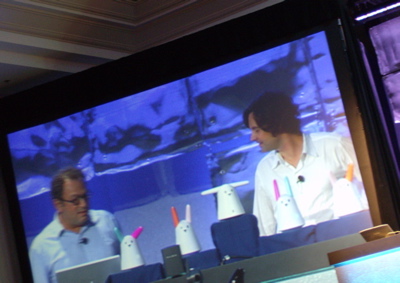 Another of my shots shows the two presenters from Eluma on stage, including VP marketing Joe Lichtenberg on the right, who just told me his firm got one of the coveted “Demo God” awards that were handed out at the final evening’s dinner (which I had to miss).
  That’s two Demo conferences in a row where companies I’ve run into early and blogged about became Demo God winners. [Just lucky, I guess…]
A funny scene near the end of Wednesday’s closing session was Chris Shipley strutting out with the surfboard giveaway, replete with shades, to the sounds of The Beach Boys’ “Surfin’ USA.” 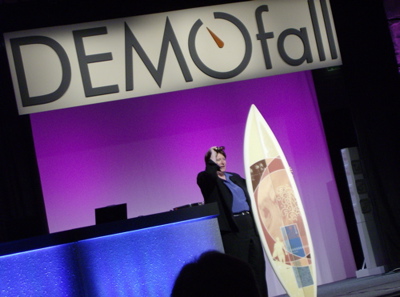 I was so hoping to win that nice stick (donated by sponsor Qualcomm). But, alas, the guy in front of me did — and he didn’t even seem excited about it. Dude?
One final ranting bitch about the show, which I just have to get in, is exemplified by my final photo, which is of the CEO of Moixa Energy presenting. [You’ll remember this outfit, if you’ve been reading my blog, as the one that got my vote for the worst name — though I’ve since decided it’s a tie with PrefPass.] His “USB Cell” may be cool — though it certainly isn’t the most visually elegant product I’ve ever seen. 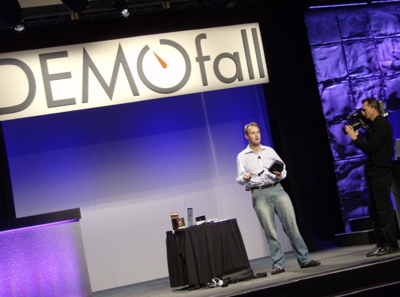 But could the guy conjur up something better to wear than the most god-awful pair of jeans I’ve even seen? I look better than that when I’ve done lumberjack work for three hours in the woods behind my house, for kee-rist sakes. In his defense, he was just one of several presenters who were dressed shabbily. And, sorry, anything including jeans fits that category for me. Please, Chris, can we have a dress code for presenters? It’s the least they can do for us. Hey, if Steve Jobs is coming on stage — fine, he wears what he wants. But these guys, they ain’t no Steve Jobs — okay? 🙂 Certainly not yet… And having them pretend like they are is just too hard to stomach.
What were the takeaways of DEMOfall 2006?
• The tech economy is strong. But we’re not in a bubble, according to the show’s producers. [How could we be when the Nasdaq is still 55% down from its high in the year 2000?]
• Money is flowing. Many of these startups-you’ve-never-heard-of have already raised substantial funding, as reported in their profiles. And a person can only wonder how so many of them get such amounts, based on what appears to be a sketchy or risky plan. I can only recall a few presenters who said they were bootstrapped — that is, surviving just on their own funds at this point. Whatever happened to the raw, truly undiscovered startups getting a chance? Must they all be VC-backed already?
• Consumer tech continues to influence enterprise IT. And Web 2.0 type services are leading the way here. The center of gravity is now on the consumer or individual user side of things. Internet apps are where the most energy is these days, not in computers, operating systems, desktop apps, and the corporate IT power base of old.
• The tech economy, and really the entire economy, is going global faster than you think. This Demo had the largest number ever of non-U.S. presenting firms. And who knows what percentage of all the firms that pitched are relying at least partially on offshore technology expertise to develop their products. Either that or on immigrants who now call the U.S. home.
One final thing: links to a couple of excellent recaps of the event by some of the good press people covering it. First, a story from CNet with several contributors, including Rafe Needleman, Daniel Terdiman, and Dan Farber, all of whom I chatted with at the conference. And another good story is from Thursday’s edition of USA Today, by Ed Baig.
Tags: DEMOfall 2006
 It provides an overview of the event — the tone, the tenor, the themes. Check it out
  They’ve raised $8 million for far from Sequoia and Globespan. Today, they announced JajahMobile, which lets you make free international calls from your cell phone — no new phone needed, no new number, and no contracts. I love the way the Demo folks describe their competition: “the global telephony industry.” Yes, indeed, and it should be plenty worried.
 The system, which has a very clean, attractive interface, always tells you who’s calling, and it gives you four options on how to deal with any call: accept it, send it to voicemail, listen to the voicemail, or accept and record the call. The latter is especially useful if someone’s giving you information but you can’t write it down because you’re driving, for example. Grand Central has been funded to date with $4 million from Halsey Minor’s venture firm, Minor Ventures, also in San Francisco, and it inherited the name and domain from a previous company of Minor’s that was in an unrelated business.
  And the prices for using the site builder tool and hosting services are very reasonable, starting at just $15 per month. If you ever get called on to help friends or relatives set up a web site (don’t we all?), this is where you should send ’em! As described today, SiteKreator offers the elegance and sophistication of a design studio at the price of a common site builder.
 My first real look at it was in their demo today, and I must say it’s an elegant interface. Changes the game. But it should be for what they paid Frog Design to do it! (Nothing like all that Microsoft money, and Bay Partners, too.) It was completely developed in Flash. Check it out. The business model of this MySpace and Facebook competitor is interesting — no advertising! Its revenues will come strictly from taking a 30% cut of all e-commerce on the site — but that should be a very, very nice number.
 Each of the “scrapblogs” you create with this free service –and it’s aimed at parents, newlyweds, vacationers, etc — is a rich-media blog that’s formatted very nicely for either sharing online or printing into a high-quality photo book. The design, attractiveness, and ease-of-use of Scrapblog was very impressive.
 The service lets you use your photos, videos, games, music, and sound effects to create an “immersive” mix, and then share it via email or IM, and/or publish it anywhere, to any web page or blog. The company calls its “mods” creation a totally new way for people to express themselves. And they seem to be convincing, already having raised $3 million in VC from Maveron. iBloks sees a ready market, too, citing a Forrester study that says 31% of consumers now spend an hour or more a day on social networking sites. [Now I’m wondering if anyone’s measuring how much work (or homework) isn’t getting done as a result?]
  What it specifically does is connect them with local events where they can meet their friends — old and new — by the hundreds, it seems. They’re only active in their home base of Boston right now, but they had a rush of 80,000 twenty-somethings sign up on their site in a short period of time recently, still in their pre-launch phase. [And, yes, they already have Series A funding from Highland Capital and General Catalyst.] Naturally, they have plans to go national. You heard it first at Demo, folks…
 It’s about sharing, publishing, and even selling your creative work — and it’s all free. eSnips puts content at the center of things, and lets it lead the way to creating new relationships. Think artists, photographers, karioki enthusiasts, anyone who wants to share his or her passion or creative pursuits. Users each get 1 gigabyte of storage for free. You just upload to folders, each of which becomes a web site — designated private, group, or public. There’s no limit, and files can be of any type. “It’s a social network focused on finding people,” the CEO said. It must be catching on, because she said eSnips already has one million registered users, and the site is now logging 3 million unique visitors per month. Geographic distribution includes about 30% U.S., and a fairly equal spread between Canada, Europe, and Asia. The Israeli based company received a seed round of funding from Gemini Israel Funds.
  The firm claims that browser personalization is the next step in personal productivity online, but notes that the market is not clearly defined — overlapping with targeted advertising, for one thing. The Demo producers call Adapativeblue’s Blueorganizer “a sight for sore eyes, going beyond social bookmarking by turning your browser into a productivity tool….It’s a browser with a brain, and it’s about time.”
  He was debuting
  His company’s solution means “personalization without registration.” Once you enable the service at the company’s site (very quick), it’s a simple, one-click process to indicate your interest in a site without identifying who you are. PrefPass is essentially a portable, user-managed identity.
 It’s a shaped-based search engine, which has obvious applications in finding manufactured parts. As Demo says, “If a picture is worth a thousand words, a doodle may well be worth that many keywords.” This search technology could be applied to many other industries as well, and who knows what possibilities in the consumer world.
 Its gig is taking virtualization up a layer, separating it from the OS and allowing it to run in a new operating environment. The firm’s technology involves what they call an “application capsule,” which isolates an app into a known good state, said CEO David Roth. Their software essentially encapsulates the app from its underlying operating system and infrastructure. “And we get amazing performance,” said Roth, “typically less than 2% difference.” Demo says of Trigence: “Expect this company to follow a trajectory that maps to the meteroric rise of VMware, and to take that trip faster.”
 And because it’s an open source system, it allows use of such technologies as Zimbra open source messaging and collaboration. “It lets Web 2.0 become a business reality,” said Greatwood. The most impressive part of this live demo, though, was seeing Greatwood take down his PostPath server, then do a restore in a minute or so, which would have taken hours with an Exchange server.
 No plugins needed. Widgets — which are live, dynamic content — used to be hard to find and hard to use, said CEO Ed Anuff. Now the process is easy, since Widgetbox organizes them into a marketplace, where you can quickly find what you need and grab it. What’s more, developers (there were 5000 in the beta) now have a way to get their widgets out to a large and growing market.
 Sure, there are others trying to help people measure what’s being said about their company in the blogosphere, but they’re nowhere near as visually rich and powerful as this one.
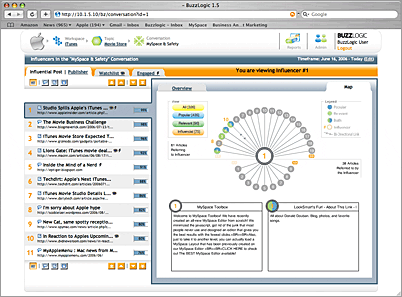 One of the cool features it has is the ability to draw “social maps” of influencers in a conversation, which the company describes is “essentially a critical path of the relationships between key influencers.”
Recent Comments