Well, two days since my return from San Diego, let me summarize my take on the latest DEMO event and share some random images and opinions. First of all, everything was extremely well run. This is *the* most crack conference team on the planet — logistics, food, press support, absolutely flawless wi-fi, the whole nine yards — even great bumper music. 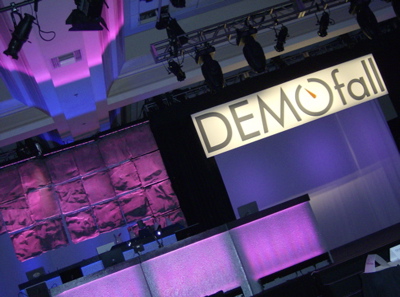 I just wish theyda told me the hotel had two towers, and that if you were unlucky enough to make your reservations a bit too late, you’d get stuck in the West Tower and have to hoof it three-quarters of a mile to where the event was held, in and around the East Tower. For the prices, there has to be a better venue in the San Diego area.
But, more importantly, what was the tenor of the event, and what were the takeaways? I touched on a lot of that in my report published on event-review site Conferenza.com the other day. But let me ramble on a bit more, now that I’m two days removed from it all. DEMOfall was definitely an upbeat affair — exhuberance was in the air at every turn. [Even if sunshine wasn’t. Now, if someone could demo a technology that would remove fog, haze, and overcast from the San Diego climate, that would really be something!] 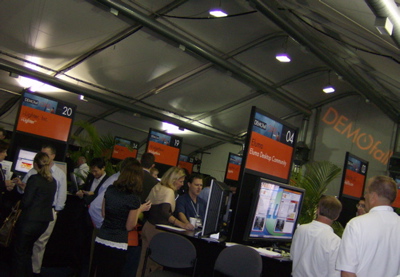 It was reminiscent of the pre-crash conference scene for sure — and I wondered how many of these people were experiencing this “high” for the first time. My guess would be a large percentage, because there were many, many young faces in the crowd.
The mix of technologies — consumer tech vs. enterprise IT, business vs. home, widgets vs. software (including another kind of widget!) — was excellent. There was something here for everybody. Almost too much — but that’s always the case at DEMO. Trying to cover it all is essentially impossible for any one reporter. Which is why outfits like Ziff Davis/CNet send multiple people — but they have separate media entities, too, which is how they can do that. 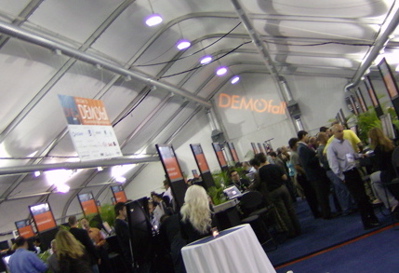 The press policy is a very democratic one, I learned: it allows only one reporter from any one media outlet, even including the WSJ, NY Times, USA Today. But let me apologize now for not covering all 67 presenting companies. Nothing against any of you that I didn’t — just not enough time. It’s flatly impossible to do, with any depth, anyway. [I did manage to blog some 37 of them, though!]
Would I recommend DEMO as the launchpad for a new startup? Absolutely, positively — if you can handle the rigor and the preparation. It’ll make a better company out of any fledgling startup, I assure you — just going through the process (starting with getting accepted). The next event, which will be #25, is in Palm Desert, CA, January 30 – February 1 (where the weather is guaranteed to be much better). It’s at the Desert Springs Resort & Spa. How does one apply to present? Read all about that here.
Let me share a few more pix I shot at DEMOfall — these with my new little HP Photosmart M425. That’s the one with the new “pretexting” feature… 🙂 Five megapixels, very compact, 3x optical — not bad for a hundred bucks. [More proof of The Cheap Revolution, as Rich Karlgaard calls it.] I’ve included a shot from the demo of the wi-fi bunny, from Paris-based Violet, a product Ed Baig of USA Today called “easily the silliest Demo product.” 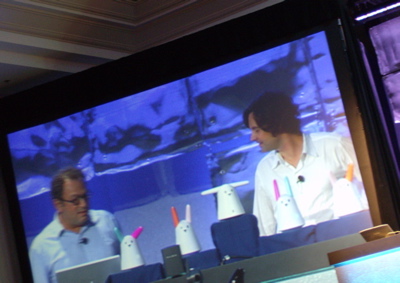 Another of my shots shows the two presenters from Eluma on stage, including VP marketing Joe Lichtenberg on the right, who just told me his firm got one of the coveted “Demo God” awards that were handed out at the final evening’s dinner (which I had to miss).
 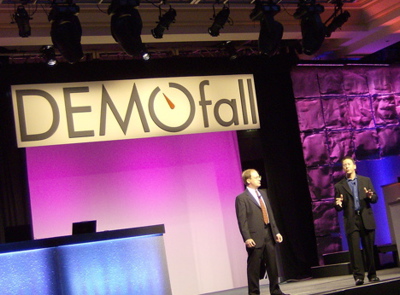 That’s two Demo conferences in a row where companies I’ve run into early and blogged about became Demo God winners. [Just lucky, I guess…]
A funny scene near the end of Wednesday’s closing session was Chris Shipley strutting out with the surfboard giveaway, replete with shades, to the sounds of The Beach Boys’ “Surfin’ USA.” 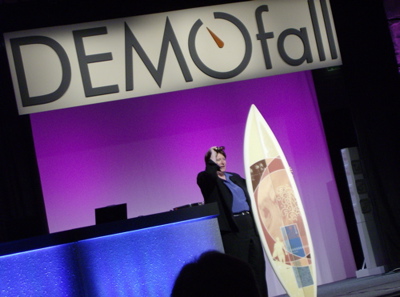 I was so hoping to win that nice stick (donated by sponsor Qualcomm). But, alas, the guy in front of me did — and he didn’t even seem excited about it. Dude?
One final ranting bitch about the show, which I just have to get in, is exemplified by my final photo, which is of the CEO of Moixa Energy presenting. [You’ll remember this outfit, if you’ve been reading my blog, as the one that got my vote for the worst name — though I’ve since decided it’s a tie with PrefPass.] His “USB Cell” may be cool — though it certainly isn’t the most visually elegant product I’ve ever seen. 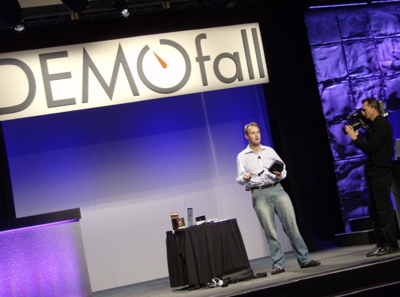 But could the guy conjur up something better to wear than the most god-awful pair of jeans I’ve even seen? I look better than that when I’ve done lumberjack work for three hours in the woods behind my house, for kee-rist sakes. In his defense, he was just one of several presenters who were dressed shabbily. And, sorry, anything including jeans fits that category for me. Please, Chris, can we have a dress code for presenters? It’s the least they can do for us. Hey, if Steve Jobs is coming on stage — fine, he wears what he wants. But these guys, they ain’t no Steve Jobs — okay? 🙂 Certainly not yet… And having them pretend like they are is just too hard to stomach.
What were the takeaways of DEMOfall 2006?
• The tech economy is strong. But we’re not in a bubble, according to the show’s producers. [How could we be when the Nasdaq is still 55% down from its high in the year 2000?]
• Money is flowing. Many of these startups-you’ve-never-heard-of have already raised substantial funding, as reported in their profiles. And a person can only wonder how so many of them get such amounts, based on what appears to be a sketchy or risky plan. I can only recall a few presenters who said they were bootstrapped — that is, surviving just on their own funds at this point. Whatever happened to the raw, truly undiscovered startups getting a chance? Must they all be VC-backed already?
• Consumer tech continues to influence enterprise IT. And Web 2.0 type services are leading the way here. The center of gravity is now on the consumer or individual user side of things. Internet apps are where the most energy is these days, not in computers, operating systems, desktop apps, and the corporate IT power base of old.
• The tech economy, and really the entire economy, is going global faster than you think. This Demo had the largest number ever of non-U.S. presenting firms. And who knows what percentage of all the firms that pitched are relying at least partially on offshore technology expertise to develop their products. Either that or on immigrants who now call the U.S. home.
One final thing: links to a couple of excellent recaps of the event by some of the good press people covering it. First, a story from CNet with several contributors, including Rafe Needleman, Daniel Terdiman, and Dan Farber, all of whom I chatted with at the conference. And another good story is from Thursday’s edition of USA Today, by Ed Baig.
Tags: DEMOfall 2006
 Turns out Sevin Rosen, with a 30-year history in the venture capital business, is throwing in the towel on its latest fund and declaring the VC model is broken.
 The sleezy entertainment industry goons need to back off and let innovation bloom. And they will, because there aren’t any deep pockets there to sue yet. The question instead, though (as the article says), is the huge amount of capital it will take to keep YouTube going. The boys at Sequoia have already thrown in $11.5 million — but that’s just the beginning of what this thing will need. Try $2 million a month, some say, just to run the service. Wow, do they need ad revenues — fast! Meantime, how much more will the VCs bet? Well, don’t think they (and their friends) can’t pour it on — and will. Yet there are those already predicting YouTube’s demise….read
  Rich Karlgaard of Forbes. [Or as Guy Kawasaki, another friend and business partner, calls him, “Brother Rich.”]
 One industry where this is happening is newspapers, with the stock of the New York Times, for example, at half what it was in 2002. Why is the industry in trouble? “Craig’s List is one reason,” he said, “a company with 23 employees.” He noted that McKinsey said the topple rate will triple again, and he gave some reasons why this volatility will stay with us. “The backside of Moore’s Law is the part that’s important. As performance increases, prices drop 30% a year. Suddenly, hundreds of millions more people can afford technology every year.” He also cited the example of Google bootstrapping its way early on, with the founders not taking equity investment but instead maxing out their credit cards.
  Read more about that in
  “It’s growing at 70% year-over-year, and will have more ad revenue than the magazine by the end of 2007.” He said that’s what got Elevation Partners interested. “In the media business, as revenues double, valuation triples.” Forbes has very definitely become a global franchise. It’s seeing most of its growth on the Internet, and most of that growth is non-U.S. “But we’ll never give up on the magazine,” he said.
Recent Comments