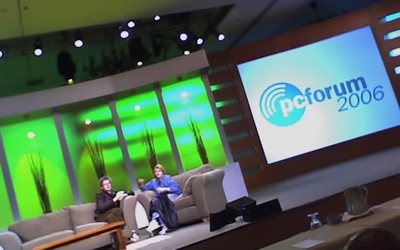
I hooked up with Jeremy via email in advance of PC Forum, and asked him if he’d like to do a little interview at the event for my blog, which of course includes lots of readers back in the Twin Cities. And he quickly responded via Blackberry that he’d be happy to. Which I really appreciated, considering how  popular this guy is now with his hot, new startup, Brightcove. Jeremy and his company even had a major feature on page 1A of the Wall Street Journal a couple of weeks ago. So, despite being very busy at PC Forum (including as a panelist — see my previous post on business models), he graciously agreed to spend time chatting with me. What’s more, he had to endure several email attempts by me to hook up with him at the conference (thanks Jeremy!). Hey, it wasn’t easy finding a specific person in a group of 450, especially with things spread out over a large property like LaCosta.
It’s hard to believe it will be 10 years this fall that Jeremy and his brother J.J. — just a couple of years out of Macalester College in St. Paul — plus the 25 or so young employees that were then part of Allaire Corp., picked up and moved the company, lock, stock, and barrel, to Cambridge, MA, at their VC’s suggestion. (That was after first considering but passing on Silicon Valley.) Thus began the legendary status of Allaire Corp. around our neck of the woods as the Web 1.0 company that got away — but one that made it very, very big in the process. The company grew to some 450 employees before being acquired for something north of $350 million by Macromedia, where Jeremy then served as CTO for three years (commuting from Boston to San Francisco, which he admits got old).
The move worked well for the company and the two Allaire brothers, Jeremy told me. Both took a strong liking to Cambridge and settled in, got married, and now have two kids each. I asked Jeremy of he ever gets back to visit his parents in Winona, MN. He said not often, but that he sees them regulary at another house they now have in the Boston area.
I also had to ask about the latest big development for J.J. — the acquisition of his startup, Onfolio, by Microsoft. (J.J. was originally scheduled to be at PC Forum and I’d planned to interview him as well, But, alas, he had to cancel due to obligations associated with the acquisition.) Jeremy told me it was a big win for J.J., for a company that he had just self-funded over the past few years. (After Allaire Corp. was acquired, Jeremy said the two didn’t really consider teaming up again in a new business, though they remain close personally — simply because they had different interests.) All six employees of Onfolio, including J.J., are now doing yet another big move — this time to Redmond. How does J.J. feel about that, I asked? “He’s really excited about it,” said Jeremy. First Ray Ozzie leaves Boston behind, now J.J…
Meantime, Jeremy, though he’s not planning to move himself anytime soon, is still quite the traveler, regularly shuttling between Brightcove’s home office in Cambridge and three others already set up: in New York City, Los Angeles, and San Francisco (the cities that most of the major content producers and media companies call home, after all). He told me the company already has 50 employees and is heading to be double that soon.
What’s been the timeline of Brightcove’s short history to date? First, Jeremy told me, he incubated the idea at General Catalyst Partners in Boston for a year or so, after leaving Macromedia. He first presented the company and its planned business model at PC Forum in March 2005. From then through the fall, he and others at the firm began selectively getting the word out to key partners and content providers. That culminated with a presentation at the very well attended insider conference “Web 2.0” (sponsored by O’Reilly), which was held in San Francisco last fall. The company soon had a public debut via a story in the New York Times, which was then followed in February by the major front-page WSJ piece. (I asked Jeremy how he happened to choose his cracker-jack PR firm, SutherlandGold, based in San Francisco, and he said he met them at last year’s PC Forum! I had the opportunity to meet two of those folks at dinner one evening — Susan Cashen, formerly of TiVo, and Amy Janzen — where we shared some good conversation with my colleague Gary Bolles of Conferenza and Microcast Communications.)
So, fast forward, how is Brightcove sitting today? Very well indeed. Jeremy gave me a rundown: it already has 200 of what he calls “broadband channels” or content partners. And, since the company started what it called a “commercial preview” in November, for video producers, it has signed up 450 companies to date. It has 700 of its video “players” deployed, and it has 7000 titles already in its library. It also has an affiliate syndication program, and one client — Reuters — has 1000 affiliates signed up to date. With this Brightcove program for Reuters, any web site or blog can simply fill out a form, put some code into their web page, and become an instant video news broadcaster. (I plan to try it out myself!) Deals with other major media firms include the New York Times, and yet others are still in the works, including CBS (as touched on in the WSJ article) — though Jeremy had no new announcements he could tell me about quite yet.
My final question for Jeremy was this: What’s it like having Barry Diller on your board? “Oh, it’s great,” he said. “He’s a remarkably intelligent guy, with a strong strategic mind for online businesses. And he’s one of the most connected people on the planet.” Jeremy said it’s very rare for Diller’s firm, IAC/InterActiveCorp, to make minority investments, which they did on the case of Brightcove. They tend to only acquire companies outright. Diller sits on Brightcove’s board, which is also quite an achievement for the startup, since he only serves on two other boards: The Washington Post and Coca-Cola.
I closed by asking Jeremy about his management team, which he said is “tremendous.” It even includes one colleague from the early days of Allaire Corp., who was also a friend of his at Macalester College in St. Paul: Adam Berrey, now Brightcove’s VP of Marketing. Where was Jeremy off to next? San Francisco, he said, to keynote at the “VON” conference. And he was going to spend some time at his offices there as well, in addition to catching up with a guy I’ve since met who was employee #4 at Allaire Corp., Ben Cantlon. (Ben recently relocated back to Minneapolis but was visiting SF this week.)
Thanks for the interview, Jeremy, and best of luck as you continue disrupting the video distribution business!
Tag: PCforum06
Tag: PCforum
 wore the sweatshirt from that event in honor of the occasion. A lot has certainly changed in those 11 years, for Sun and everyone else. In recent years, Bill made the move to VC-land and joined Kleiner Perkins — where his former Sun colleague, Vinod Khosla, has been a partner for many years.
 planned my morning so I’d get up real early and do a few hours of email and writing for my blog (it was way too cold to surf, anyway), then pack up and head north from my place in San Clemente to catch Guy’s keynote speech at 12:30. It would be a short drive from there to the airport, I figured. Well, I rushed and rushed and barely made it to the conference’s press room right about the appointed time, only to find out his speech had just ended! Apparently, they’d moved up the schedule. Darn, I’d missed it! Since I’d never actually met Guy — though I’d heard him speak a couple of times, and was instrumental in getting him to speak at a large technology event in the Twin Cities several years ago — I was bound and determined I was actually going to meet him this time (which circumstances had prevented me from doing previously). So, off I tromp, over to the Marriott, where I figured he might still be hangin’ around afterwards talking to folks. And, sure, enough, as I’m walking in and down the hall toward the meeting rooms, here comes Guy right toward me, carrying his briefcase, big smile on his face, slowly starting to make his way for the door. So, I introduced myself, and we had a nice chat as he walked together back to the lobby. After explaining that we had a common friend in Rich Karlgaard, I asked Guy what he spoke about (“the Art of the Start”), and how many were in the audience (200, he was told — many of them entrepreneurs launching businesses to market to boomers). I also asked him about his blog….of course! He seemed like he wasn’t all that impressed with his “gross numbers” so far. So, I asked how many visitors he gets, and he said, “Oh, I have about 10,000 readers.” I said, hey, that’s great. Then, I wished him luck, said I’d catch him somewhere else soon, and we both split. But at least I don’t feel so bad now about my 2000 readers last month. Gee, a fifth of the way to Guy Kawasaki — I’ll take that any day! Guy’s blog, by the way, which he just launched January 1, is
  were quite good, too. Esther Dyson kicked things off by referring to some pundit’s remark that search was as good as it’s going to get. “I don’t agree,” said Jeff Weiner. “Search is the great democratizer,” and he says lots more good stuff is coming — “like voting on search results and other Web 2.0 stuff.” But he also made an excellent point: that for a company to really take advantage of search, it needs a smart webmaster (read: for SEO and SEM), or to “be wealthy enough to hire that out.” As an example of something new, Weiner also offered up “Yahoo Answers,” a service whereby anyone can ask a question and anyone can answer. It’s essentially a knowledge search service, he said, which had a December beta launch.
  individual websites to do global broadcasting.” What’s interesting now, Jeremy said, is that his firm is encountering an incredible willingness to experiment” (presumably by the traditional video distribution businesses, and by video producers). Why? “Out of fear, to pursue new revenue opportunities, just to stay out in front.” Esther asks what friction he’s seeing…. “It’s similar to the early days of e-commerce,” he said, “where manufacturers worried about going direct, then ended up discovering that blended distribution worked best. It’s the same now.” When asked what challenges he sees, Leonard Liu of Augmentum, whose firm is providing software development services for U.S. firms via a staff of 450 in China, says the challenges are many, including language. “But China is the next big player” in this space, he said. “We’ve seen in India what can happen. But it takes a true understanding of China — for example, the young people are different than the old — as far as how the cultures work together.” Liu said 60% of what his firm does is total product development, “from beginning to end.” Intel is one big customer. And how does Microsoft react, now that it isn’t such a target, Esther asked of the fourth panelist. “How can we marry all this friction-free software to the Windows environment,” was his obvious first answer. “But we see many opportunities — advertising, subscription models, Office Live. This is an exciting time, now that we’re unleashed to an extent. We think we’re responding well to what people want and don’t want.”
Recent Comments