Graeme Thickins on Tech

Reflections & analysis about innovation, technology, startups, investing, healthcare, and more .... with a focus on Minnesota, Land of 10,000 Lakes. Blogging continuously since 2005.

Page 82 of 144

Raising Startup Money? Here’s 20 Ways

This is not the first post I’ve done that mentions Tech Coast Angels, one of the largest and oldest angel investing organizations in the country, which is of course in Southern California. (Here’s another good one from about 10 months ago.) Interesting that the term “angel” originated in the techcoastangelsentertainment business, but TCA has little to do with Hollywood. It sure has a whole lot to do with funding technology startups in that part of the country, though! (I also had the good fortune to do an extensive interview in early 2007 with the founder of Tech Coast Angels, the late Louis Villalobos, which was later published in The Angel Journal.)

This organization is actually comprised of four networks of angels covering a large part of the SoCal geography, from Santa Barbara down to San Diego. One of my favorite places, Orange County, is where the largest and oldest of these networks is situated.  And that’s where the subject of this post hails from.

Frank Peters, a successful, now semi-retired software entrepreneur (he marketed his product to Wall Street firms starting back in the ’80s), has been active as an angel investor for 10 years, and at the time of this post he’d been with Tech Coast Angels for five years. On the side, he produced a great podcast for a few years called “The Frank Peters Show” — subtitled “Startup Stories in Angel Investing and Venture Capital.” He was prolific — averaging about 60 podcasts per year for a while. Pretty amazing! These episodes provided some great listening for both entrepreneurs and angel investors. He had some excellent interviews with really interesting subjects. It was a podcast that definitely helped people better understand angel investing.

Frank did one great episode that was an interview with two experienced fellow TCA angels: Dave Berkus (how many angels do you know who’ve done 60 deals?), and Sid Mohasseb, who runs Venture Farm, which he described as “an equity funding source that adds hands-on experience to the execution process.” The topic of the podcast was “20 Ways to Fund Your Startup” — a list that Dave Berkus developed, but which all three guys discussed in this one-hour+ episode.  Here’s a quick rundown of the gist of that discussion:

THE BIG LIST: 20 Way$$ to Feed Your Startup Habit
Of the various ways to raise startup capital, angel financing is about in the middle of the continuum, Dave said. Some founders, however, try it too early — they don’t bootstrap enough first.  If you do, say the panelists, you’ll have a better chance of getting an audience in the first place to be considered to receive funding. So, here’s the rundown, courtesy of Dave, with some points noted by him and the others as he went through the list:

1) Credit cards – this can be $20-30k, even $50k in some cases, which will require a personal guarantee (but not mortgaging your house).
2) Securing arrangements with suppliers to slow down payments – assuming the business is started – or seeking deferred payment – lawyers typically do that – many even do pro bono work as a way to give back to the community.
3) Take out another mortgage – scary for many, perhaps, but rates remain quite low; it shows the founder has significant belief in what he or she is doing.
4) Wealthy relatives – “if you were born lucky” – they’re more likely than others to invest.
5) Friends – “means you’re getting lucky, if you have good ones!”  – can be on your board of advisors, too, which costs you nothing.
6) Take on consulting work – even let your company be both a consulting and product development business at first.
7) Affiliate with an incubator – whether physical or virtual – they can help build your management team and more.
8) Well-connected attorney – angels listen to their recommendations.
9) A “Rented” CFO – they don’t get paid for just getting the money, but for the financial systems they set up – the analysis of the data is what they deliver, and credibility.
10) Recruit a professional CFO – angels feel much more comfortable then.
11) Get prepaid licenses for your technology – a combination of selling service as well as product – maintenance agreements can be part of this (16-20% of list price of software) – recurring revenue –  customers are essentially paying for the engineering and product development – helps refine the value proposition – you don’t need to give it away for free.
12) Accelerated payments – of course, you have to have a revenue stream first.
13) Royalties for very specific projects – let those fund your product development – seek out anyone that can benefit from the technology (not just your main target customers).
14) Angel financing – “later the better” to approach them, because you’re then more likely to get funded – however, can be anywhere on the continuum – the later it is, the more likely you’ll get funded (angels will look at what you’ve done so far – how many of the above you’ve taken advantage of) – if you go to angels earlier, your valuation will be lower.
15) Bank line of credit – $50k is available to almost anybody with good credit (with personal guarantee).
16) Strategic partnerships – customer or supplier, helping to develop, promising to distribute, etc – helps to define channels for later sales and distribution.
17) Venture capital, pension funds
18) Private placements
19) Professional restructurers
20) Investment bank, public offering

Dave pointed out again that angels are more in the middle of this continuum — they aren’t where you start.  “They’re an avenue for the sophisticated entrepreneur that understands all the other sources and where the risk is, and how fast they need the money.”

In the closing discussion, Frank commented that TCA was ten years old at that point, and was getting more sophisticated.  Yes, the others agreed — and “more prudent, cautious, and jaded.”  But Dave added that it was certain they were much more powerful as a group than as individuals. Frank noted that the angel financing business, at least for TCA, things slow down towards the end of the year — until around mid-January.

Then, the three discussed a recent university study, in which certain TCA members participated, called “Angels in Groups,” for which a large amount of data on angel investments was gathered.  One of the biggest surprises of the study, they agreed, was the average length of time to a liquidity event. Many angels think of it as generally 3 to 5 years, but they noted that was not happening for those deals studied.  Dave said the study found that 61% of the angels surveyed had returns greater than the amount they invested, “meaning 39% didn’t!”  The conclusion is that angel investing is more risky than most people think. A diversity of investments is important “before you can count your chickens,” said Dave. Luis Villalobos, the founder of TCA, thought a portfolio of 25 or more investments was a minimum to expect good returns. The study showed that success happens when the angel is involved in the business. The entrepreneur benefits from the sharing of the experience of angels. Finally, the study found that it doesn’t tend to pay for angels to reinvest, which is somewhat worrisome, the panelists noted. “TCA traditionally funds 2-3% of deals they see,” said Dave. “But when we’re ready to take deals to VCs, those firms only invest in 1% of what they see, on average.”  Therein lies a problem, because angels often to have to invest a second or third time to keep the business going before it’s ready for the VCs. ‘”It’s a game of patience,” Dave said.

Frank Peters concluded this particular podcast by saying he thinks there’s a need to “start testifying more about angel investing, more education, chewing over issues.”

I like the list of 20 sources of startup money, though — it’s a list that all new and aspiring entrepreneurs need to know. There really are a ton of ways, and most of them do qualify as bootstrapping… or just plain being clever!

It Was Another Great ‘Minnedemo’ on Thursday Night

On a brisk Minnesota evening in early December, what better to do than get together to drink beer and watch demos with 200+ of your closest tech friends and talk code, startups, business models, and all that good stuff?
Minnedemo1207crowd Thursday night, the scene for Minnedemo again was O’Gara’s Garage in St.Paul, and the joint was a-jumpin’! We didn’t need a band — we were all our own entertainment!
Minnedemo1207ogaras

Thanks to our sponsors, we not only got two free beers (or sodas) each, but we also could trade canned food donations for even more beer tickets, so we could then play big shot and buy beer for our friends. Trading canned food for beer….does_it_get_any_better_’n_that? It was a hoot….lots of great conversation and new friends made. You have to be at one of these things to really appreciate the energy of the Minnesota tech community! If you haven’t caught one yet, make sure you get to the next one in April (date to be announced). Hey, it’s FREE — whadya want?!? 🙂 That one will be the full-day-Saturday version we call “Minnebar.” It all part of Minnesota’s answer to the worldwide phenomenon called Barcamp — and we are definitely one of the most active locales outside the Valley.

Here’s a rundown on Thursday night’s great presenters, including some detail about the very cool new products they were demoing:

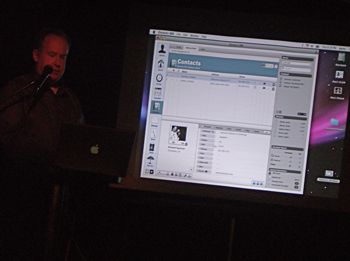
Ntractive LLC (Dale Jensen, Cofounder/CEO) – This startup, based in Grand Forks, is a winner of the “InnovateND” award, and is receiving its first-round funding from St. Paul-based RAIN Source Capital. Ntractive has developed a “hybrid” app for small business management called “Elements SBM.” This app, initially for the MacOS, provides web application flexibility with unprecedented ease of use not generally found outside of the traditional desktop application. The result is a visually elegant and technically innovative solution that allows small business users to quickly become more productive. Minnedemo1207dalejensen The company officially launches at MacWorld in San Francisco in mid-January, but chose Minnedemo (yay!) as the venue its first public demonstration. Till now, small businesses had to choose a desktop app or a web app, but, said Jensen, “With our hybrid app, we’ve made it possible for the first time to really have the best of both of those worlds.”
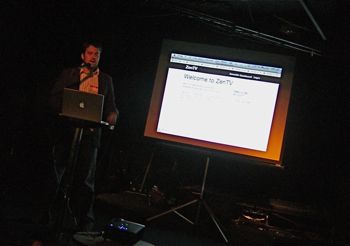
Zencoder Video Transcoding System (Jon Dahl, cofounder of Slantwise Design) – Zencoder provides “bulletproof video transcoding.” Minnedemo1207jondahl It’s described as a full-featured video transcoding platform that handles every aspect of video processing, from queuing to transcoding to storage. Video transcoding systems are complex and difficult to get right, Dahl said. Zencoder claims its platform is reliable and scalable, costs far less than a custom-built solution, and yet is highly customizable. To be notified when it’s released, enter your email address at the site.



Valtira (Morgan Catlin, Product Director) – The Valtira Online Marketing Platform is a complete online solution for marketing professionals. It’s “software as a service” — all you need is a web browser. Valtira manages the IT infrastructure, operations, and upgrades from its Tier 1 data center. The platform empowers the marketing team to manage online initiatives without the need for IT support. Components include Content Management, Campaign Management, Blogging and Forums, Prospect Management, Email Marketing, Sales Portals, Social Networking, Online Surveys, Real-time Analytics, and Support & Training. Valtira just announced a new, free campaign tracking solution that lets you track up to 15 marketing campaigns.

JRuby (Charles Nutter) – JRuby is a 100% pure-Java implementation of the Ruby programming language. The JRuby community recently announced the release of JRuby 1.1 beta 1, the first release toward their goal of JRuby 1.1. JRuby 1.1 represents a concerted focus on speed and refinement. Ruby code can completely compile in an Ahead Of Time (AOT) or Just In Time (JIT) mode, yielding a faster Ruby! It uses less memory than previous releases. The community wants people to download JRuby 1.1b1 and provide feedback: “test your applications and help us make JRuby 1.1 a great release.”

Grapheety (Gavin Quinn) – A map-based social exploration site. All stories and pictures are tagged onto the map by users. For a part-time effort by a bunch of fulltime employed guys, it’s quite an effort. Read more about the latest release here on the Grapheety blog.

All in all, it was another super Minnedemo, and I’m very glad I was there! If you missed it and want more info on the presenting firms, please visit their sites and make contact with them directly. They’ve love to hear from you! Once again, many thanks to co-organizers Dan Grigsby and Luke Francl for another great job, and also to our illustrious sponsors. They’re awesome.

Rock on, Minnesota tech!

Marc Orchant – We Mourn a Big Loss

UPDATE (12/10/07): I am extremely sorry to report the passing of Marc Orchant yesterday. Marc was a friend and inspiration to so many people. How is it he could make anyone he talked to feel like the most important person in the world? What a smile, what an upbeat person! I will really miss him. My sincere condolences to Sue and the family. When I try to understand this, I’m reminded of what Joe Gibbs said recently when he learned of the passing of Sean Taylor: “The way I’m going to deal with it is, God tells us that it will take a thousand years for us to begin to understand heaven.” Rest in peace, brother.

UPDATE (12/9/07): Oliver Starr (who, by the way, is no longer affiliated with Blognation) is regularly posting updates on Marc Orchant’s condition. The family is getting an enormous outpouring of well wishes and support, which just shows what an impact Marc has had on so many people. Keep praying.

ORIGINAL POST (12/3/07): (Note: photo is from a group shot I took at DEMOfall, September 2007.) I was really floored this afternoon to learn, via my Twin Cities buddy Steve Borsch, that our close friend Marc Orchant suffered a massive coronary yesterday. Marcorchant2
Horrible, totally unexpected news. Steve told me it was reported earlier today by Oliver Starr, Marc’s blogging colleague at Blognation, via this post. According to Oliver, Marc is in critical condition at a hospital in his hometown of Albuquerque, New Mexico.

Marc is one of my closest and best blogger friends, and just a great, great guy. He’s been a real inspiration to me, and one of the most helpful, positive, fun-loving guys you could ever want to know. I pray for his recovery, and I send my best to his wife, Sue, and the kids.  He’s too young for this!  Marc, we love you and we need you back, buddy!

What’s Up With the Market? Watch This…

Oh, this is too funny — a British television skit on understanding financial markets. I’ve never felt that embedding funny YouTube videos was something I needed to do in this venue, but this one made me change my mind.

Unless your securities portfolio consists entirely of Apple stock, you have to be wondering what the hell is going on in the market today, and seriously questioning whether you have the cajones to stay in it.  Well, watch this — talk about comic relief!  Man, does everyone need a little of this right now. (Tip of the hat to Paul Kedrosky of Infectious Greed for the heads-up to this one.)

Raising Startup Money? Here’s 20 Ways

Speaking of Southern California [my last post was on Hollywood, if you can believe that], I think it’s time I did another post about Tech Coast Angels, one of the largest and oldest angel investing organizations in the country. Interesting that the term "angel" originated in the entertainment business, but TCA has little to do with Hollywood — rather, they have a whole lot to do with funding technology startups. Techcoastangels
This group is actually comprised of four networks of angels covering a large part of the SoCal geography, from Santa Barbara down to San Diego. My second favorite place, Orange County, is where the largest and oldest of these networks is situated.  And that’s where the subject of this post hails from.

Frank Peters, a successful, now semi-retired software entrepreneur (he sold his product to Wall Street firms starting back in the ’80s), has been active as an angel investor for 10 years, and the past five with Tech Coast Angels. On the side, he’s been producing a great podcast for the past two years called "The Frank Peters Show" — subtitled "Startup Stories in Angel Investing and Venture Capital." He’s averaged about 60 podcasts per year so far (pretty amazing). It’s very worthwhile listening for both entrepreneurs and current or potential angel investors — these are great interviews with really interesting subjects, and will definitely help you better understand angel investing. If you have an iPod or iPhone, they’re ideal to listen to in the car to make better use of that commute or long road trip.

Frank’s latest podcast is an interview with two experienced fellow TCA angels: Dave Berkus (how many angels do you know who’ve done 60 deals?), and Sid Mohasseb, who runs Venture Farm, which he describes as "an equity funding source that adds hands-on experience to the execution process." The topic of this podcast is "20 Ways to Fund Your Startup" — which is a list that Dave Berkus developed, but which all three guys discuss in this one-hour+ episode. (If you want to skip the general chat at the beginning and cut right to the chase, the "20 Ways" stuff begins at about 28:25 into the podcast.)  Here’s a quick rundown of the gist of the discussion if you don’t have time to listen right now:

Ways to Feed Your Startup Habit
Of the various ways to raise startup capital, angel financing is about in the middle of the continuum, Dave said. Some founders, however, try it too early — they don’t bootstrap enough first.  If you do, say the panelists, you’ll have a better chance of getting an audience in the first place to be considered to receive funding. So, here’s the rundown, courtesy of Dave, with some points noted by him and the others as he went through the list:

1) Credit cards – this can be $20-30k, even $50k in some cases, which will require a personal guarantee (but not mortgaging your house).
2) Securing arrangements with suppliers to slow down payments – assuming the business is started – or seeking deferred payment – lawyers typically do that – many even do pro bono work as a way to give back to the community.
3) Take out another mortgage – scary right now, but rates are quite low – shows founder has significant belief in what he or she is doing.
4) Wealthy relatives – "if you were born lucky" – more likely than others to invest.
5) Friends – "means you’re getting lucky, if you have good ones"  – can be on board of advisors, too, which costs you nothing.
6) Take on consulting work – even let your company be both a consulting and product development business at first.
7) Affiliate with an incubator – whether physical or virtual – they can help build management team, etc.
8) Well-connected attorney – angels listen to their recommendations.
9) "Rented" CFO – they don’t get paid for just getting the money, but for the financial systems they set up – the analysis of the data is what they deliver, and credibility.
10) Recruit a professional CFO – angels feel much more comfortable then.
11) Get prepaid licenses for your technology – a combination of selling service as well as product – maintenance agreements can be part of this (16-20% of list price of software) – recurring revenue –  customers are essentially paying for the engineering and product development – helps refine the value proposition – you don’t need to give it away for free.
12) Accelerated payments – of course, you have to have a rev stream first.
13) Royalties for very specific projects – let those fund your product development – seek out anyone that can benefit from the technology (not just your main target customers).
14) Angel financing – "later the better" to approach them, because you’re then more likely to get funded – however, can be anywhere on the continuum – the later it is, the more likely you’ll get funded (angels will look at what you’ve done so far – how many of the above you’ve taken advantage of) – if you go to angels earlier, your valuation will be lower.
15) Bank line of credit – $50k is available to almost anybody with good credit (with personal guarantee).
16) Strategic partnerships – customer or supplier, helping to develop, promising to distribute, etc – helps to define channels for later sales and distribution.
17) Venture capital, pension funds
18) Private placements
19) Professional restructurers
20) Investment bank, public offering

Dave noted again that angels are in the middle of this continuum.  "They’re an avenue for the sophisticated entrepreneur that understands all the other sources and where the risk is, and how fast they need the money."

In the closing discussion, Frank commented that TCA is ten years old now, and is getting more sophisticated.  Yes, the others agreed — and "more prudent,
cautious, jaded."  But Dave added that it’s certain they’re much more powerful as a group than as individuals. Frank noted that the angel financing business, at least for TCA, slows down at this time of year — from now till about January 10.

Then, the three discussed a recent university study, in which certain TCA members participated, called "Angels in Groups," for which a large amount of data on angel investments was gathered. (The link to the PDF of this study is on Frank’s web page for this podcast (show #132). One of the biggest surprises of the study, they agreed, was the average length of time to a liquidity event. Many angels think of it as generally 3 to 5 years, but they noted that was not happening for those deals studied.  Dave said the study found that 61% of the angels surveyed had returns greater than the amount they invested, "meaning 39% didn’t!"  The conclusion is that angel investing is more risky than most people thought. A diversity of investments is important "before you can count your chickens," said Dave. Luis Villalobos, the founder of TCA, thinks a portfolio of 25 or more investments is a minimum to expect good returns. The study showed that success happens when the angel is involved in the business. The entrepreneur benefits from the sharing of the experience of angels. Finally, the study found that it doesn’t tend to pay for angels to reinvest, which is somewhat worrisome, the panelists noted. "TCA traditionally funds 2-3% of deals they see," said Dave. "But when we’re ready to take deals to VCs, those firms only invest in 1% of what they see, on average."  Therein lies a problem, because angels often to have to invest a second or third time to keep the business going before it’s ready for the VCs. ‘"It’s a game of patience," Dave said.

Frank Peters concluded this podcast by saying he thinks there’s a need to "start testifying more about angel investing, more education, chewing over issues."  And he encourages suggestions for future podcasts by email to him at frank@thefrankpetersshow.com.

UPDATE (11/28):  And here’s a bonus link on Five of the Best Tips for Courting Angels.

« Older posts Newer posts »