Graeme Thickins on Tech

Reflections & analysis about innovation, technology, startups, investing, healthcare, and more .... with a focus on Minnesota, Land of 10,000 Lakes. Blogging continuously since 2005.

Page 83 of 144

Blowtorch Wants to Disrupt Hollywood (and there’s a Minnesota connection)

"The Hollywood distribution model doesn’t work for the 18 to 24 year old demographic," says Kim Garretson, a Minneapolis-based business development consultant for Blowtorch Entertainment, a new film production startup based in California.Kimgarretsonblowtorch
"They want entertainment content here, there, and everywhere, in bite-sized portions. And they want it before they go to the theater." 
This fickle demographic is looking to be entertained, and for authenticity, he says. 

Does disruption sound like a big undertaking? Well, Blowtorch just announced $50 million in funding, so we can assume they’re serious. Garretson, a longtime Twin Cities startup veteran and business development whiz, left Best Buy last year, where he was a liaison to the venture capital community. Since then, he’s been quietly working in the Valley VC world, helping VCs vet deals and advising portfolio companies on distribution strategies. Garretson and a former business partner, Kelly Rodriques, went back into business together finding funding for early-stage deals. Then the Blowtorch deal came along. In addition to his involvement with the new company, Kim is currently finishing a business plan for a top Hollywood actor’s film company.

Rodrigues, who’s based in the Bay Area, recently became an entertainment and media industry venture partner for Seattle-based Ignition Partners. Last week, he announced the $50M first round for Blowtorch from Ignition and hedge funds, and now is well into launching the firm, where he’s taken on the CEO role. With his long background teaming with Garretson, he naturally turned to him as a business development adviser. "Blowtorch is disrupting the traditional Hollywood studio and distribution model for feature films targeting the college crowd," said Garretson. "Six feature films will be produced over the next 18 months, released as party-like events near the top 200 college campuses."

BlowtorchlogoThe company says its editorial vision is to "balance professional-grade
production with user participation to create a consistently engaging
experience." That will include full-length films,
professional-grade shorts, an online community, mobile offerings, and
live events. Blowtorch has assembled a diverse team of executives from
the entertainment, marketing, and technology industries with
expertise creating media for young adults. (This list is impressive — see the details here in the news release.)

The Secret Sauce: Getting Brands Involved
But the really interesting part of this whole thing, from a marketing standpoint, is how big advertisers will play in it. It should be no surprise that product placement and sponsorship by big brands is part of the plan here, especially when you look at the backgrounds of the management team and board. "We have set out to build a media company that delivers a consistently compelling experience that will lead to stronger engagement across all the channels our audience uses everyday," said CEO Rodrigues, "And we are confident we have found meaningful ways for marketers to be a part of this experience."  Garretson’s role in business development, he tells me, will be going after some of those deals with big brands.

On the user-gen side of the equation, the company has announced a contest called "The Blowtorch Short Film Big Screen Challenge."  BlowtorchcontestHere are the rules, short and sweet: "Submit a video of your best short film idea. The theme can be anything at all related to “TECHNOLOGY.”
Internet dating, killer robot vacuums, used time machine salesmen…whatever. Remember, it’s all about the idea, not how you shoot it. So, a video camera
is great, but a web-cam works too.
Shoot it, pitch it, just get your idea out there. If yours wins, we’ll fly
you out to LA to produce it for real.
Submit as many as you like, just keep them under 3 minutes."

By the way, funding like Blowtorch’s gets you some good PR, too. Check out the coverage that just magically 🙂 popped up in The Washington Post, Variety, The Hollywood Reporter….oh, and couple other rags you may have heard of: TechCrunch and PaidContent. Amazing what real marketing budgets can do, isn’t it?  And if you’re wondering what the budget will be to promote the films, I learned it’s $3 milllion — per film.

So, there you have it, gang. I keep telling you Twin Cities startup folks are into some interesting deals!
Just leave it to me, your trusty, intrepid bi-coastal reporter (left
coast and third coast), to fill you in on these Minnesota-California
connections (read: real money). I got more, too, so stay tuned….

UPDATE (12/29/07):  I love the fact that I got to this story before Fortune Magazine did.

So, What Have I Been Up to Lately?

Glad you asked. Would you believe I launched another blog? That’s right, I’m a glutton for punishment. It’s actually a blog for my business.  (So, I guess that means this one becomes my personal blog)  The new blog is the first online wrinkle for a new practice of my consulting firm (GT&A Strategic Marketing), which I call NewMediaWise — so that’s where you’ll find it.
Its purpose is to explore the new world of marketing that’s being enabled by social media tools and technologies. Nmwscreenshot
Design of the site is by Geise Design. Randy and I have worked together much in the past, including when we did interim gigs together for the launch of BestBuy.com back in 2000. Randy’s a real master at web site design and development, and is particularly adept at ExpressionEngine™, an amazing platform behind many great sites (such as PaidContent.org and iLounge). I’m looking forward to getting the rest of the site built out.  Meantime, I’ll be blogging there about all things new media and marketing related. Here at Tech~Surf~Blog, I’ll continue to write about all kinds of other topics, including my coverage of tech conferences…and, of course, a little surfing from time to time.  If you’re interested in new media and marketing, I hope you’ll get a chance to check out the new blog and become a reader there as well.

What else have I been up to?  Well, I was quoted twice in the media in the past week or so — first in a business article in the Minneapolis Star-Tribune, and then in an article on "The Business of Blogs" in the December 2007 issue of Twin Cities Business magazine (but that site doesn’t yet feature the current issue at the time of this posting).  So, its been a busy November so far.  Happy Thanksgiving to you all, and now bring on December!

UPDATE (the day after Thanksgiving): Oh, I almost forgot another thing: Tech~Surf~Blog was named one of "Top 100 Analyst Blogs" by Techobabble 2.0 (a blog written by an Edelman PR exec in the UK) . Can ya beat that?
 

LinkedIn’s Growth Beats Facebook’s

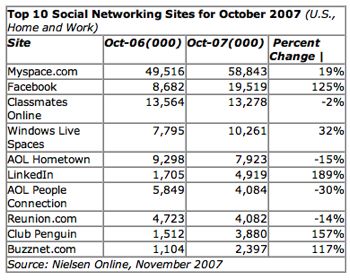
So you think Facebook’s growing rapidly, huh?  Well, check this out. Nielsen just released its latest ranking of the top social networks (for the month of October 2007), and it shows LinkedIn grew at a significantly faster clip than any of the top ten — even oh-so-hip darling Facebook. Of course, these numbers reflect usage at both home and work, and the latter is the traditional stronghold of professional network LinkedIn. Socntwksgrowth
But Facebook’s made no secret about expanding its user base into the adult working world, too — not just college kids passing around party pix.

What’s surprising is that, even with all the rapid — and rabid — Facebook adoption lately by us professionals (yes, I’m hooked, too), LinkedIn is growing even faster. Hipness is not everything, it seems — functionality matters, too. And LinkedIn has built up a pretty good stronghold in the professional networking/recruiting/job search space. (And you have to love founder Reid Hoffman also having a nice stake in Facebook as an early investor.)

Another reason LinkedIn may be scoring bigger growth: I’m not aware of companies banning it at work, but I certainly have heard that to be the case with Facebook inside some firms.
What’s your experience?  Should either of these sites be banned at work?  [The nerve of these employers, thinking people shouldn’t be searching for new jobs or sharing party invites when they’re supposed to be working…  :-)]

UPDATE (Thanksgiving Day, 11/22): Oh, this is too funny. GigaOM just posted Giving Thanks for…Facebook?

UPDATE (11/23): You have to love this juicy tidbit via TechCrunch UK…. Rumour: NewsCorp to Buy LinkedIn.  I think it could very well be true — I agree with one of the commenters that LinkedIn + the WSJ could be a great combo.


‘Social DNA’: Do You Know Where Your Digital Genes Are?

You knew it had to be coming: a way to map your online social self. My god, how did we get along without this till now? Thank you, eSnips (I think). Esnipslogo
I mean, Facebook asks some questions when you create your profile there [many of them lame, certainly for adults]. And it seems to me MySpace does, too — but then I never go there anymore.  [I remember they force you to tell your age on your profile, so I went with the max they would allow: 91.] Do I need another social network now?  Well, let me think about that… 🙂  But I went through the sign-up procedure, anyway. After all, if I’m doing a post, I’d better. And it was interesting. More on that in a bit.  First, some background…

eSnips is a content-sharing site that officially launched at DEMOfall in September 2006 (my coverage). CEO Yael Elish, a veteran Internet entrepreneur, told me then that her site lets "everyday people share content in one place, without having to manage so many accounts."  She said then that it was about sharing, publishing, and even selling your creative work — and was all free. At that time, eSnips offered 1GB of free space, but that’s now been upped to 5GB. Traffic to the site appears to be growing nicely when viewed at Alexa.

So, what’s this new wrinkle of "Social DNA" all about?  From today’s press release:

A key premise of Web 2.0 services is the ability to discover like-minded people through common friends or tags. eSnips Social DNA takes this ability to the next level by matching people with others who resemble them most based on hundreds or thousands of common defined aspects of their lives. It’s done through a series of fun, creative and often intriguing 1-2 minute online quizzes across multiple topics (referred to as Social Genes).

The multiple-choice quizzes are just one type of “Social Gene” that makes up a user’s Social DNA.  The other type is a List, where users can express their musical, literary, cinematic and even dietary preferences.  A List can express personal favorites in a more diverse way than a Quiz, which is why a mixture of both is essential to get comprehensive Social DNA results.

Immediately upon answering the first question, users get exposed to others who responded like them.  As they continue the quiz, the matches change until eventually a user only sees the highest scoring matches. They also can see how their answers compared to rest of the population, shown through a uniqueness score and set of graphs. Upon completing a quiz, users can quickly and easily create a fun widget to post on their website or blog.

Here’s a screenshot of the page I got after I went through my first quiz, in the category of Business & Technology.
I chose the Web 2.0 quiz (natch). As you can see, only 30% answered like me, so I’m "in the minority" — how special! This is just one quiz of many I could have done.  I didn’t count how many quizzes there were, but I’m assuming there would have to be hundreds, eventually, anyway. [Note the service is, of course, labeled beta — what isn’t?] Esnipsresultspg_2

My take after going through one quiz is that the questions were a bit trivial — even silly. I think eSnips is trying too hard to be funny, in an attempt to make the process fun (which of course it has to be).  I just question the scientific nature of all this, I guess, if there is any.  Should there be?  More than a few of the questions didn’t offer an answer that I liked.  Nonetheless, I think this Social DNA concept is fascinating, and I have no doubt that eSnips users — mostly all younger than me — will eat it up.  Why?  Because it plays right into the powerful need to get your online profile "just right."  I heard a stat last week that active social networkers are spending up to an hour a week on average fiddling with their profile.  This will enable them to go nuts like on no other site I know!  If you’re into finding/discovering people online (can you say dating?), this will be a very engaging and "sticky" feature for eSnips. I think it’s bound to boost traffic to the site, bigtime.  It will be interesting to watch that play out over the next weeks and months.

Defrag 8: Final Tidbits and Recap

Well, a few days have gone by since Defrag ended, and I always like to let things settle a bit before I have my final say on a conference. This is that post, which also captures some highlights from the rest of the second day’s program.

The "Next-Level Discovery" panel featured an eclectic group, including an IT professor from Berkeley (Marti Hearst), a general manager of Dow Jones Factiva (Lou Paglia), the inventor of Jabber and now working at Wikia on a project to create an open search engine (Jeremie Miller), and the CEO and cofounder of code-search site Krugle (Steve Larsen). Discoverypanel
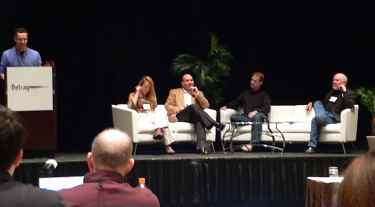
Brad Horowitz of Yahoo was the moderator. Here’s a sampling of what we heard:

Hearst said discovery is about finding things you weren’t expecting to find. But, today, in the enterprise, "people are about search." She said today it’s about navigating, whereas in the future it will be just "saying what you want." Hearst said we’re starting to see the convergence of two trends: massive collections of implicit user behavior, and better handling of longer queries.

Lou Paglia is the GM of the corporate research division at Dow Jones Factiva, which "normalizes thousands of news information sources from around the world for corporate research people." He said that in the enterprise today, Facebook is a way of discovering, as is checking stocks, for example. Jeremie Miller, open source guru that he is, said that, for next-level discovery to happen, we need better connection of independent parties. "The fabric must grow there."  Steve Larsen spoke of efforts to make search smarter, and that there are now more than 100 vertical search sites (his company being one example). "These could do to the major search sites what cable TV did to the networks."  These vertical search sites are about specific interests of consumers, he said. Because they constrain what one is looking for, you can assume implicit things about them. And you can present results that provide context, the real meaning of discovery."  Horowitz said Flickr (a Yahoo property) mines the "interestingness" of people and "reflects that back to the community" — and that this is "better than just explicit things like ratings." There’s value in these implicit behaviors, and it lowers the barriers of participation.

In the discussion period afterwards, Factiva’s Paglia spoke of the "hidden web" and how it’s a big area of need in the corporate world. He said his firm is seeing a change in the paradigm. "How do you get beyond the article? What’s the actual knowledge in the news? What about the data element to help managers make decisions? We want to help people get to where they want to go."  Krugle’s Larsen said his company’s code search engine can even link all the way back to the market requirements that caused a given piece of code to be developed. Wikia’s Miller said "the dark web will cease to be known … information wants to be found." Doc Searls asked from the front row, "What about searching old web pages?"  Miller said "these are a real treasure, but it’s very hard." Factiva’s Paglia, however, said "we’re getting there." Another audience question was about social search. The panelists noted that one company working in that area, Me.dium, was here, and that Microsoft has such a project. Horowitz said Del.icio.us (also a Yahoo property) is "headed more this way."  Esther Dyson asked whether more structure was needed for search. Horowitz said it depends on who’s providing that structure. Larsen said visualization is one way to give search more structure. Paglia asked, "Why should we have to search at all? You should just be able to log onto your CRM and be told what things you need to action on today." Horowitz closed the panel by commenting that "it’s amazing how ossified search results are!" People are locked into a certain look or way that search results are presented to them, but implied this needs to change, to get better.

The Elephant in the Room
A special add to the program, who flew in just for the second day of Defrag, was technologist Kevin Marks of Google. Kevinmarksonstage
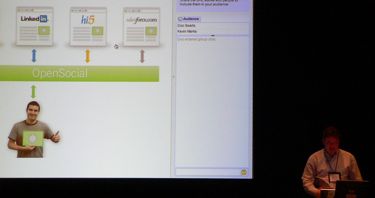
Formerly with Technorati and Apple, Marks said his area of responsibility at his new employer covers basically everything except search and ads. The word was that he came to event in response to one of the impromptu Open Space discussions the previous day, called " Closed Private," which took issue with Google’s new "Open Social" spec — as it might relate to the enterprise, at least.  And the word was Kevin showed up to explain his side… 🙂  A great recap of his talk was done by my friend Sean Ammirati — it’s here on  Read/Write Web.  Also, for those of you into the details, here’s Kevin Mark’s slide presentation. A key thing many people may not be noticing is that two of the already announced partners for Open Social are Oracle and Salesforce.com. So remember this, friends, as Kevin said: "Business is social, too."  I say that’s a key takeaway from this event. And I think it’s great that Google chose to show up here. It really speaks to the significance of this first-year gathering called Defrag.

And From Sponsor Yahoo….
Jeremy Zawodny of the Yahoo Developer Network gave an interesting presentation, saying his areas of interest were Open Source, Social Everywhere ("the ‘Net always has been"), Web Services, and Web Platforms. Zawodnyfuture
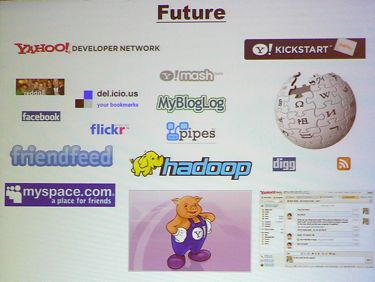
His "Future" slide shows where he’s focused, so I include it here.  For more, see Jeremy’s blog.

The Guys With the Money
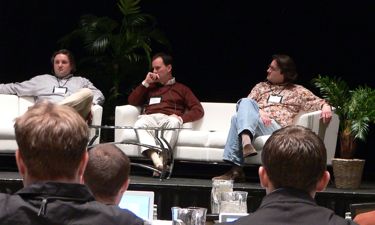
How could there be a conference without a VC panel?  It just can’t happen. But we were very lucky to have partners from arguably three of the most successful firms investing in Web 2.0 technology today: SoftTech VC (Jeff Clavier), Union Square Ventures (Al Wenger), and the Foundry Group (Brad Feld). Here are some highlights:

Feld said there’s a notion now that it only takes $2-3 million in invested capital today to become a profitable business in this space, well below what’s traditionally been the case. Clavier noted that "the $100k you spend today to develop your prototype is like $1 million ten years ago." Wenger reminded us, though, that "if you fall behind after you hit a vein, that’s problematic." 
Vcpanel

Feld said his first investment as a VC was only $50k (Net Genesis), and the he only invested $100k in Harmonics (which developed Guitar Hero). "A typical seed investment now is $250-500k, where it used to be $5 million," he said. "It’s faster now to get to a proof point." Later, we learned that Clavier really doesn’t invest in "enterprise software" [though one would assume he’s interested in social networking as it applies to business, or why was he at an event that was more enterprise focused?], whereas Feld chimed in that "he loves enterprise software!"  He thinks it’s amazing that so many VCs "don’t like it anymore."  Consumer-oriented Web 2.0 deals have certainly taken much of the attention away, but a major trend is emerging whereby those technologies are now leading advancements in enterprise productivity.  And Feld inserted here his take on that, which I think is a major takeaway from Defrag: "I like what I’m seeing in enterprise IT spending increase projections for 2008 — double digits, maybe 20%," he said. Most VCs want to fit into one or the other category (consumer or enterprise), "but I’ve never been able to separate them." Wenger noted the huge difference in the two is that, in an enterprise business, "you must focus on building a sales team." No small undertaking, to be sure, nor cheap.  Feld noted that, of course, very few companies become successful on both sides.  His advice to startups: "Don’t overcommit too early which side you’re going to focus on."

As the afternoon’s sessions continued , we heard a very good presentation by Nova Spivack, founder of Radar Networks, called "Towards a Usable Semantic Web". He referred to the "third decade of the Web" as being about "transforming it from a file server to a database."  For a selection of his slides, see my Defrag pix on Flickr. Nova’s firm has introduced a new service called Twine, which he says represents the next level in knowledge management —  "knowledge networking." Nova defines that term as "social networking + semantic web + collaboration + search."

My Recap of Defrag Version 1.0
This first-year event was great, in nearly every way.  In fact, I can’t think of a single thing I’d change when I fill out the comment form — except maybe to publish a list of attendees. [Unfortunately, the sponsor wiki sites were not fully populated with everyone in attendance — which amazed me. Perhaps they were expecting everyone to sign up on their own?  They didn’t.] It was really the people attending this event that made it such a rich expertience.  That was the key, and I say hooray to the producers for getting so many key players out for this one.  At one point, producer Eric Norlin said it was like "getting the band back together" from Esther Dyson’s great PC Forum events, now retired. I mean, when you have people like David Weinberger, Doc Searls, Chris Locke, Esther, Jerry Michalski, and so many other early Internet pioneers in the same room, it can’t help being a thought-provoking experience!  I was taken by what Steve Larsen said about the event. He told me: "I was at the first PopTech conference, and I also attended the early PC Forums. This event has the same feel."  Steve also pointed me to a blog post about those early days of this core group of Internet and online community pioneers, which gives you a feel for what things were like back then. It’s good to look back, but I also think Defrag made some history of its own on these two days in Denver in late 2007.

As I spoke to Eric Norlin on the second day, I think he and
a colleague really hit on the essence of Defrag #1: "It’s all about
questions, not answers."  That really wraps it up as best as anyone can. And I know that I’ll be back again next year for more.


« Older posts Newer posts »