Well, I’ve now had a chance to catch my breath after a whirlwind few days in NYC at Gigaom’s Big Data event. So, this morning, I got to thinking, after doing our weekly Minnov8 podcast, that I should try to tell you about some of the high points for me at the event — some (but not all) of which are touched on in the 20 previous posts I did from there… 🙂

It was one awesome conference, for sure. One interesting factoid I learned, which came out right near the end of the event, was something that ties into the news of the day, especially here in Minnesota: a company called Dataminr actually alerted its customers about the Target Stores data breach 14 minutes ahead of the financial wires. Pretty impressive. (Here’s how Dataminr describes what it does: “Using powerful, proprietary algorithms, we transform the Twitter stream into actionable alerts, identifying the most relevant information in real-time for clients in Finance, News, and the Public Sector.”) Perhaps only Brian Krebs knew about the impact of the breach before they did?
How fast can humans and algorithms think? We learned that the limit of human decision-making is 1000 milliseconds — lower, and you’re in the algorithmic ecosystem. And that was the crux of a talk that was the best-of-the-best at this conference for me. It was delivered with mega-gusto by New Zealander (and decathlete) Sean Gourley, founder and CTO of Quid. “How humans and machines can team up to solve big problems.”
I know my data geek friends would especially have liked a panel that included data scientists from three of Silicon Valley’s top companies, LinkedIn, Airbnb, and Uber. Well, here it is, guy-geeks and girl-geeks, for your viewing pleasure: “The best websites aren’t just built, they’re calculated.”
No one would argue that Big Data is a complex topic. But what’s the biggest challenge around it in corporate America today? “I wish the problems were just technical,” said Boyd Davis, a VP in Intel’s datacenter software division. “The biggest challenge is getting senior execs to understand how Big Data impacts business models.”
The most moving talk at Structure Data was an interview of Ramona Pierson, cofounder of Declara, by Gigaom’s Mathew Ingram. She began with her incredible personal story — which, I kid you not, literally took our collective breath away! Here’s a retweet I did that captured the feeling as it happened:
“@BigDataWild +1 “@bmkatz: Wow – gobsmacked at @ramonapierson personal story and how it informs what she does now at @declara #gigaomlive.”
Her company is building an impressive platform that creates a CognitiveGraph™ to give every individual their own personalized learning path. (Investors include Peter Thiel and Data Collective.) Here’s the interview: “Why the future of social search is semantic.”
Some more tidbits from the conference for my data geek friends:
• Spark seems to be the next big thing out there in Big Data after Hadoop. (Hint: because it runs faster.) Gigaom says it’s increasingly replacing MapReduce in next-generation Big Data applications. Check out DataBricks, the first company to certify applications for Spark.
• Met Life is hiring 1000 data professionals in Raleigh NC (Research Triangle Park). And Ford already has 300 people working in data analytics. (Both companies had on-stage presenters at the conference.)
• Dennis Crowley, CEO of Foursquare, was interviewed by Mathew Ingram. The big question at the end was, "Will we get to the point when we don't even have to check in — just walk into a place?" Crowley's (non) answer: "That's a good question: what will a Foursquare app look like that doesn't require a checkin?" Hmmm. Here’s the full interview: “How does Foursquare think about data, and what are the technical approaches?”
A couple of cool exhibitor companies I talked to:
• Brainspace – A new beta launched at SXSW creates meaningful connections between people and ideas, accelerating the flow of knowledge, discovery, and innovation. Tap into the collective intelligence of the web to discover and connect with the best content and people related to your interests. “Stop stockpiling bookmarks you’ll never see again.” Amen to that!
• SpaceCurve – “If you can’t get the data in, how can you get the answers out?” A real-time platform for organizations that want to turn big data into value as quickly as it is created. It concurrently ingests, fuses, and analyzes Internet of Things, Industrial Internet, spatial, sensor, weather, social media, historical and other data to deliver immediately actionable intelligence at petabyte scales.
How did my conference reporting experiment go?
You know, the one I talked about in my post before I left? ("Big Data Storms the Big Apple This Week") In that, I talked about how I was going to post on my blog, then flip those posts as I wrote them into my Flipboard mag (“Big Data in the Wild”), and then also tweet on my new Twitter account for the magazine (@BigDataWild). I’ve reported from a ton of conferences in my day, but I’d never tried anything as crazy, wacko as this! —- i.e., managing my blog, a magazine, and two Twitter accounts (I also tweeted a bit on my main account), and, um, cross-posting between them. It was all I could do to keep everything straight! But, hey, I like to push the envelope.
Adding to the merriment, I had to use three different devices to pull this off: my iPhone 5S to shoot pix, and my MacBook Air and iPad Air to write the blog posts and tweets. Oh, wait, I also was tweeting from the iPhone. I have an app for my blog platform on the iPad, so I could post from that, and I think I even posted from the same app on my iPhone, too. I had to juggle between devices for another reason: there were no power strips in the main conference room! (Nor the breakout rooms.) That was my only real bitch about this event: all the power strips they had were five or six on one table outside the main room… for 1000+ attendees! What? (Major fail, Gigaom.) But somehow I muddled through, because I had varying degrees of power on my three devices and managed to switch between them. Thank God battery life on the iPad is so good!
As I said above, I did 20 blog posts while there, and I counted about 65 tweets I did on my new account. I now have about 200 followers there, a really great group of data gurus, many of whom were at the event. My Flipboard magazine is rockin’ along, too — now with almost 4800 subscribers, more than 92,000 page flips, and 337 articles.
A couple things I learned: First, posting from my iPhone or iPad blog app, the post title shows up in the Flipboard mag as "Graeme Thickins posted an entry" — what? Bad app!! Second, using iPhone photos in my blog posts looked fine there, but, even though I chose the largest JPG file size, they looked like hell on the Flipboard mag — they want really high-res files, it seems. So, just for kicks, I switched on the second day to using PNG screen grabs of speaker photos from the Gigaom event site — and, for some weird reason, even though they weren’t big files either, they looked fine in the mag. Go figure.
Speaking of photos…
Here’s my Flick set from the event.
 What’s cool is that the video has a Minnesota connection. It turns out Yankovic and his longtime coproducer
 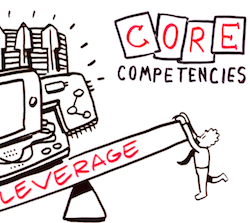 tapped TruScribe to make it — starting some ten months ago. TruScribe is headquartered in Madison WI, but also has an office in downtown St. Paul. (In addition, it maintains international operations through many key European partnerships.) Andrew Herkert, who’s VP of sales and a cofounder, heads the St. Paul office and helped launch the company while a student at the University of St. Thomas about five years ago. TruScribe has grown significantly since then.
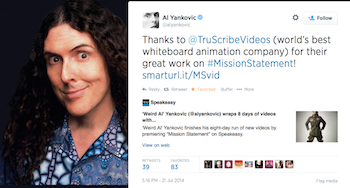 TruScribe is getting a ton of praise today (including from Al himself), as you can see on its Twitter account.




Recent Comments