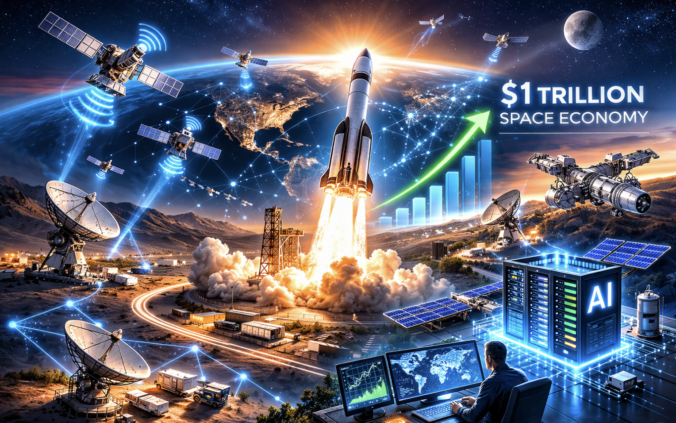
Our state may not launch rockets, but it quietly builds the technologies that make the growing space economy possible.
Minnesota actually has a surprisingly deep set of companies connected to the space industry. Many state firms provide materials, electronics, engineering services, sensors, and manufacturing that go into spacecraft, satellites, and launch systems used by organizations such as NASA, SpaceX, Boeing, and Lockheed Martin.
Several notable Minnesota companies are directly or indirectly participating in the space economy. Here are just some of the state’s companies with space industry connections
1. ION Corporation (Eden Prairie) – Aerospace engineering and testing company doing direct NASA mission work.
2. Stratasys (Eden Prairie – Nasdaq: SSYS) – 3D printing is increasingly used for rocket engines, brackets, and satellite components.
3. QuesTek Innovations (has a facility in Waconia) – Advanced alloys and materials for rocket engines and extreme thermal environments.
4. Collins Aerospace (Burnsville) – Part of Raytheon Technologies. Collins systems are used in satellites, spacecraft navigation, and communications payloads.
5. Northrop Grumman (facility in Plymouth) – Global aerospace contractor. Minnesota operations contribute to electronics, engineering, and mission systems.
6. BAE Systems (Minneapolis) – Builds radiation-hardened electronics, sensors, and spacecraft avionics used in many satellite systems.
7. Chandler Industries (Minneapolis) – Supplies high-precision components used in spacecraft assemblies and aerospace hardware.
8. EarthDaily Analytics / Geosys (Maple Grove) – Uses satellite data and space-based imaging analytics for agriculture and climate intelligence, an important part of the satellite data economy.
An Emerging Space Infrastructure Project
The Minnesota Aerospace Complex in Rosemount is a planned $1+ billion hypersonic testing and aerospace facility. Potential uses will be testing hypersonic vehicles, spacecraft reentry materials, and advanced propulsion systems. If completed, it could become one of the largest aerospace testing facilities in the U.S. (More here.)
Three Main Sectors
These Minnesota sectors feed the space industry:
• Advanced manufacturing: Minnesota has strong precision machining and electronics supply chains used by aerospace primes.
• Robotics & autonomy: Companies building robotics and AI systems for inspection, drones, and autonomous vehicles may transition to space applications.
• Satellite analytics & AI: Minnesota’s agtech and geospatial analytics firms increasingly rely on satellite data.
Little Known Companies, But Some Big Ones, Too
Minnesota doesn’t yet have a large cluster of rocket startups, but it does have a quiet ecosystem of organizations connected to the space economy — often through satellites, materials science, robotics, geospatial data, and advanced manufacturing. Think the supply chain of space.
In geospatial and satellite data, consider Descartes Labs. It was founded in New Mexico but maintains a significant Minneapolis engineering presence. It uses satellite imagery and AI to analyze agriculture, climate, and geopolitics. Its customers include U.S. government agencies and global enterprises. It works with data from NASA, ESA, and commercial satellite constellations. Satellite data analytics is one of the fastest-growing segments of the space economy.
In the category of robotics, sensors, and autonomy, don’t forget about a major tech firm like Seagate Technology (Nasdaq: STX) with its work in advanced data storage R&D. Storage systems are used in satellite ground systems and data infrastructure. Its technology supports satellite data processing pipelines.
Another publicly traded firm is SkyWater Technology (Nasdaq: SKYT), a Bloomington-based semiconductor foundry. It produces radiation-tolerant chips and advanced microelectronics. Radiation-tolerant semiconductors are essential for satellites and deep-space missions.
Why Minnesota Could Become a Space Supply-Chain Hub
Thus, Minnesota has many ingredients needed for space-industry infrastructure. Again, these are our main strengths: 1) advanced manufacturing – including precision machining and aerospace components, 2) materials science – extreme-environment materials and additive manufacturing, 3) semiconductors – specifically radiation-hardened electronics, and 4) AI and geospatial analytics – which is turning satellite data into usable insights.
A Trillion-Dollar Industry On the Verge of Breaking Out
For a further perspective in the space industry, and how 2026 could be the year things really take off (pun intended). see this recent blog post from my client Timmaron Group. (SpaceX IPO, anyone?)
And this recent WSJ article will provide some further perspective: The Space Economy Is Mission-Critical. Here’s What Leaders Need to Know.
——
Postscript: The list of Minnesota companies above is not intended to be all-inclusive. Know of another company doing space-related work here in our state? If so, tell me in the comments.

Leave a Reply